Research on CBD for Parkinson’s is mixed. CBD (cannabidiol), a non-intoxicating compound from hemp often taken as CBD oil, eased psychosis in a small open study, lowered anxiety and tremor during a stressful test after one dose, and improved quality-of-life scores in a small randomized trial, all with CBD alone. Larger placebo-controlled trials since 2021, mostly of CBD-rich extracts with a little THC, found no difference on their main goals. The FDA has not approved CBD for Parkinson’s disease. The FDA has approved only one drug that contains CBD: Epidiolex, a prescription medicine for seizures linked to Lennox-Gastaut syndrome, Dravet syndrome or tuberous sclerosis complex in people 1 year of age and older.
Quick facts
- A 2022 meta-analysis pooled the 3 randomized trials of CBD alone and found CBD did better than placebo, with moderate certainty (Bilbao 2022, BMC Medicine).
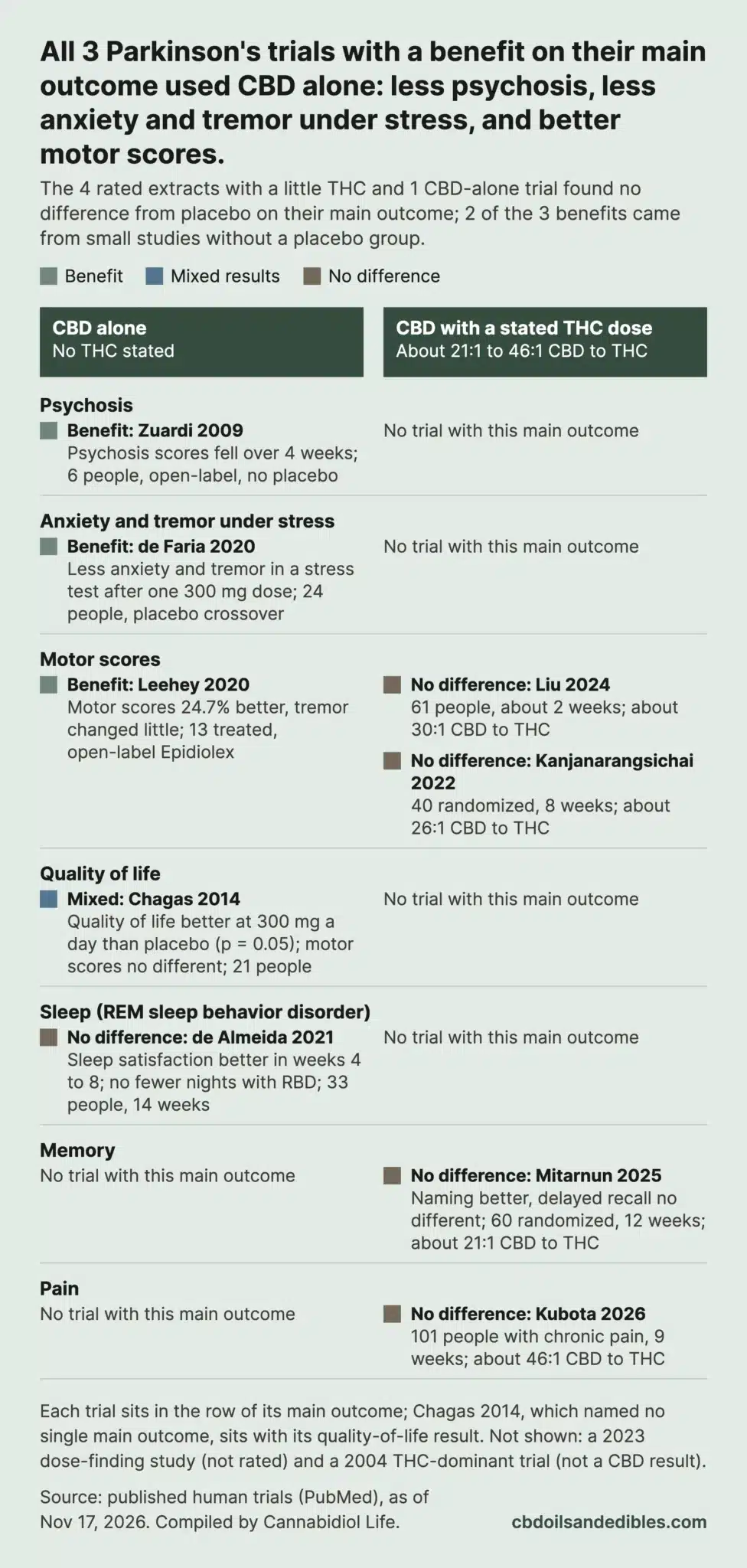
- All 5 trials of CBD alone found a favorable result on at least one measure (psychosis, anxiety and tremor under stress, motor scores, quality of life or sleep satisfaction); 3 did on their main outcome, 2 of them without a placebo group (our study table).
- Placebo-controlled trials from 2021 to 2026 (33 to 101 people) found no difference on their main outcomes; nearly 3 in 4 people in the rated trials (262 of 359) were in trials of CBD-rich extracts with a little THC (our study table).
- Randomized CBD-alone trials gave up to 300 mg of CBD a day; the four later extract trials gave about 16, 26, 44 and 192 mg a day (doses used in studies).
- Two newer registered trials (27 people enrolled, 88 planned) give CBD at up to 300 or 400 mg a day; neither has posted results yet (ClinicalTrials.gov, November 17, 2026).
- No study in people has measured how CBD interacts with carbidopa-levodopa or other Parkinson’s medicines; the Epidiolex label lists liver-enzyme (CYP) interactions with other drugs (medicine interactions).
Does CBD help with Parkinson’s? What the research shows
The evidence is mixed. Favorable studies found less psychosis, less anxiety and tremor under stress, better quality-of-life scores and, in an open study, better motor scores with little tremor change; a 2022 meta-analysis of CBD-alone trials found a moderate-certainty benefit. Placebo-controlled trials since 2021, most of CBD-rich extracts with a little THC, found no difference on their main goals.
THC, unlike CBD, is the compound in cannabis that causes a high (see CBD vs THC). Here CBD does not mean corticobasal degeneration, a rare brain disease also abbreviated CBD that can look like Parkinson’s, as the American Parkinson Disease Association notes. Whether CBD oil is good for Parkinson’s depends on the symptom, so the sections below take each in turn. For other conditions, see our CBD research by health condition.
How has the research changed over time?
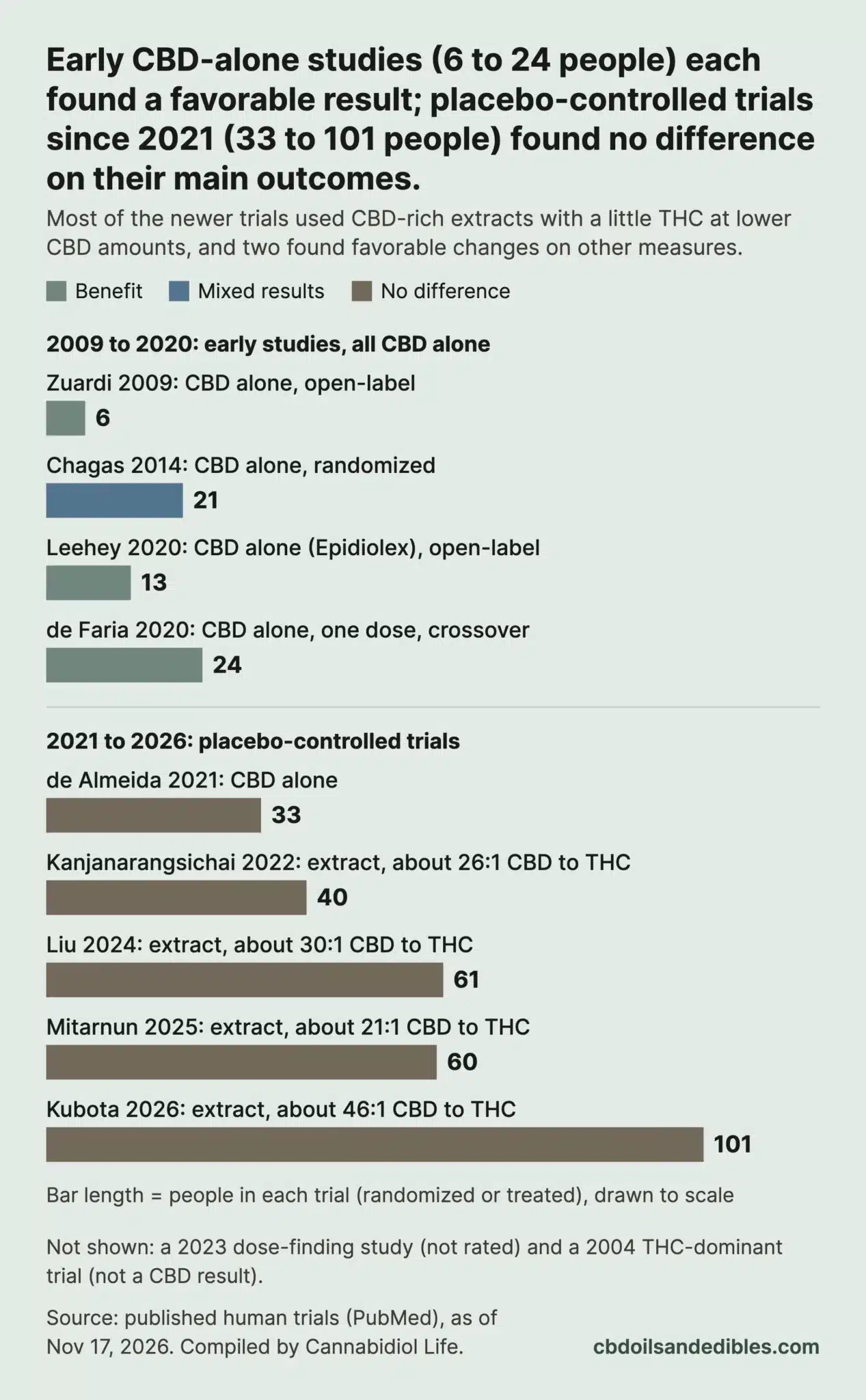
The first CBD studies in Parkinson’s, from 2009 to 2020, were small (6 to 24 people) and used CBD alone: 75 to 300 mg a day, one 300 mg dose or high-dose Epidiolex. Each reported a favorable result on at least one measure, though two had no placebo group and one tested a single dose.
The placebo-controlled trials published from 2021 to 2026 were larger (33 to 101 people). Most used CBD-rich extracts with a little THC at lower CBD amounts (about 16 to 44 mg a day; one gave about 192 mg for about 2 weeks). None found a difference from placebo on its main outcome (sleep behavior, motor scores, memory or pain), though two found favorable changes on other measures: sleep satisfaction in weeks 4 to 8 (de Almeida 2021) and naming scores (Mitarnun 2025).
Does CBD help Parkinson’s motor symptoms?
Open-label, high-dose Epidiolex (CBD alone, no placebo) improved motor scores 24.7% in 10 people who finished, but tremor changed little (-0.4 points, no test reported) (Leehey 2020). One 300 mg dose of CBD alone lowered tremor under stress (de Faria 2020). Three randomized trials (one CBD alone, two CBD-rich extracts with a little THC) found no motor difference.
Motor symptoms include tremor, stiffness, slowness and, for some people on levodopa, dyskinesia (extra involuntary movements), scored on the MDS-UPDRS rating scale.
Can CBD oil stop tremors?
One dose of CBD lowered tremor under stress, but no trial in our review found that CBD stops tremor. In a randomized crossover study of 24 people with Parkinson’s, a single 300 mg dose of CBD alone lowered tremor during a simulated public-speaking test (de Faria 2020).
Longer studies did not show a tremor benefit: the Epidiolex study, registered as a tremor study, saw little change in its tremor score (no placebo group). In a 2024 trial of a CBD-rich extract with a stated THC dose (about 30:1), rest tremor scores improved on the extract but the change did not differ from placebo (Liu 2024). Essential tremor is a different condition, and none of these trials studied CBD for essential tremor.
What about stiffness, slowness and dyskinesia?
In a 6-person open-label psychosis study of CBD alone, total UPDRS scores fell (no test reported) and motor function did not get worse (Zuardi 2009). Randomized trials found no motor difference with CBD alone at 75 or 300 mg a day (Chagas 2014) or with CBD-rich extracts (Kanjanarangsichai 2022; Liu 2024).
In Liu 2024, dyskinesia trended better on placebo and worse on the extract, with no treatment effect. In an exploratory 8-person study (no test reported), motor scores rose, meaning worse, in all 3 people on a high-CBD 1:20 THC-to-CBD oil and fell on the about-equal and THC-dominant oils (Di Luca 2023). An oral cannabis extract with two to three times as much THC as CBD had no effect on levodopa-induced dyskinesia (Carroll 2004); that is a THC-dominant result, not a CBD result.
Can CBD help with psychosis in Parkinson’s?
One small study suggests it might. In an open-label study of 6 people with Parkinson’s psychosis (seeing or believing things that are not real), psychosis scores fell significantly over 4 weeks of CBD alone starting at 150 mg a day (Zuardi 2009). There was no placebo group, and no randomized trial in our review has tested CBD for this.
Does CBD help anxiety in Parkinson’s?
In a randomized crossover trial of 24 people with Parkinson’s, one 300 mg dose of CBD alone lowered anxiety during a simulated public-speaking test (de Faria 2020). In an 8-week randomized trial of a CBD-rich extract (about 15.6 mg CBD + 0.6 mg THC a day), anxiety and depression scores did not differ from placebo (Kanjanarangsichai 2022).
CBD, on the other hand, can reduce anxiety and may have anti-inflammatory properties.
On open-label Epidiolex, an anxiety score changed little (+0.33 points, no test reported) (Leehey 2020 registry results). A finished 27-person trial of full-spectrum CBD oil for anxiety and depression in Parkinson’s has no results yet (see by the numbers). For anxiety without Parkinson’s, see CBD for anxiety.
Does CBD help sleep and REM sleep behavior disorder in Parkinson’s?
In a 4-person case series, CBD cut RBD episodes (REM sleep behavior disorder, acting out dreams); night-time sleep improved on open-label Epidiolex (Leehey 2020). A 14-week randomized trial of CBD alone (75-300 mg a day, 33 people) did not reduce nights with RBD, though sleep satisfaction was better in weeks 4 to 8 at 300 mg (de Almeida 2021).
In the 2024 Colorado trial of a CBD-rich extract with a little THC, taken for about 2 weeks, sleep scores favored placebo (Liu 2024). A later analysis of 18 people with restless legs from the 2021 trial found no difference (de Almeida 2023, counted once with that trial). See also CBD for sleep.
Does CBD help Parkinson’s pain?
Two small studies reported lower scores on a pain scale, with no test reported: open-label Epidiolex (CBD alone) and a high-CBD 1:20 oil taken by 3 people. In the largest trial (101 people with chronic pain), a CBD-rich extract with a little THC taken for 9 weeks did not change pain scores compared with placebo (Kubota 2026).
On Epidiolex, the pain severity score fell 1.86 points (Leehey 2020 registry results). In the 8-person dose-finding study (Di Luca 2023), one pain scale fell 1.3 points on the 1:20 oil, and a second pain rating rose 0.5 points on that oil. The Kubota 2026 extract held about 44 mg CBD + 0.96 mg THC a day (about 46:1), and the trial’s other non-motor scales did not differ either. Open studies of smoked cannabis, which contains THC, reported lower pain 30 minutes after smoking (Shohet 2017, 20 people); that is not a CBD result. See also CBD for pain.
Can CBD improve quality of life and thinking in Parkinson’s?
Quality-of-life scores were better on 300 mg a day of CBD alone than on placebo in a 2014 randomized trial of 21 people without dementia (p = 0.05), and emotional and behavioral control improved on open-label Epidiolex (Chagas 2014; Leehey 2020). In a 2022 randomized trial of a CBD-rich extract, quality of life improved more on placebo (Kanjanarangsichai 2022).
For thinking, naming scores were better on a CBD-rich extract with a little THC (about 21:1) over 12 weeks (mean difference 0.37), though delayed recall, the main outcome, did not differ (Mitarnun 2025: 60 randomized, 51 analyzed). On open-label Epidiolex, scores on the MoCA thinking test rose 1.0 point (no test reported). In the Colorado trial (6.4 mg THC a day in the extract), people did worse on a verbal fluency test and reported thinking side effects at least twice as often as on placebo (Domen 2023, same trial as Liu 2024).
Every human trial in our review: CBD for Parkinson’s study table
Our review found 11 human trials of CBD or CBD-containing cannabis in Parkinson’s disease with published results. We rated the 9 that tested CBD alone or CBD with a stated THC dose on each trial’s main outcome: 3 found a benefit (2 open-label studies without a placebo group and 1 single-dose study), 1 was mixed and 5 found no difference from placebo. By product: CBD alone, 5 trials (3 benefit, 1 mixed, 1 no difference); CBD with a stated THC dose, 4 trials (all no difference). One dose-finding study was not rated, and one THC-dominant trial is not counted as a CBD result. Doses are the amounts each study gave.
| Study (year) | Design and people | Product and daily amount | Length | Main result |
|---|---|---|---|---|
| CBD alone (THC not stated) | ||||
| de Almeida 2021 | Randomized, placebo-controlled; 33 people with REM sleep behavior disorder | CBD capsules, 75 to 300 mg a day | 14 weeks | Sleep satisfaction better in weeks 4 to 8 at 300 mg, not later; no fewer nights with RBD (main outcome) |
| Leehey 2020 | Open-label, no placebo; 13 treated, 10 finished | Epidiolex, raised to 20-25 mg/kg a day | 10-15 days at the top dose | Motor scores 24.7% better and total scores 17.8% better; tremor score changed little (-0.4 points, no test reported) |
| de Faria 2020 | Randomized crossover, placebo-controlled; 24 people | CBD 300 mg, one dose | Single dose | Less anxiety and less tremor during a simulated public-speaking test (main outcomes) |
| Chagas 2014 | Randomized, placebo-controlled; 21 people (7 per group) | CBD 75 or 300 mg a day | 6 weeks (per a 2021 review table) | Quality-of-life scores better at 300 mg than placebo (p = 0.05); no difference in motor scores |
| Zuardi 2009 | Open-label, no placebo; 6 people with psychosis | CBD starting at 150 mg a day | 4 weeks | Psychosis scores fell; motor function not worse (total UPDRS fell, no test reported) |
| CBD with a stated THC dose (ratio or doses given) | ||||
| Kubota 2026 | Randomized, placebo-controlled (phase 2); 101 people with chronic pain, 87 finished | Extract about 46:1 CBD to THC: about 44 mg CBD + 0.96 mg THC a day | 9 weeks | No difference in pain (main outcome) or other non-motor scales |
| Mitarnun 2025 | Randomized, placebo-controlled; 60 randomized, 51 analyzed | Extract about 21:1, under the tongue: 26 mg CBD + 1.2 mg THC a day | 12 weeks | Naming score better on CBD; no difference in delayed recall (main outcome) or inflammation markers |
| Liu 2024 | Randomized, placebo-controlled (phase 2); 61 people | Extract about 30:1: about 192 mg CBD + 6.4 mg THC a day | About 2 weeks | No difference in motor scores (main outcome); sleep, thinking and daily-living scores favored placebo |
| Kanjanarangsichai 2022 | Randomized, placebo-controlled; 40 randomized, 36 analyzed | Extract about 26:1, under the tongue: about 15.6 mg CBD + 0.6 mg THC a day | 8 weeks | No difference in motor scores (main outcome); quality of life improved more on placebo |
| Di Luca 2023 (not rated) | Randomized dose-finding (phase 1b); 8 people with pain | Three oils: 1:20 THC to CBD (about 18 mg CBD + 0.9 mg THC), about equal THC and CBD (about 8 mg each), and a THC-dominant oil (about 17 mg THC) | 35-42 days | Tested tolerability: all three oils tolerated, no serious side effects; benefit not tested |
| THC-dominant (not counted as a CBD result) | ||||
| Carroll 2004 | Randomized crossover, placebo-controlled; 19 randomized, 17 finished; dyskinesia from levodopa | Oral cannabis extract with two to three times as much THC as CBD | 4 weeks per phase | No effect on dyskinesia (main outcome) or other measures |
What do reviews of CBD for Parkinson’s conclude?
Several systematic reviews report favorable findings, including a 2022 meta-analysis of CBD alone rated moderate certainty. These are a selection: reviews whose own results report a favorable finding, each shown with its own limit. The CBD trials they include are already in our table, so we do not count them again.
| Review | What it pooled | Favorable finding | Its own limit |
|---|---|---|---|
| Bilbao 2022, BMC Medicine | CBD alone: 3 Parkinson’s trials in our table (Chagas 2014, de Almeida 2021, de Faria 2020); the review counts 101 participants, while the three trials enrolled 78 people | CBD did better than placebo on pooled Parkinson’s symptom scores (standardized mean difference -0.41), moderate certainty | Different samples, trial lengths, doses and routes limit confidence in the findings (the authors) |
| Varshney 2023, Cannabis and Cannabinoid Research | Cannabis, CBD and nabilone (a THC-like drug), 13 studies | These treatments improved motor symptoms more than placebo; CBD improved psychiatric symptoms in a dose-dependent way | Mixes THC products with CBD; the authors call for large trials of each form |
| Bahji 2022, Journal of Cannabis Research | Cannabis-based medicines in three brain diseases (11 Parkinson’s studies) | Link between CBD-based products and easing of motor symptoms in Parkinson’s and Huntington’s disease | The authors call these preliminary conclusions from a limited number of studies |
| Urbi 2022, Journal of Parkinson’s Disease | Cannabis: 5 randomized and 18 non-randomized studies | Possible benefit for tremor, anxiety, pain, sleep quality and quality of life | No compelling evidence to recommend cannabis in Parkinson’s |
| Oikonomou 2022, Journal of Neural Transmission | 7 Parkinson’s randomized trials of different cannabis products | Anxiety and anxiety-induced tremor were lower in the CBD group | No motor improvement in the 2 trials with a motor main outcome; trials small and inhomogeneous |
| Thanabalasingam 2021, Therapeutic Advances in Neurological Disorders | Cannabis and derivatives: 15 studies (6 randomized) | Most uncontrolled studies favored cannabis | Pooled controlled trials showed no significant motor improvement; all randomized trials at high risk of bias |
| Bougea 2020, Complementary Therapies in Clinical Practice | Medical cannabinoids: 5 randomized and 9 uncontrolled studies | One CBD trial lowered anxiety and tremor in a stressful situation; uncontrolled studies reported motor and non-motor benefits | The few small randomized trials did not confirm the uncontrolled benefits |
How might CBD affect Parkinson’s? Lab and animal findings
Researchers think CBD may act on the body’s endocannabinoid system and inflammation, based on lab and animal work. In animal models, plant cannabinoids including CBD improved movement and reduced catalepsy (a frozen, rigid state) without changing dopamine content (2024 review). In an animal model of Parkinson’s, CBD reduced nerve-cell loss and inflammation and improved movement (2021; see CBD for inflammation).
In rats with levodopa-induced dyskinesia, CBD reduced abnormal movements without blunting levodopa’s benefit (2025). No human CBD trial has measured whether CBD slows Parkinson’s; the 2014 trial found no difference in BDNF, a brain growth factor, or in brain chemistry scans (Chagas 2014). A study of medical cannabis with more THC than CBD found no difference in levodopa dose or disease stage over time versus matched non-users (Goldberg 2023).
More clinical trials are necessary to understand whether and how to safely and effectively use CBD for the treatment of PD symptoms
How much CBD oil was used in Parkinson’s disease studies?
There is no official dose of CBD for Parkinson’s disease, and research does not show what amount works for a given person. In rated trials, adults received about 15.6 mg of CBD a day (in an extract with a little THC) up to 20-25 mg/kg a day of Epidiolex (Kanjanarangsichai 2022; Leehey 2020).
The CBD-alone randomized trials used 75 to 300 mg a day or one 300 mg dose (Chagas 2014; de Almeida 2021; de Faria 2020). These are the amounts researchers used in studies. They are not dosing advice.
Trials gave CBD as capsules, oral solutions (including Epidiolex) or oils, some taken under the tongue; none compared forms for people with tremor or trouble swallowing, and no Parkinson’s trial tested gummies, vapes or creams. Some trials raised the dose step by step (Leehey 2020; Liu 2024), and no trial compared one dosage schedule with another. The dose-finding study’s two CBD-containing oils gave about 8 to 18 mg of CBD a day; its THC-dominant oil gave almost none (0.18 mg).
CBD vs THC for Parkinson’s: what is the difference?
CBD and THC both come from the cannabis plant; THC causes a high and CBD does not. In a controlled 2017 study, oral CBD at up to 800 mg showed no signs of abuse potential in people who often smoke marijuana (Babalonis 2017). No trial has compared the benefits of CBD and THC in Parkinson’s.
Open studies of smoked, THC-containing cannabis reported better motor and tremor scores 30 minutes after smoking, while a randomized trial of a THC-dominant extract found no effect on dyskinesia (Lotan 2014; Shohet 2017; Carroll 2004). The four rated CBD-rich extracts in our table contained a little THC (about 21:1 to 46:1 CBD to THC), so they are labeled “CBD with a stated THC dose”. THC has its own risks: in a 47-person interview study of mostly smoked medical cannabis, confusion and hallucinations were each reported by 17%, and 5 people (10.6%) stopped (Balash 2017). In adults aged 50 and older, THC raised dry mouth, dizziness, balance problems, thinking problems and drowsiness in a dose-dependent way (Velayudhan 2024).
Pure CBD does not cause a “high” and does not pose a risk of abuse or dependence.
What about medical marijuana and Parkinson’s?
Medical marijuana contains THC. The Parkinson’s Foundation says there is “no conclusive evidence it helps with PD symptoms” and that “Medical marijuana should never replace prescribed PD medications.” Products over the federal hemp THC limit count as marijuana; see the legal note.
What do Parkinson’s organizations and patient surveys say?
The American Parkinson Disease Association wrote in 2024 that “There is minimal clinical trial data that support CBD-related health claims” and advises talking with your neurologist first. The Parkinson’s Foundation says CBD “may reduce anxiety and inflammation,” and that CBD and THC “both can have side effects including dizziness, memory issues, and balance problems.”
Surveys describe what users report. In a survey of 1,881 people with Parkinson’s, 54.6% of those who knew their product type took higher-CBD products. More than half reported improvement in pain, anxiety, agitation and sleep, while dry mouth, dizziness and thinking changes were common side effects (20.9% to 30.8%), and 30.8% had not told their doctor (Holden 2022). In a German survey of 1,348 people, 54% of those taking oral CBD and 68% of those inhaling THC-containing cannabis reported improvement (Yenilmez 2021).
In a US survey of 1,064 people, 24.5% had used cannabis in the past 6 months, most often for anxiety (45.5%), pain (44.0%) and sleep (44.0%) (Feeney 2021). At Parkinson’s centers, 80% of providers who answered a survey had patients using cannabis (Bega 2017). In a chart review of 69 patients at a US neurology practice, mostly using tinctures with about equal THC and CBD, 87% were noted to improve in at least one Parkinson’s symptom (Aladeen 2023). In a 15-person snapshot study, people taking CBD/THC products had lower thinking (MoCA) scores than those who were not (Sousa 2023). Surveys, chart reviews and snapshot studies can’t show whether CBD caused a change.
Our data: CBD for Parkinson’s by the numbers (November 2026)
Cannabidiol Life compiled these figures on November 17, 2026, from our study table, ClinicalTrials.gov and PubMed.

- All 5 trials of CBD alone found a favorable result on at least one measure, and 3 of them on their main outcome.
- Pooled in a 2022 meta-analysis, the 3 randomized trials of CBD alone did better than placebo, with moderate certainty.
- All 3 main-outcome benefits came from CBD-alone trials; all 4 rated extracts with a little THC and 1 CBD-alone trial found no difference.
- Nearly 3 in 4 people in the rated trials (262 of 359) were in trials of CBD-rich extracts with a little THC, not CBD alone.
- Randomized CBD-alone trials gave up to 300 mg of CBD a day; the four later extract trials gave about 16, 26, 44 and 192 mg.
- Two newer registered trials (27 people enrolled, 88 planned) give CBD at up to 300 or 400 mg a day; neither has posted results.
- The largest trial (101 people) was about 4 times the size of the largest one before 2021 (24 people).
- 6 of the 9 rated trials lasted 8 weeks or less; the longest ran 14 weeks.
- All 11 trials gave CBD by mouth or under the tongue, as capsules, solutions or oils; none tested gummies, vapes or creams.
- PubMed added 18 papers on CBD and Parkinson’s in 2025, up from 1 in 2015, and 20 more in 2026 through November 17.
| What we counted | Figure (as of November 17, 2026) |
|---|---|
| Registered studies giving CBD to people with Parkinson’s disease (ClinicalTrials.gov) | 5; all Phase 2; 4 randomized |
| Status of those registered studies | 3 completed, 1 recruiting (Argentina, 88 planned), 1 unknown |
| Completed registered studies with posted results | 2 of 3 (67%): NCT02818777 and NCT03582137 |
| People in the registered studies | 114 enrolled in the 3 completed studies; 103 planned in the other 2 |
| Newest registration | NCT07651930 (Poland): full-spectrum CBD oil at 30, 60 or 300 mg a day for anxiety and depression in Parkinson’s; finished November 2024, registered July 2025, no results yet |
| PubMed papers with cannabidiol and Parkinson’s in the title or abstract (search) | 187; 165 (88%) added since 2015; 20 added in 2026 to November 17; 7 tagged randomized controlled trial; 9 tagged systematic review or meta-analysis |
| Human trials with published results in our review | 11; of the 9 we could rate, 3 found a benefit, 1 was mixed and 5 found no difference |
| Our research database (5,446 cannabis studies) | All 123 that mention CBD and Parkinson’s were screened; all 7 human-trial papers among them are in our study table (2 are follow-up papers of trials already listed) |
| US searches a month for “cbd for parkinson’s” (Ahrefs, yearly average) | 2019: 1,086; 2020: 144; 2021: 148; 2022: 153; 2023: 111; 2024: 74; 2025: 57 |
| 2026 search demand | Ahrefs shows unusual month-to-month spikes for this keyword (reported as 100% desktop) that we could not verify, so we do not report a 2026 figure |
Method: Our-data facts are computed by one script. The trial tally comes from our verified study table (11 trials with published results; 9 rated on each trial’s main outcome). Registry counts come from the ClinicalTrials.gov API v2 (every returned record read; a study was kept when cannabidiol is a named intervention and Parkinson’s a listed condition). PubMed counts come from the linked title and abstract search by entry date, and search demand from Ahrefs US monthly estimates. People are counted as treated, randomized or enrolled, in that order of preference. The number of registered studies shows research interest, not whether CBD works.
Cite this data: Cannabidiol Life, “Our data: CBD for Parkinson’s by the numbers (November 2026),” cbdoilsandedibles.com, https://cbdoilsandedibles.com/health/cbd-for-parkinsons-disease/, data as of 2026-11-17.
Does CBD interact with carbidopa-levodopa and other Parkinson’s medicines?
No study in people has measured how CBD interacts with carbidopa-levodopa (Sinemet), MAO-B inhibitors such as rasagiline (Azilect), dopamine agonists, amantadine or entacapone. People in the Parkinson’s trials kept taking their usual medicines. The Epidiolex label says CBD is broken down mainly by the liver enzymes CYP2C19 and CYP3A4.
The Epidiolex label, written for prescription seizure doses, advises considering lower doses of drugs processed by CYP1A2, CYP2C8 or UGT1A9 and of oral drugs carried by the P-gp transporter, and dose changes for drugs processed by CYP2B6 or CYP2C19. The FDA labels for rasagiline (Azilect) and ropinirole (Requip) name CYP1A2 as the main enzyme that breaks each one down, and the Epidiolex label calls CBD a weak inhibitor of CYP1A2, so CBD may affect enzymes that process these medicines (rasagiline label; ropinirole label). In 18 healthy adults, one dose of a CBD-rich extract (640 mg CBD + 20 mg THC) raised blood levels of test drugs: omeprazole 207%, losartan 77%, midazolam 56% and caffeine 39%; no Parkinson’s medicine was tested (Bansal 2023). The Colorado trial’s authors list CYP2C19 and CYP3A4 drug interactions among likely factors in its side effects (Liu 2024).

The FDA says that using CBD with alcohol or other drugs that slow brain activity raises the risk of sedation and drowsiness, which may lead to injuries. In a survey, 39% of people with Parkinson’s using natural health products knew these could interact with Parkinson’s medicines (Diadhiou 2024). If you take other medicines, antidepressants included, have your prescriber or pharmacist check them for interactions before you use CBD. Do not stop, reduce or change any prescribed medicine or treatment without talking to the doctor who prescribed it.
Is CBD safe for Parkinson’s patients? Side effects in studies
At high Epidiolex doses (20-25 mg/kg a day), all 13 people had side effects, most often diarrhea (85%), sleepiness (69%) and tiredness (62%), and 3 stopped (Leehey 2020). On a CBD-rich extract (about 192 mg CBD + 6.4 mg THC a day), dizziness affected 58.1% vs 20.0% on placebo, and 13 could not reach the full dose (Liu 2024).
Dizziness and falls. In the 8-person dose-finding study, drowsiness and dizziness (3 people each) went away after the dose was lowered (Di Luca 2023). A 2026 meta-analysis of all cannabinoids, including THC products, found more confusion (risk ratio 4.44) and dizziness (risk ratio 2.78) than placebo (Fernandes 2026). No CBD study in Parkinson’s has measured falls. For thinking side effects, see quality of life and thinking.
Liver. Liver enzymes rose in 5 of 13 people (38.5%) on 20-25 mg/kg a day of Epidiolex (Leehey 2020). The Colorado trial (about 192 mg CBD a day for about 2 weeks) found no notable liver test changes (Liu 2024), and alkaline phosphatase was higher on 26 mg CBD + 1.2 mg THC a day (Mitarnun 2025). On the Epidiolex label, at prescription seizure doses, the liver enzyme ALT rose above 3 times normal in 13% at 10-20 mg/kg a day and 12% at 25 mg/kg a day, vs 1% on placebo. Most of those rises were in people also taking the seizure drug valproate, and at 10-20 mg/kg a day the rate was 3% in people taking neither valproate nor clobazam. In healthy adults on 5 mg/kg a day for 28 days, 5.6% had liver enzymes above 3 times normal vs 0% on placebo (Florian 2025).
Blood pressure and other effects. Standing blood pressure did not change in two Parkinson’s studies (Leehey 2020 registry results; Liu 2024). In 9 healthy men, a single 600 mg dose lowered resting systolic blood pressure by 6 mmHg (Jadoon 2017). A 2022 review of oral CBD trials listed digestive symptoms, sleepiness and loss of appetite among common side effects (Souza 2022).
Talk to your doctor before using CBD, especially if you take any medicines or supplements, have liver problems, or have a health condition. Do not use CBD if you are pregnant, planning a pregnancy or breastfeeding. The FDA strongly advises against using CBD, THC or marijuana in any form during pregnancy or while breastfeeding. CBD products are not for children. Keep them out of reach of children and pets. If a child swallows a CBD or THC product, call Poison Control at 1-800-222-1222 or get medical care right away.
What should you look for in a CBD product for Parkinson’s?
Before you buy, learn how to read a certificate of analysis (COA), the lab report that should come from an accredited third-party lab and match your product’s batch and its CBD and THC amounts. To check the lab named on a COA, see our guide to verifying the lab.
Every main-outcome benefit in our study table came from CBD alone; our full-spectrum vs broad-spectrum vs isolate chart shows how the three product types differ. Full-spectrum extracts keep other hemp compounds along with CBD; our guide to the entourage effect explains the idea that they may work better together.
Is CBD legal?
Federal law is changing. Under the 2018 Farm Bill definition, hemp (including hemp-derived CBD) is cannabis with no more than 0.3% delta-9 THC by dry weight, and it is not a controlled substance. A new federal definition applies in two steps (section 781 of Public Law 119-37, with start dates set by Public Law 119-103).
Since November 12, 2026, hemp products that contain cannabinoids the plant cannot produce naturally no longer count as hemp. Starting December 11, 2026, the rest of the definition applies. It counts total THC, including THCA, and a finished hemp product such as a CBD oil or gummy qualifies as hemp only if each container holds no more than 0.4 mg of total THC and similar cannabinoids, and contains no cannabinoids that were synthesized or manufactured outside the plant. Some full-spectrum CBD products contain more THC than that. State laws differ and can be stricter. This is general information, not legal advice.
Frequently asked questions
Is CBD good for Parkinson’s patients?
Research is mixed. Small studies of CBD alone found less psychosis, less anxiety and tremor after one dose, better quality-of-life scores and, without placebo, better motor scores with little tremor change. A 2022 meta-analysis of CBD-alone trials found moderate-certainty benefit. Placebo-controlled trials since 2021, mostly of CBD-rich extracts with a little THC, found no difference on their main goals.
Is CBD or THC better for Parkinson’s?
No trial has compared CBD and THC for Parkinson’s benefits. An 8-person dose-finding study gave three oils (high-CBD, about equal THC and CBD, and THC-dominant) and tested tolerability, not benefit. Open studies of smoked, THC-containing cannabis reported better motor scores within 30 minutes, but a randomized trial of a THC-dominant extract found no effect on dyskinesia.
How long does CBD oil take to work for Parkinson’s?
It depends on the measure. One 300 mg dose lowered anxiety and tremor in the same test session (de Faria 2020). Sleep satisfaction was better in weeks 4 to 8, not later (de Almeida 2021). Epidiolex motor changes were measured after 10-15 days at the top dose (Leehey 2020). No study shows how long CBD takes for one person.
Can CBD cause tremors?
In Parkinson’s trials, main motor outcomes did not get worse, though motor scores rose in all 3 people on a high-CBD 1:20 oil (no test reported) (Di Luca 2023). In a 1986 CBD study in dystonia, a different movement disorder, two people with parkinsonian features had worse tremor and slowness above 300 mg a day (Consroe 1986).
Are CBD gummies good for Parkinson’s?
No Parkinson’s trial has tested CBD gummies; trials used capsules, oral solutions and oils. Our guide “How much CBD should you take?” lists pre-measured products such as gummies and capsules as one way to avoid dosing errors. See what to look for in a CBD product above.
Can you get medical marijuana for Parkinson’s?
It depends on your state: not every state allows medical marijuana, and each state’s program decides which conditions qualify. Medical marijuana contains THC, which is not the same as CBD, and CBD products are regulated differently under federal hemp law (see the legal note above). Check your state’s program rules before you apply.
The bottom line on CBD for Parkinson’s
Small studies of CBD alone found favorable results for psychosis, anxiety and tremor under stress, motor scores (with little tremor change) and quality of life, two of them without a placebo group, and a 2022 meta-analysis of the randomized CBD-alone trials found a moderate-certainty benefit. Larger placebo-controlled trials since 2021, mostly of CBD-rich extracts with a little THC at lower CBD amounts, found no difference on their main outcomes, and two newer trials of up to 300 or 400 mg a day have not posted results. No study in people has measured how CBD interacts with levodopa, and side effects were common at high doses.
How we researched this
We searched PubMed and ClinicalTrials.gov on November 17, 2026, screened all 123 studies on CBD and Parkinson’s in our research database, and checked every study and figure against its abstract, full text, publisher page or registry record. We do not sell or recommend products on this page. Figures in Our data, Cannabidiol Life’s Evidence Tracker, show the date and source used.
Sources
Show the source list
- US Food and Drug Administration. (2024). FDA Regulation of Cannabis and Cannabis-Derived Products, Including Cannabidiol (CBD) FDA Q&A page, content current as of 07/16/2024.
- Bilbao A, et al. (2022). Medical cannabinoids: a pharmacology-based systematic review and meta-analysis for all relevant medical indications. BMC Med 20(1):259. PubMed 35982439
- American Parkinson Disease Association (APDA). (2024). Use of Cannabidiol (CBD) for PD symptoms. APDA blog, published 2024-02-09, modified 2024-10-15.
- Leehey MA, et al. (2020). Safety and Tolerability of Cannabidiol in Parkinson Disease: An Open Label, Dose-Escalation Study. Cannabis Cannabinoid Res 5(4):326-336. PubMed 33381646
- de Faria SM, et al. (2020). Effects of acute cannabidiol administration on anxiety and tremors induced by a Simulated Public Speaking Test in patients with Parkinson’s disease. J Psychopharmacol 34(2):189-196. PubMed 31909680
- Liu Y, et al. (2024). Short-Term Cannabidiol with Δ-9-Tetrahydrocannabinol in Parkinson’s Disease: A Randomized Trial. Mov Disord 39(5):863-875. PubMed 38487964
- Zuardi AW, et al. (2009). Cannabidiol for the treatment of psychosis in Parkinson’s disease. J Psychopharmacol 23(8):979-83. PubMed 18801821
- Chagas MH, et al. (2014). Effects of cannabidiol in the treatment of patients with Parkinson’s disease: an exploratory double-blind trial. J Psychopharmacol 28(11):1088-98. PubMed 25237116
- Kanjanarangsichai A, et al. (2022). Cannabidiol-enriched cannabis extraction product in Parkinson’s disease: A randomized, double-blind, and placebo-controlled trial in Buriram Hospital. J Neurosci Rural Pract 13(4):663-668. PubMed 36743777
- Di Luca DG, et al. (2023). A Phase Ib, Double Blind, Randomized Study of Cannabis Oil for Pain in Parkinson’s Disease. Mov Disord Clin Pract 10(7):1114-1119. PubMed 37476317
- Carroll CB, et al. (2004). Cannabis for dyskinesia in Parkinson disease: a randomized double-blind crossover study. Neurology 63(7):1245-50. PubMed 15477546
- ClinicalTrials.gov. NCT02818777: registry record with posted results for the Leehey 2020 Epidiolex study.
- Chagas MH, et al. (2014). Cannabidiol can improve complex sleep-related behaviours associated with rapid eye movement sleep behaviour disorder in Parkinson’s disease patients: a case series. J Clin Pharm Ther 39(5):564-6. PubMed 24845114
- de Almeida CMO, et al. (2021). Cannabidiol for Rapid Eye Movement Sleep Behavior Disorder. Mov Disord 36(7):1711-1715. PubMed 33754375
- de Almeida CMO, et al. (2023). The Effect of Cannabidiol for Restless Legs Syndrome/Willis-Ekbom Disease in Parkinson’s Disease Patients with REM Sleep Behavior Disorder: A Post Hoc Exploratory Analysis of Phase 2/3 Clinical Trial. Cannabis Cannabinoid Res 8(2):374-378. PubMed 35749710
- Kubota GT, et al. (2026). Cannabis-Based Oil for Pain and Other Non-Motor Symptoms in Parkinson’s Disease: A Randomized Controlled Trial. Mov Disord. PubMed 42563548
- Shohet A, et al. (2017). Effect of medical cannabis on thermal quantitative measurements of pain in patients with Parkinson’s disease. Eur J Pain 21(3):486-493. PubMed 27723182
- Mitarnun W, et al. (2025). Cannabidiol and cognitive functions/inflammatory markers in Parkinson’s disease: A double-blind randomized controlled trial at Buriram Hospital (CBD-PD-BRH trial). Parkinsonism Relat Disord 135:107841. PubMed 40267585
- Domen CH, et al. (2023). Cognitive Safety Data from a Randomized, Double-Blind, Parallel-Group, Placebo-Controlled Phase IIb Study of the Effects of a Cannabidiol and Δ9-Tetrahydrocannabinol Drug on Parkinson’s Disease-Related Motor Symptoms. Mov Disord 38(7):1341-1346. PubMed 37212386
- Varshney K, et al. (2023). Cannabinoids in Treating Parkinson’s Disease Symptoms: A Systematic Review of Clinical Studies. Cannabis Cannabinoid Res 8(5):716-730. PubMed 37253174
- Bahji A, et al. (2022). Cannabinoids in the management of behavioral, psychological, and motor symptoms of neurocognitive disorders: a mixed studies systematic review. J Cannabis Res 4(1):11. PubMed 35287749
- Urbi B, et al. (2022). Effects of Cannabis in Parkinson’s Disease: A Systematic Review and Meta-Analysis. J Parkinsons Dis 12(2):495-508. PubMed 34958046
- Oikonomou P, et al. (2022). Randomized controlled trials on the use of cannabis-based medicines in movement disorders: a systematic review. J Neural Transm (Vienna) 129(10):1247-1256. PubMed 35859051
- Thanabalasingam SJ, et al. (2021). Cannabis and its derivatives for the use of motor symptoms in Parkinson’s disease: a systematic review and meta-analysis. Ther Adv Neurol Disord 14:17562864211018561. PubMed 34104218
- Bougea A, et al. (2020). Medical cannabis as an alternative therapeutics for Parkinsons’ disease: Systematic review. Complement Ther Clin Pract 39:101154. PubMed 32351233
- Alves ADF, et al. (2024). Use of phytocanabinoids in animal models of Parkinson’s disease: Systematic review. Neurotoxicology 105:34-44. PubMed 39182852
- Giuliano C, et al. (2021). Neuroprotective and Symptomatic Effects of Cannabidiol in an Animal Model of Parkinson’s Disease. Int J Mol Sci 22(16). PubMed 34445626
- Nascimento GC, et al. (2025). Cannabidiol improves L-DOPA-induced dyskinesia and modulates neuroinflammation and the endocannabinoid, endovanilloid and nitrergic systems. Prog Neuropsychopharmacol Biol Psychiatry 141:111456. PubMed 40684872
- Goldberg T, et al. (2023). Long-term safety of medical cannabis in Parkinson’s disease: A retrospective case-control study. Parkinsonism Relat Disord 112:105406. PubMed 37211456
- Babalonis S, et al. (2017). Oral cannabidiol does not produce a signal for abuse liability in frequent marijuana smokers. Drug Alcohol Depend 172:9-13. PubMed 28088032
- Lotan I, et al. (2014). Cannabis (medical marijuana) treatment for motor and non-motor symptoms of Parkinson disease: an open-label observational study. Clin Neuropharmacol 37(2):41-4. PubMed 24614667
- Balash Y, et al. (2017). Medical Cannabis in Parkinson Disease: Real-Life Patients’ Experience. Clin Neuropharmacol 40(6):268-272. PubMed 29059132
- Velayudhan L, et al. (2024). Adverse events caused by cannabinoids in middle aged and older adults for all indications: a meta-analysis of incidence rate difference. Age Ageing 53(11). PubMed 39602500
- Parkinson’s Foundation. (n.d.). Medical Marijuana. parkinson.org.
- Holden SK, et al. (2022). Higher Risk, Higher Reward? Self-Reported Effects of Real-World Cannabis Use in Parkinson’s Disease. Mov Disord Clin Pract 9(3):340-350. PubMed 35392299
- Yenilmez F, et al. (2021). Cannabis in Parkinson’s Disease: The Patients’ View. J Parkinsons Dis 11(1):309-321. PubMed 33216043
- Feeney MP, et al. (2021). Weeding through the haze: a survey on cannabis use among people living with Parkinson’s disease in the US. NPJ Parkinsons Dis 7(1):21. PubMed 33658517
- Bega D, et al. (2017). Medicinal Cannabis for Parkinson’s Disease: Practices, Beliefs, and Attitudes Among Providers at National Parkinson Foundation Centers of Excellence. Mov Disord Clin Pract 4(1):90-95. PubMed 30713951
- Aladeen TS, et al. (2023). Medical Cannabis in the Treatment of Parkinson’s Disease. Clin Neuropharmacol 46(3):98-104. PubMed 37191563
- Sousa A, DiFrancisco-Donoghue J. (2023). Cannabidiol and Tetrahydrocannabinol Use in Parkinson’s Disease: An Observational Pilot Study. Cureus 15(7):e42391. PubMed 37621812
- ClinicalTrials.gov search used for the by-the-numbers registry counts (run November 17, 2026).
- ClinicalTrials.gov. NCT06629389: registered study of CBD in Parkinson’s disease (status as of November 17, 2026 in the by-the-numbers table).
- ClinicalTrials.gov. NCT03582137: registry record with posted results for the Liu 2024 trial.
- Medical University of Warsaw (sponsor). (2025). The Impact of Different Concentrations of Hemp-Derived Cannabidiol (CBD) Full-spectrum Oil Solutions in the Treatment of Depressive and Anxiety Disorders in Parkinson’s Disease Patients. ClinicalTrials.gov NCT07651930.
- PubMed search used for the by-the-numbers paper counts (run November 17, 2026).
- Jazz Pharmaceuticals / US FDA-approved labeling. (2026). EPIDIOLEX (cannabidiol) oral solution: Full Prescribing Information. DailyMed SPL set ID 8bf27097-4870-43fb-94f0-f3d0871d1eec, version 35, effective 2026-05-29.
- Teva Neuroscience / US FDA-approved labeling. (2020). AZILECT (rasagiline) tablets: Full Prescribing Information. DailyMed SPL set ID a40d0e73-3f9f-4b01-979d-402c9cdaeb60, version 26, effective 2020-06-30.
- Alembic Pharmaceuticals / US FDA-approved labeling. (2026). Ropinirole tablets: Full Prescribing Information. DailyMed SPL set ID 6d1a0f9f-5fa0-43fa-83b9-0d18a129fd0c, version 22, effective 2026-09-02.
- Bansal S, et al. (2023). Evaluation of Cytochrome P450-Mediated Cannabinoid-Drug Interactions in Healthy Adult Participants. Clin Pharmacol Ther 114(3):693-703. PubMed 37313955
- US Food and Drug Administration. (2020). What You Need to Know (And What We’re Working to Find Out) About Products Containing Cannabis or Cannabis-derived Compounds, Including CBD. FDA Consumer Update, content current as of 03/05/2020.
- Diadhiou S, et al. (2024). Natural Health Products for Symptomatic Relief of Parkinson’s Disease: Prevalence, Interest, and Awareness. J Parkinsons Dis 14(6):1257-1264. PubMed 38943398
- Fernandes JVA, et al. (2026). Safety and efficacy of cannabinoid-based interventions in Parkinson’s disease: A frequentist and bayesian meta-analysis of randomized controlled trials. Rev Neurol (Paris). PubMed 42966680
- Florian J, et al. (2025). Cannabidiol and Liver Enzyme Level Elevations in Healthy Adults: A Randomized Clinical Trial. JAMA Intern Med 185(9):1070-1078. PubMed 40622698
- Jadoon KA, et al. (2017). A single dose of cannabidiol reduces blood pressure in healthy volunteers in a randomized crossover study. JCI Insight 2(12). PubMed 28614793
- Souza JDR, et al. (2022). Adverse Effects of Oral Cannabidiol: An Updated Systematic Review of Randomized Controlled Trials (2020-2022). Pharmaceutics 14(12). PubMed 36559092
- Consroe P, et al. (1986). Open label evaluation of cannabidiol in dystonic movement disorders. Int J Neurosci 30(4):277-82. PubMed 3793381