Research on CBD for bipolar disorder is early. In the one published trial, a 2024 pilot of 35 adults with bipolar depression, CBD (cannabidiol, a non-intoxicating hemp compound) was added to their usual medicines. More people on CBD were in remission at week 2 in an additional analysis, while week-8 depression scores matched placebo. The FDA has not approved CBD for bipolar disorder. The FDA has approved only one drug that contains CBD: Epidiolex, a prescription medicine for seizures linked to Lennox-Gastaut syndrome, Dravet syndrome or tuberous sclerosis complex in people 1 year of age and older (FDA).
Quick facts
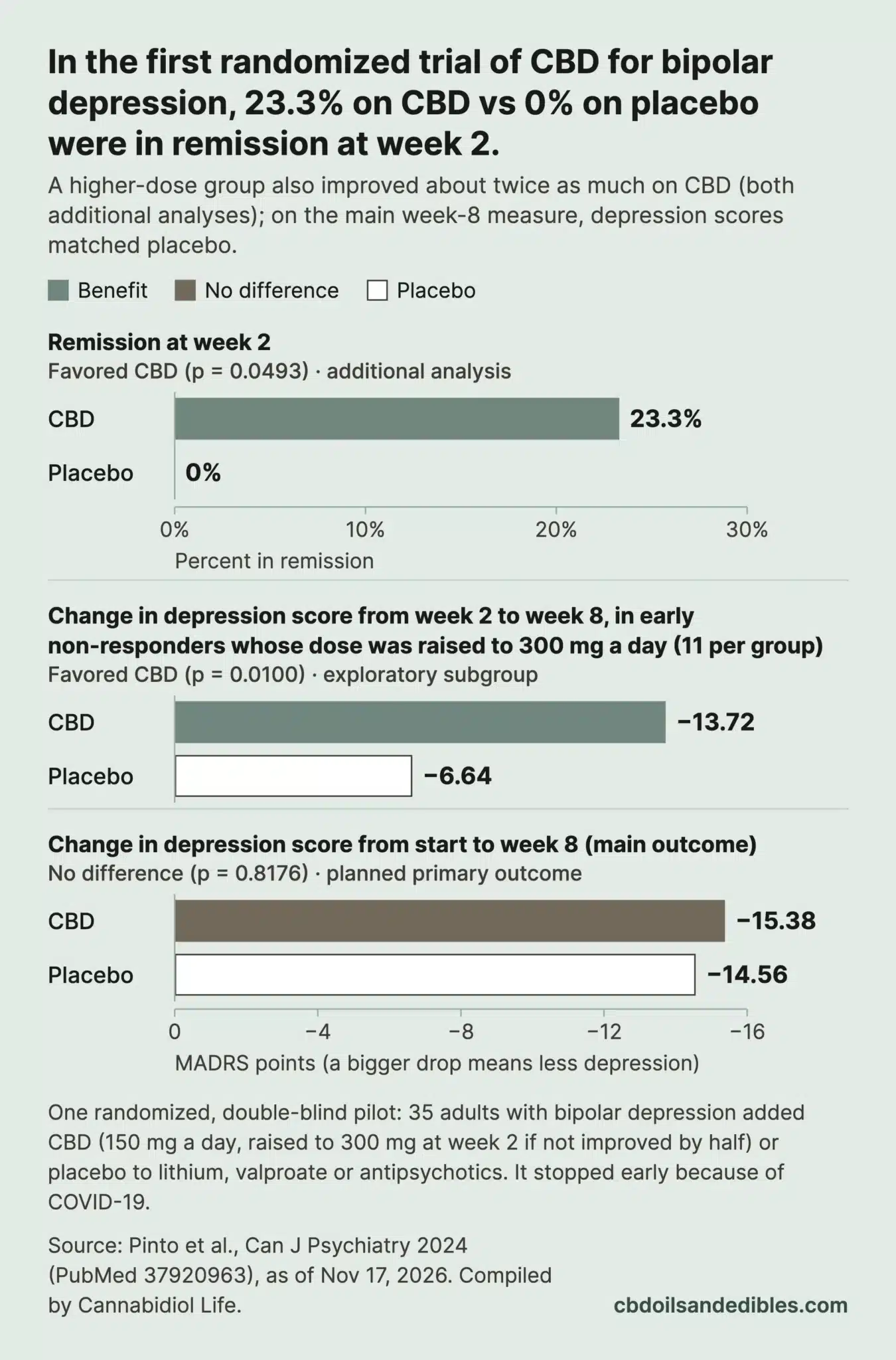
- In the one published trial, a 2024 pilot of 35 adults with bipolar depression, 23.3% on CBD and 0% on placebo were in remission at week 2, in an additional analysis (p = 0.0493) (Pinto 2024).
- People who had not improved by half at week 2 and moved to 300 mg a day improved about twice as much on CBD as on placebo over the next six weeks (MADRS -13.72 vs -6.64; exploratory, 11 per group) (Pinto 2024).
- On the trial’s main measure, depression scores fell about equally by week 8 (MADRS -15.38 on CBD vs -14.56 on placebo; p = 0.8176), and manic symptoms did not differ over 12 weeks (Pinto 2024).
- Lamotrigine levels did not change significantly with CBD in 63 people with epilepsy; at seizure doses, liver-enzyme rises were 7 times as common with valproate (21% vs 3%), and no published trial has measured lithium levels (Gaston 2023; Epidiolex label).
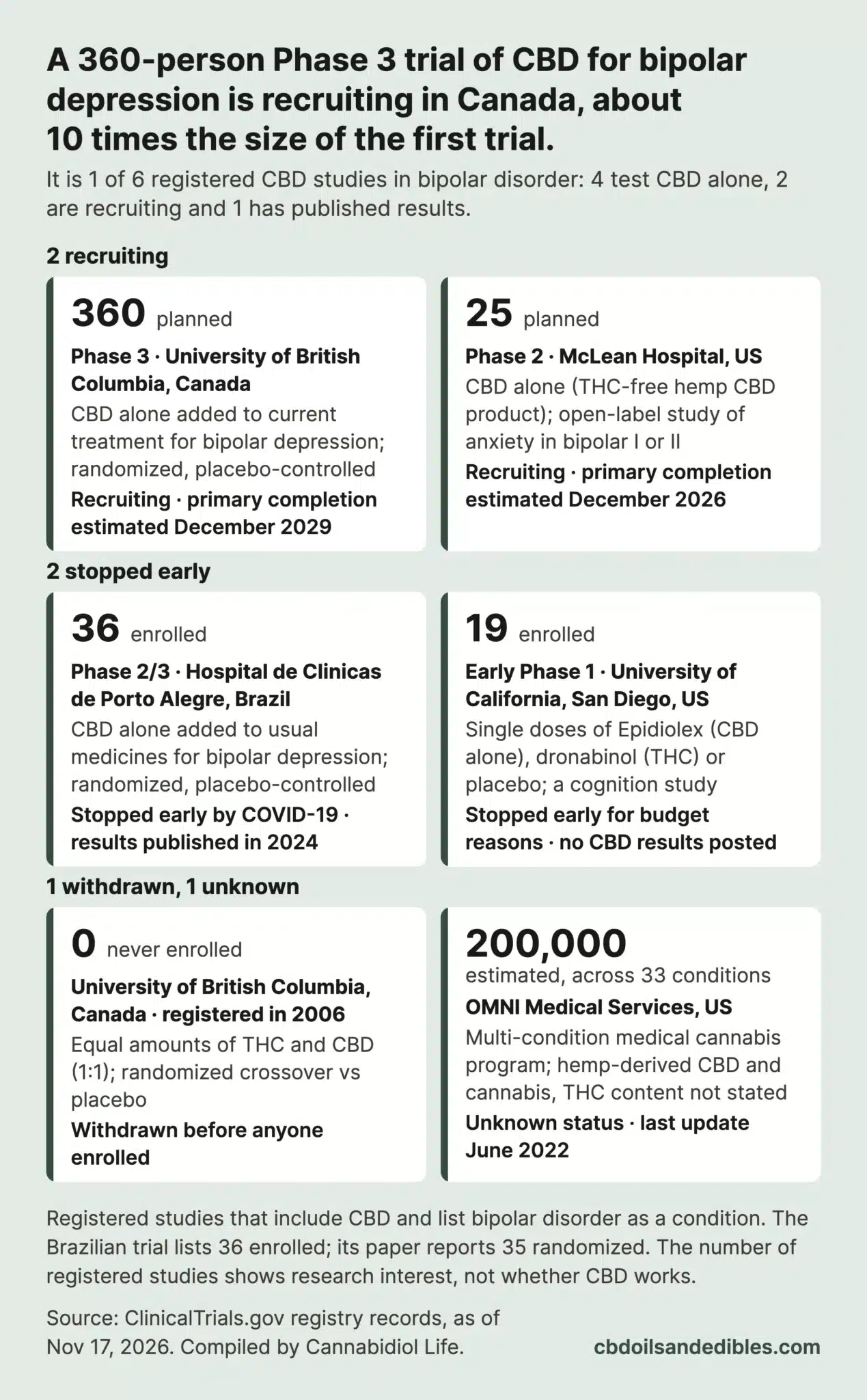
- A 360-person Phase 3 trial, about 10 times the size of the first, is recruiting in Canada, with primary completion estimated for December 2029 (ClinicalTrials.gov NCT05867849).
Does CBD help with bipolar disorder? What the research shows
A small 2024 randomized pilot in bipolar depression found favorable results in two additional analyses: more early remissions on CBD, and a larger drop in depression scores in a higher-dose group. Its main week-8 comparison found no difference from placebo. A 2020 review, written before that trial, found no trials in mood disorders but said CBD “might have a role.”
CBD for bipolar depression: what the 2024 trial found
The trial ran at a hospital in Porto Alegre, Brazil. It was double-blind and placebo-controlled, and it randomized 35 adults (19 on CBD, 16 on placebo) with bipolar I or II who were in a depressive episode. They took CBD alone, as THC-free capsules of 99.6% pure CBD in corn oil, on top of lithium, valproate or atypical antipsychotics. The main outcome was measured at 8 weeks and safety at 12 weeks, and the COVID-19 pandemic stopped the trial early (Pinto 2024; NCT03310593).
At week 2, more people on CBD were in remission (23.3% vs 0%), in an additional analysis that the authors called “marginally significant.” Among early non-responders whose dose was raised, depression scores fell more on CBD than on placebo from week 2 to week 8, in an exploratory analysis.
On the main outcome, depression scores fell about equally on CBD and placebo by week 8, and response and remission at week 8 did not differ significantly (full figures in the study table). The same limits apply to every result: it was a small pilot that stopped early, and the authors say its findings “need to be seen as preliminary.” The additional analyses were not among the trial’s stated outcomes, and the authors ran the higher-dose analysis because of the high early response.
Brazilian public funders (FAPESP and INCT-TM) paid for the trial, and BSPG-Pharm donated the CBD. Several authors hold CBD-related patents, and two had received fees from BSPG-Pharm in the past, as the paper states. Lakshmi Yatham, who leads the next trial, said the pilot “showed signals for efficacy of CBD which provided an impetus for this large trial” (UBC, 2024), a 360-person Phase 3 study now recruiting in Canada (NCT05867849).
What reviews say (a selection)
These are a selection of the reviews we read. A 2020 systematic review searched studies up to July 2019, before the 2024 trial. It found 16 studies, most in other conditions, mixing CBD alone and CBD with THC, and no clinical trials in people with mood disorders. It said “some articles point in the direction of benefits of cannabidiol to treat depressive symptoms” and that CBD “might have a role as a treatment for mood disorders.” It also said: “There is a lack of evidence to recommend cannabidiol as a treatment for mood disorders.” Its lead author also led the 2024 trial (Pinto 2020).
How the research has changed since 2005
Interest came before trials. A 2005 review found no systematic studies of cannabinoids in bipolar disorder, noted that some patients said cannabis eased their mania or depression, described pharmacology suggesting that THC and CBD may have antidepressant and antipsychotic effects, and called for controlled trials; the patient reports were about cannabis, and the review had no CBD result in people with bipolar disorder (Ashton 2005). A Canadian trial of an extract with equal amounts of THC and CBD (1:1) was registered in 2006 but withdrawn before anyone enrolled (NCT00397605). The first randomized trial then tested a different design, CBD alone added to usual medicines for bipolar depression, and found favorable results in additional analyses while its main week-8 result matched placebo; the Canadian Phase 3 trial of the same approach began recruiting in October 2023 (NCT05867849).
Bipolar I, bipolar II, mania and depression: where CBD has been studied
Bipolar disorder involves clear changes in mood, energy and activity levels. Bipolar I is defined by manic episodes, periods of an unusually elevated or irritable mood with a marked increase in activity, and bipolar II by depressive and hypomanic episodes, with hypomania less severe than mania (NIMH).
For bipolar depression, there is the 2024 trial, which enrolled both types (about two in three people had bipolar I), and a Phase 3 trial now recruiting. No trial has tested CBD for mania; manic symptoms were measured as a safety outcome in the depression trial, and the results are in the mania section below.
Anxiety and sleep in bipolar disorder
A 2026 JAMA Internal Medicine review described “emerging low-certainty evidence” that CBD alone may reduce anxiety in people with anxiety disorders, a different group from people with bipolar disorder (Kansagara 2026). In the 2024 bipolar trial, anxiety scores (HAMA) did not differ from placebo (p = 0.8435). A 25-person open-label study at McLean Hospital in the US, testing a THC-free hemp CBD product for anxiety in bipolar disorder, is listed as recruiting (NCT05457465). No trial in our review reported a separate sleep outcome in people with bipolar disorder. For the wider research, see our articles on CBD for anxiety and CBD for sleep.
Can CBD trigger mania or make bipolar disorder worse?
In the 2024 bipolar trial, manic symptoms on the YMRS (Young Mania Rating Scale) did not differ between CBD and placebo over 12 weeks (p = 0.9460), in people also taking mood stabilizers or antipsychotics. No trial has tested CBD for mania, and this trial had 35 people.
There were no significant differences in the development of manic symptoms or any other adverse effects.
Federal health agencies list mood effects among CBD’s possible side effects. The FDA lists “changes in mood, most commonly experienced as irritability and agitation” (FDA), and NCCIH also lists changes in mood (NCCIH).
The Epidiolex label carries a warning for the whole class of antiepileptic drugs, not a finding about CBD in bipolar disorder: these drugs “increase the risk of suicidal thoughts or behavior” (relative risk 1.8 across pooled antiepileptic-drug trials). Its Medication Guide lists “an extreme increase in activity and talking (mania)” among warning signs to report (Epidiolex label).
If you are in crisis or thinking about harming yourself, call or text 988 to reach the 988 Suicide & Crisis Lifeline. In an emergency, call 911.
THC is a separate concern. Cannabis use is linked to manic symptoms (see cannabis and THC). No study in our review tested whether trace THC in CBD products triggers mania.
Study table: the 2024 CBD trial in bipolar depression, outcome by outcome
Every published human trial of CBD in bipolar disorder is in this table. Registered studies without results are in the registry table.
The trial at a glance
| Study | Year | Design | People | Product and dose | Length | Result |
|---|---|---|---|---|---|---|
| Pinto et al., Porto Alegre, Brazil (Can J Psychiatry; PMID 37920963; NCT03310593) | 2024 | Randomized, double-blind, placebo-controlled pilot; CBD added to lithium, valproate or atypical antipsychotics; stopped early by COVID-19 | 35 adults (19 CBD, 16 placebo) with bipolar I or II in a depressive episode | CBD alone (THC-free capsules, 99.6% pure CBD in corn oil); 150 mg a day, raised to 300 mg a day at week 2 if not improved by half | 8 weeks (main outcome); 12 weeks for safety | Favorable in additional analyses (week-2 remission; higher-dose subgroup); no difference on the main week-8 depression score |
Results by outcome (favorable results first)
| Outcome | Type of analysis | CBD | Placebo | Result |
|---|---|---|---|---|
| Remission at week 2 | Additional analysis (in the paper’s methods; not a stated secondary or registered outcome) | 23.3% | 0% | Favored CBD (p = 0.0493; authors: “marginally significant”) |
| Depression change, weeks 2-8, in early non-responders whose dose was raised (11 per group) | Exploratory subgroup | MADRS -13.72 | MADRS -6.64 | Favored CBD (difference -7.08, 95% CI -12.50 to -1.69; p = 0.0100); HAMD also favored CBD (p = 0.0004) |
| Depression change, start to week 8 (MADRS) | Main (primary) outcome | -15.38 | -14.56 | No difference (-0.82, 95% CI -7.81 to 6.17; p = 0.8176) |
| Response at week 2 | Additional analysis (in the paper’s methods; not a stated secondary or registered outcome) | 42.1% | 31.3% | No difference (p = 0.7270) |
| Response at week 8 | Planned secondary outcome | 57.9% | 62.5% | No difference (p = 1.0) |
| Remission at week 8 | Planned secondary outcome | 47.4% | 31.3% | Not significantly different (p = 0.4910) |
| Anxiety (HAMA) | Other outcome | -8.54 | -8.03 | No difference (p = 0.8435) |
| Daily functioning (FAST) | Other outcome | -11.53 | -12.05 | No difference (p = 0.9246) |
| Psychotic symptoms (BPRS) | Other outcome | -10.40 | -7.16 | No significant difference (-3.24, 95% CI -7.45 to 0.97; p = 0.1314) |
| Other depression and severity scales (HAMD, PHQ-9, CGI-S) | Other outcomes | HAMD -10.29; PHQ-9 -9.32; CGI-S -1.60 | HAMD -7.82; PHQ-9 -8.65; CGI-S -2.12 | No significant differences (HAMD p = 0.3106; PHQ-9 p = 0.7860; CGI-S p = 0.3573) |
| Manic symptoms (YMRS), 12 weeks | Safety | -0.22 | -0.35 | No difference (p = 0.9460) |
| Side effects (UKU scale) and lab tests (blood count, TSH, creatinine, liver enzymes) | Safety | UKU -8.74 | UKU -6.87 | No significant differences (UKU p = 0.7273); 1 person on CBD stopped for a skin rash |
| Body mass index | Safety | -0.17 | +0.55 | Small difference (p = 0.0044) |
How CBD was used in bipolar disorder studies: forms and doses
There is no official dose of CBD for bipolar disorder, and research does not show what amount works for a given person. In the 2024 trial, adults took 150 mg a day, raised to 300 mg a day at week 2 if they had not improved by half (Pinto 2024). These are the amounts researchers used in studies. They are not dosing advice. Talk to your doctor before trying CBD, especially if you take any medicines.
The forms differ from study to study. The 2024 trial used capsules of pure CBD in corn oil, not a retail CBD oil. The McLean Hospital study uses a THC-free hemp CBD product taken twice a day for 4 weeks; its record does not state the amount (NCT05457465). The Canadian Phase 3 trial plans 200 to 600 mg a day for 6 weeks, using a product called ProZ-001 (NCT05867849; UBC, 2024). A University of California, San Diego study gave single 600 mg doses of Epidiolex, but it stopped early and has posted no results (NCT04231643). On timing, MADRS depression scores in the 2024 trial fell by about 10 points on average by week 2, with no significant difference between CBD and placebo.
How CBD might work: what lab and animal studies show
Researchers study how CBD acts on the endocannabinoid system and on other brain signals, such as serotonin. In gene-modified mice that become hyperactive in new surroundings, proposed as a model for mania and other hyperactivity disorders, CBD “strongly blunted” the hyperactivity (Aitta-Aho 2019). In a mouse model of depression, CBD had “fast and maintained antidepressant-like effects” that depended on the 5-HT1A serotonin receptor (Linge 2016). In a rat amphetamine model of mania, CBD protected against oxidative damage and raised BDNF, a brain growth factor, but did not change hyperactivity (Valvassori 2011). Results in animals and cells may not carry over to people.
Cannabis and THC in bipolar disorder: a separate question from CBD
This section is about cannabis and THC (tetrahydrocannabinol, the compound in marijuana that causes a high), not CBD. None of these results is a CBD result.
Three studies reported favorable findings; two are small pilots from the same research group, and their samples may overlap. In a 2012 pilot, people with bipolar disorder who smoked marijuana showed mood improvement on several clinical scales after smoking (Gruber 2012). A 2016 pilot from the same group found no added harm to thinking skills and reported easing of mood symptoms after use in daily ratings (Sagar 2016). A 2026 study found that cannabis users with bipolar disorder performed like healthy non-users on timing and attention tasks (Miranda 2026).
Other studies found no benefit, or found harm. Two small THC trials in hospitalized people with unipolar or bipolar depression found no improvement, and anxiety and psychotic symptoms emerged in more than half of patients (Stanciu 2021). In a study that tracked people through their day, cannabis use was followed by more positive mood but also by more manic and depressive symptoms (Tyler 2015). A 2026 meta-analysis linked cannabis use with later bipolar disorder (RR 2.46, 8 studies) and with manic or hypomanic symptoms (RR 2.11, 6 studies) (Sanjuan-Ortiz 2026). A Danish register study linked cannabis use disorder with later bipolar disorder in men (HR 2.96) and women (HR 2.54) (Jefsen 2023). Most of these are observational links, and most did not measure the THC or CBD content of what people used.
About 24% of people with bipolar disorder use cannabis (Pinto 2019), and 52% to 71% have used it at some point (CANMAT 2023).
Expert groups have taken positions on cannabis, not on CBD. CANMAT’s 2023 task force states: “Individuals with bipolar disorder should avoid the use of cannabis” (moderate certainty, strong recommendation), and notes that the THC and CBD content of the cannabis studied “were not determined” (CANMAT 2023). The American Psychiatric Association said in 2025 that there is “insufficient evidence that cannabis is an effective treatment for any psychiatric disorder” (APA 2025). The 2026 JAMA Internal Medicine review advises avoiding cannabis in “those with bipolar or psychotic disorders” (Kansagara 2026). A 2023 umbrella review of 25 reviews (24 on recreational use, 1 on therapeutic use) linked recreational cannabis with suicidal thoughts and attempts, including in bipolar disorder, and concluded that the literature “considers cannabidiol safe for treatment” (Shamabadi 2023).
What people with bipolar disorder report about CBD
In online bipolar support forums, some people say low-THC CBD helps with anxiety, sleep or appetite loss from their medicines. Others say even small amounts of THC brought on paranoia, psychosis or hypomania for them, and several say they told their psychiatrist first. Personal stories can’t show whether CBD works; that takes controlled trials.
Our data: CBD for bipolar disorder by the numbers (November 2026)
We computed these figures ourselves from our study table, ClinicalTrials.gov, PubMed, the Epidiolex label and search data, as of November 17, 2026. Each one names its source, with a link where the source is online.

- In the one published trial, 23.3% on CBD vs 0% on placebo were in remission at week 2, in an additional analysis (Pinto 2024).
- Among early non-responders raised to 300 mg a day, depression scores fell about twice as much on CBD as on placebo (exploratory; 11 per group) (Pinto 2024).
- Over 12 weeks, manic symptoms did not differ between CBD and placebo (YMRS -0.22 vs -0.35; p = 0.9460) in 35 adults (Pinto 2024).
- Lamotrigine blood levels did not change significantly as CBD rose to 50 mg/kg a day in 63 people with epilepsy (p = 0.4587) (Gaston 2023).
- On the trial’s main week-8 measure, depression scores fell about equally: MADRS -15.38 on CBD vs -14.56 on placebo (p = 0.8176) (Pinto 2024).
- A 360-person Phase 3 trial now recruiting in Canada is about 10 times the size of the 35-person published trial (ClinicalTrials.gov NCT05867849).
- Of 6 registered CBD studies in bipolar disorder, 4 test CBD alone (2 in 3); 2 are recruiting and 1 has published results (ClinicalTrials.gov).
- In the trial, 57% also took lithium, 71% antipsychotics and 60% antidepressants; lab tests did not differ between CBD and placebo (Pinto 2024).
- The one published trial used capsules of 99.6% pure CBD; no published trial has tested a retail CBD oil or gummy for bipolar disorder (Pinto 2024).
- PubMed lists 43 papers on CBD and bipolar disorder or mania, about 1 in 200 CBD papers; cannabis has 637, 14.8 times as many (PubMed).
- US searches for “cbd for bipolar” averaged 303 a month over the last 12 months, 35.5% below the 2019 average of 471 (Ahrefs Keywords Explorer, US, November 17, 2026).
- At Epidiolex seizure doses (10 and 20 mg/kg a day), ALT rose above 3 times normal 7 times as often with valproate (21% vs 3%) (Epidiolex label).
The number of registered studies shows research interest, not whether CBD works.
Registered CBD studies in bipolar disorder (ClinicalTrials.gov, November 17, 2026)
| Study (registry ID) | Sponsor, country | Design and phase | People | Product label | Status on ClinicalTrials.gov (Nov 17, 2026) | Results |
|---|---|---|---|---|---|---|
| CBD for Bipolar Depression (CBD-BD), NCT05867849 | University of British Columbia, Canada | Randomized, placebo-controlled, Phase 3; CBD added to current treatment in bipolar I or II depression in people who did not respond to at least one first-line treatment | 360 planned | CBD alone | Recruiting (last updated April 2025); primary completion estimated December 2029 | None yet |
| Cannabidiol for anxiety and depression in bipolar disorder, NCT05457465 | McLean Hospital, US | Open-label, single group, Phase 2; anxiety in bipolar I or II | 25 planned | CBD alone (THC-free hemp CBD product) | Recruiting (status verified March 2026); primary completion estimated December 2026 | None yet |
| Cannabidiol as an add-on treatment for bipolar depression, NCT03310593 | Hospital de Clinicas de Porto Alegre, Brazil | Randomized, placebo-controlled, Phase 2/3 | 36 enrolled (35 randomized, per the paper) | CBD alone | Terminated (interrupted by the COVID-19 pandemic) | Published 2024 (PMID 37920963); none posted on the registry |
| Cannabis and cognition in bipolar disorder, NCT04231643 | University of California, San Diego, US | Randomized, single doses of Epidiolex, dronabinol (THC) or placebo; early Phase 1 | 19 enrolled | CBD alone (Epidiolex arm) | Terminated (budget) | No CBD results posted |
| Cannabinoids in bipolar affective disorder, NCT00397605 | University of British Columbia, Canada | Randomized crossover vs placebo | 0 (never enrolled) | CBD with a stated THC dose: equal amounts of THC and CBD (1:1) | Withdrawn (never started) | None |
| OMNI medical cannabis program (33 conditions), NCT03944447 | OMNI Medical Services, US | Non-randomized, multi-condition | 200,000 estimated | Unclear (hemp-derived CBD and cannabis; THC content not stated) | Unknown (last update June 2022) | None posted |
Method. On November 17, 2026, we searched ClinicalTrials.gov (condition “bipolar OR mania OR manic”, intervention “cannabidiol OR CBD OR Epidiolex”, plus four wider searches), read every record and kept those with cannabidiol as an intervention and bipolar disorder as a listed condition. We searched PubMed the same day by title and abstract: 43 papers that mention CBD and bipolar disorder or mania (2 tagged as randomized trials and 12 as systematic reviews or meta-analyses); we read each one, and 1 is a published trial of CBD in bipolar disorder. Cannabidiol Life’s research database of 5,446 studies holds 49 CBD studies that mention bipolar disorder, mania or mood disorders; we screened each one. Trial figures come from the published paper (Pinto 2024), and medicine figures from Gaston 2023 and the Epidiolex label. Search demand comes from Ahrefs Keywords Explorer, US; the tool repeats the same 12-month pattern since 2021, so no claim is made about change since 2021. A script computed each fact from these sources.
Cite this data: Cannabidiol Life, “Our data: CBD for bipolar disorder by the numbers (November 2026),” cbdoilsandedibles.com, https://cbdoilsandedibles.com/health/cbd-for-bipolar-disorder/, data as of 2026-11-17.
Can you take CBD with bipolar medication?
In the 2024 trial, people took CBD or placebo with lithium, valproate or antipsychotics for up to 12 weeks, and lab tests and side effects did not differ significantly. The Epidiolex label reports more liver-enzyme rises with valproate. No published trial has measured CBD with lithium; in an epilepsy program, lamotrigine levels did not change significantly with higher CBD doses.

Can you take CBD with lithium?
No published trial has measured whether CBD changes lithium levels, and the Epidiolex label does not mention lithium. In the 2024 trial, 20 of the 35 people took lithium along with CBD or placebo for up to 12 weeks. Lab tests did not differ between the groups, but lithium blood levels were not reported (Pinto 2024).
CBD and bipolar medicines: what is known (November 2026)
| Medicine | What studies or the label show | Sources |
|---|---|---|
| Lithium | No published data on lithium levels with CBD oil or other CBD products (details in the section above). | Pinto 2024; Epidiolex label |
| Valproate (Depakote, divalproex) | The Epidiolex label says taking it with valproate increases liver-enzyme rises. In its Lennox-Gastaut and Dravet syndrome trials, at prescription doses of 10 and 20 mg/kg a day, ALT rose above 3 times normal in 21% on valproate without clobazam, 30% on valproate plus clobazam, 4% on clobazam alone and 3% on neither (in its tuberous sclerosis complex trial, at 25 mg/kg a day: 25% on valproate without clobazam and 6% on neither). In an open-label epilepsy program of purified CBD (Epidiolex) at 5 to 50 mg/kg a day, liver enzymes were higher in people also taking valproate, and free valproate levels rose with CBD dose, which the authors judged likely of minor clinical significance. Two trials found CBD changed valproate exposure little (17% lower exposure; “no clinically relevant effect”). | Epidiolex label; Gaston 2017; Gaston 2023; Ben-Menachem 2020; Morrison 2019 |
| Lamotrigine | In an open-label epilepsy program of purified CBD (5 to 50 mg/kg a day), lamotrigine blood levels did not change significantly as the CBD dose rose (34 adults and 29 children on lamotrigine; p = 0.4587). The Epidiolex label names no lamotrigine interaction, although lamotrigine was one of the medicines most often taken in its seizure trials (37% and 30% of patients). | Epidiolex label; Gaston 2023 |
| Antipsychotics (such as quetiapine and aripiprazole) | In the 2024 trial, 25 of 35 people took antipsychotics with CBD or placebo; side effects and labs did not differ significantly. In a cancer trial, CBD did not raise the chance of side effects, and the CBD dose people chose was not related to antipsychotic use. In a review of adverse-event reports, significant side effects with quetiapine, haloperidol, aripiprazole and cariprazine were linked to THC-dominant medical cannabis (18% or more THC, about 1% CBD), not to CBD oil. | Pinto 2024; Downs 2026; Chrobak 2024 |
| Antidepressants (such as sertraline) | In the 2024 trial, 21 of 35 people also took antidepressants; side effects and labs did not differ significantly between CBD and placebo. In the same review of adverse-event reports, 2 of 20 reports involved CBD oil taken with sertraline. | Pinto 2024; Chrobak 2024 |
CBD changes how the body clears some other drugs. The Epidiolex label calls it a moderate inhibitor of CYP2C19, an inhibitor of UGT1A9 and a weak inhibitor of CYP1A2, and strong CYP3A4 or CYP2C19 inducers lower CBD levels: rifampin lowered CBD by about 32% (Epidiolex label). A 2024 systematic review of real-world reports for cannabis, THC and CBD together found valproate among the most widely reported interactions, and clinicians found an unexpected blood level of the prescribed drug in 18 instances (58%) (Nachnani 2024). Do not stop, reduce or change any prescribed medicine or treatment without talking to the doctor who prescribed it.
CBD can affect how other drugs you are taking work, potentially causing serious side effects.
Side effects and other safety warnings
Talk to your doctor before using CBD, especially if you take any medicines or supplements, have liver problems, or have a health condition.
In the 2024 bipolar trial, side effects and lab tests, including liver enzymes, did not differ significantly from placebo; body mass index fell slightly on CBD compared with placebo, and one person stopped for a skin rash (Pinto 2024). In Epidiolex trials for Lennox-Gastaut and Dravet syndromes at prescription doses (10 and 20 mg/kg/day), sleepiness or sedation affected 32% on CBD vs 11% on placebo, and it adds up with alcohol and other sedating medicines. Decreased appetite, diarrhea and fatigue were also among the most common side effects (Epidiolex label). In a 2020 meta-analysis of randomized trials, CBD’s links with abnormal liver tests, sleepiness and sedation were limited to childhood epilepsy studies, where CBD may have interacted with clobazam or valproate; outside those studies, diarrhea was the one side effect more common on CBD (OR 5.03) (Chesney 2020).
On the Epidiolex label, the liver enzyme ALT rose above 3 times normal in 13% of people at 10 and 20 mg/kg/day vs 1% on placebo. In a trial of healthy adults taking 1,500 mg a day for about 3.5 weeks, seven (44%) had ALT above normal and five (31%) above 5 times normal (Watkins 2021). The FDA says “CBD can cause liver injury” (FDA), and NCCIH says “CBD use has been associated with liver injury, male reproductive harm, and interactions with other drugs” (NCCIH). Warnings about mood and suicidal thoughts are in the mania section.
Using CBD can lead to a positive drug test: in a 2026 controlled study, at least one person in every group taking CBD oil with a little THC tested positive, as did one urine sample from the CBD-only group (Wolinsky 2026).
Do not use CBD if you are pregnant, planning a pregnancy or breastfeeding. The FDA strongly advises against using CBD, THC or marijuana in any form during pregnancy or while breastfeeding.
CBD products are not for children. Keep them out of reach of children and pets. If a child swallows a CBD or THC product, call Poison Control at 1-800-222-1222 or get medical care right away. No trial in our review tested CBD in children with bipolar disorder.
What should you look for in a CBD oil if you have bipolar disorder?
If you are considering a CBD oil for bipolar disorder, check its certificate of analysis (COA) from an accredited third-party lab; our checklist shows how to read a COA and match its batch to your bottle. Then verify the lab on a COA. To compare product types, see our side-by-side chart of full-spectrum vs broad-spectrum CBD and isolate.
Is CBD legal?
Federal law is changing. Under the 2018 Farm Bill definition, hemp (including hemp-derived CBD) is cannabis with no more than 0.3% delta-9 THC by dry weight, and it is not a controlled substance. A new federal definition applies in two steps (section 781 of Public Law 119-37, with start dates set by Public Law 119-103). Since November 12, 2026, hemp products that contain cannabinoids the plant cannot produce naturally no longer count as hemp. Starting December 11, 2026, the rest of the definition applies. It counts total THC, including THCA, and a finished hemp product such as a CBD oil or gummy qualifies as hemp only if each container holds no more than 0.4 mg of total THC and similar cannabinoids, and contains no cannabinoids that were synthesized or manufactured outside the plant. Some full-spectrum CBD products contain more THC than that. State laws differ and can be stricter. This is general information, not legal advice.
Frequently asked questions
Can CBD be used as a mood stabilizer?
CBD has been studied alongside mood stabilizers, not as one. In a 2024 trial of adults with bipolar depression taking lithium, valproate or antipsychotics, additional analyses found more early remissions on CBD and a bigger drop in a higher-dose group, while week-8 scores matched placebo. No trial has tested CBD in place of a mood stabilizer.
Is CBD safe for people with bipolar disorder?
In the 2024 bipolar trial, which followed 35 adults for 12 weeks, side effects, manic symptoms and lab tests did not differ from placebo. No larger or longer trial has reported yet. Known concerns include liver-enzyme rises (more often with valproate), sleepiness and mood changes; see bipolar medicines and side effects.
Can CBD cause psychosis?
In the 2024 bipolar trial, psychotic symptoms (BPRS) did not differ between CBD and placebo (Pinto 2024). NCCIH says CBD “may also produce psychotic effects or cognitive impairment in people who also regularly use THC.” Cannabis is a separate question: in a Danish register study, cannabis use disorder was linked to later psychotic bipolar disorder (HR 4.05) (Jefsen 2023).
Is CBD or THC better for bipolar disorder?
No published study has compared CBD and THC in bipolar disorder. CBD alone was tested in the 2024 trial, with favorable early and higher-dose results in additional analyses while its main result matched placebo. For cannabis, small pilots reported better mood after use; two small THC trials in depression found no improvement; CANMAT advises avoiding it. See cannabis and THC.
Are there clinical trials of CBD for bipolar disorder?
Yes. As of November 17, 2026, ClinicalTrials.gov lists 2 recruiting studies: a 360-person Phase 3 trial in Canada adding CBD to usual medicines for bipolar depression, and a 25-person open-label study at McLean Hospital on anxiety in bipolar disorder. The 2024 Brazilian trial has published results. See the registered studies.
The bottom line on CBD for bipolar disorder
In the one published trial of CBD for bipolar depression, more people on CBD were in remission at week 2 (23.3% vs 0%) and a higher-dose group improved about twice as much, both in additional analyses, while week-8 depression scores matched placebo and manic symptoms did not differ. Lamotrigine levels did not change significantly with CBD in an epilepsy program, liver-enzyme rises were more common with valproate at seizure doses, and no published trial has measured lithium levels. A 360-person trial, about 10 times larger, is recruiting in Canada.
Our pilot trial showed signals for efficacy of CBD which provided an impetus for this large trial
Find more CBD and health research in our health hub.
How we researched this
We do not sell or recommend products on this page. Every study cited was checked at PubMed or the publisher. Figures in Our data, Cannabidiol Life’s Evidence Tracker, show the date and source used.
On November 17, 2026, we searched PubMed, ClinicalTrials.gov and Cannabidiol Life’s research database (method note above) and checked every number against its source: the PubMed abstract or full text, the ClinicalTrials.gov record, the Epidiolex label or Ahrefs. This page will be updated January 1, 2027, with re-run data.
Sources
Show the source list
- Pinto JV, Crippa JAS, Ceresér KM, et al. Cannabidiol as an Adjunctive Treatment for Acute Bipolar Depression: A Pilot Study. Can J Psychiatry. 2024;69(4):242-251. PubMed 37920963; doi:10.1177/07067437231209650
- ClinicalTrials.gov. Cannabidiol as an Adjunctive Treatment for Bipolar Depression (Hospital de Clinicas de Porto Alegre). NCT03310593
- ClinicalTrials.gov. Cannabidiol for Bipolar Depression (CBD-BD) (University of British Columbia). NCT05867849
- Chow Q, UBC Faculty of Medicine. UBC researchers launch clinical trial exploring CBD for bipolar depression. February 27, 2024. med.ubc.ca
- Pinto JV, Saraf G, Frysch C, et al. Cannabidiol as a Treatment for Mood Disorders: A Systematic Review. Can J Psychiatry. 2020;65(4):213-227. PubMed 31830820
- Ashton CH, Moore PB, Gallagher P, Young AH. Cannabinoids in bipolar affective disorder: a review and discussion of their therapeutic potential. J Psychopharmacol. 2005;19(3):293-300. PubMed 15888515
- ClinicalTrials.gov. Cannabinoids in Bipolar Affective Disorder: A Controlled Pilot Study (University of British Columbia). NCT00397605
- National Institute of Mental Health. Bipolar Disorder. nimh.nih.gov
- Kansagara D, Terry GE, Ayers CK, D’Souza DC. Cannabis and Mental Health: A Review. JAMA Intern Med. 2026. PubMed 41801216
- ClinicalTrials.gov. Assessing the Impact of Cannabidiol for Anxiety and Depression in Bipolar Disorder (McLean Hospital). NCT05457465
- US Food and Drug Administration. What You Need to Know (And What We’re Working to Find Out) About Products Containing Cannabis or Cannabis-derived Compounds, Including CBD. fda.gov
- NIH National Center for Complementary and Integrative Health. Cannabis (Marijuana) and Cannabinoids: What You Need To Know. nccih.nih.gov
- Jazz Pharmaceuticals. EPIDIOLEX (cannabidiol) oral solution: Full Prescribing Information and Medication Guide. DailyMed SPL version 35, effective 2026-05-29.
- US Food and Drug Administration. FDA Regulation of Cannabis and Cannabis-Derived Products, Including Cannabidiol (CBD): Questions and Answers. fda.gov
- ClinicalTrials.gov. Effects of Cannabis on Cognition and Endocannabinoid Levels in Bipolar Disorder Patients and Healthy Volunteers (University of California, San Diego). NCT04231643
- Aitta-Aho T, Maksimovic M, Dahl K, Sprengel R, Korpi ER. Attenuation of Novelty-Induced Hyperactivity of Gria1-/- Mice by Cannabidiol and Hippocampal Inhibitory Chemogenetics. Front Pharmacol. 2019. PubMed 30984001
- Linge R, Jiménez-Sánchez L, Campa L, et al. Cannabidiol induces rapid-acting antidepressant-like effects and enhances cortical 5-HT/glutamate neurotransmission. Neuropharmacology. 2016. PubMed 26711860
- Valvassori SS, Elias G, de Souza B, et al. Effects of cannabidiol on amphetamine-induced oxidative stress generation in an animal model of mania. J Psychopharmacol. 2011. PubMed 19939866
- Gruber SA, Sagar KA, Dahlgren MK, et al. Marijuana impacts mood in bipolar disorder: a pilot study. Ment Health Subst Use. 2012. PubMed 35444716
- Sagar KA, Dahlgren MK, Racine MT, et al. Joint Effects: A Pilot Investigation of the Impact of Bipolar Disorder and Marijuana Use on Cognitive Function and Mood. PLoS One. 2016. PubMed 27275781
- Miranda A, Holloway BM, Peek E, et al. Evidence for pro-cognitive benefits of cannabinoids in people with bipolar disorder. Neuropsychopharmacology. 2026. PubMed 42481733
- Stanciu CN, Brunette MF, Teja N, Budney AJ. Evidence for Use of Cannabinoids in Mood Disorders, Anxiety Disorders, and PTSD: A Systematic Review. Psychiatr Serv. 2021. PubMed 33530732
- Tyler E, Jones S, Black N, Carter LA, Barrowclough C. The relationship between bipolar disorder and cannabis use in daily life: an experience sampling study. PLoS One. 2015. PubMed 25738578
- Sanjuan-Ortiz C, Querol P, Aymerich C, et al. Cannabis use and subsequent onset of manic symptoms and bipolar disorder: A systematic review and meta-analysis. J Affect Disord. 2027;416:122588 (epub October 2026). PubMed 42838231
- Jefsen OH, Erlangsen A, Nordentoft M, Hjorthøj C. Cannabis Use Disorder and Subsequent Risk of Psychotic and Nonpsychotic Unipolar Depression and Bipolar Disorder. JAMA Psychiatry. 2023. PubMed 37223912
- Pinto JV, Medeiros LS, Santana da Rosa G, et al. The prevalence and clinical correlates of cannabis use and cannabis use disorder among patients with bipolar disorder. Neurosci Biobehav Rev. 2019. PubMed 30974123
- Tourjman SV, Buck G, Jutras-Aswad D, et al. Canadian Network for Mood and Anxiety Treatments (CANMAT) Task Force Report: A Systematic Review and Recommendations of Cannabis use in Bipolar Disorder and Major Depressive Disorder. Can J Psychiatry. 2023. PubMed 35711159
- American Psychiatric Association. Position Statement in Opposition to Cannabis as Medicine for Psychiatric Disorders. 2025. psychiatry.org
- Shamabadi A, Ahmadzade A, Pirahesh K, et al. Suicidality risk after using cannabis and cannabinoids: An umbrella review. Dialogues Clin Neurosci. 2023. PubMed 37427882
- ClinicalTrials.gov. Outcomes Mandate National Integration With Cannabis as Medicine (OMNI Medical Services). NCT03944447
- Gaston TE, Bebin EM, Cutter GR, Liu Y, Szaflarski JP. Interactions between cannabidiol and commonly used antiepileptic drugs. Epilepsia. 2017. PubMed 28782097
- Gaston TE, Bebin EM, Cutter GR, Grayson L, Szaflarski JP. Final analysis of potential drug-drug interactions between highly purified cannabidiol and anti-seizure medications. Epilepsia Open. 2023. PubMed 37593907
- Ben-Menachem E, Gunning B, Arenas Cabrera CM, et al. A Phase II Randomized Trial to Explore the Potential for Pharmacokinetic Drug-Drug Interactions with Stiripentol or Valproate when Combined with Cannabidiol. CNS Drugs. 2020. PubMed 32350749
- Morrison G, Crockett J, Blakey G, Sommerville K. A Phase 1, Open-Label, Pharmacokinetic Trial to Investigate Possible Drug-Drug Interactions Between Clobazam, Stiripentol, or Valproate and Cannabidiol. Clin Pharmacol Drug Dev. 2019. PubMed 30791225
- Downs G, Greer R, Moses G, et al. Drug Interactions in People on Cannabidiol: Is There Cause for Concern? Cannabis Cannabinoid Res. 2026. PubMed 39539239
- Chrobak AA, Woroń J, Siwek M. Green rush and red warnings: Retrospective chart review of adverse events of interactions between cannabinoids and psychotropic drugs. Front Pharmacol. 2024. PubMed 39502532
- Nachnani R, Knehans A, Neighbors JD, et al. Systematic review of drug-drug interactions of delta-9-tetrahydrocannabinol, cannabidiol, and Cannabis. Front Pharmacol. 2024. PubMed 38868665
- Chesney E, Oliver D, Green A, et al. Adverse effects of cannabidiol: a systematic review and meta-analysis of randomized clinical trials. Neuropsychopharmacology. 2020. PubMed 32268347
- Watkins PB, Church RJ, Li J, Knappertz V. Cannabidiol and Abnormal Liver Chemistries in Healthy Adults: Results of a Phase I Clinical Trial. Clin Pharmacol Ther. 2021. PubMed 33022751
- Wolinsky D, Zamarripa CA, Spindle TR, et al. The acute and chronic pharmacokinetics and pharmacodynamics of oral cannabidiol with and without low doses of delta-9-tetrahydrocannabinol. J Anal Toxicol. 2026;50(1):bkaf075. PubMed 40704705