

Verifying the legitimacy of a cannabis testing laboratory is a crucial step in ensuring product safety and compliance. This guide walks you through three primary methods to verify cannabis testing laboratories, helping you make informed decisions about your cannabis products.
With all three methods, we will be focusing our attention to the “FOOTER” of the Certificate of Analysis; see the image below for reference.

The first of the three methods will probably be the most inconvenient, so let’s get this one done first.
1. VERIFY THE DEA LICENSE NUMBER OF THE LAB
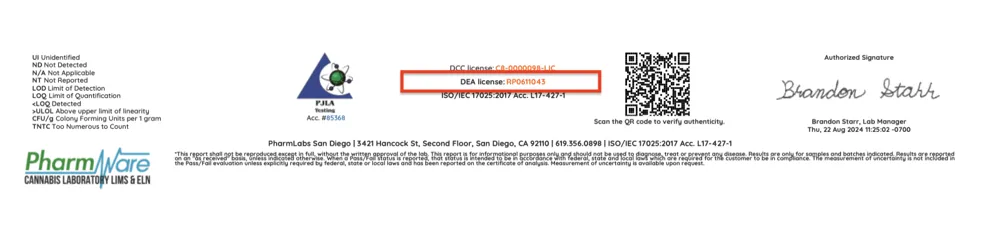
Inconveniently, the DEA does not provide an online database, which would allow you the ability to authenticate any marketed DEA license number.
Therefore, to verify the validity and current status of a specific lab’s DEA license, you’ll need to call them directly; here’s the number to the DEA Registration Call Center:
Note: Have the lab’s full DEA registration/license number handy as you will need that to provide to DEA employee that you speak with on the phone.
2. State Licensing Authorities for Cannabis Labs

Another way to verify the legitimacy of a lab is to use State-Level Databases.
Many states with legal cannabis industries maintain lists of approved and registered labs.
For example, in California, the Department of Cannabis Control (DCC) lists all state-licensed cannabis testing labs. These databases often include licensing numbers, including DEA accreditation details, if applicable.
Most labs have a DCC number at the bottom of their COA, so we recommend starting with this agency first.
However, if you do not see a DCC license number, we’ve gone ahead and provided the names with their website links in the table below to all cannabis state-licensing authorities.
| STATE | REGULATORY BODY | URL |
|---|---|---|
| AL | Cannabis is illegal; no state-level database for cannabis testing labs. | |
| AK | Alcohol and Marijuana Control Office (AMCO) | Link |
| AZ | Arizona Department of Health Services (ADHS) | Link |
| AR | Arkansas Department of Health (ADH) | Link |
| CA | Department of Cannabis Control (DCC) | Link |
| CO | Colorado Department of Public Health and Environment (CDPHE) | Link |
| CT | Department of Consumer Protection (DCP) | Link |
| DE | Delaware Department of Health and Social Services (DHSS) | Link |
| DC | Alcoholic Beverage Regulation Administration (ABRA) | Link |
| FL | Office of Medical Marijuana Use (OMMU) | Link |
| GA | Georgia Access to Medical Cannabis Commission (GMCC) | Link |
| HI | Department of Health (DOH) | Link |
| ID | Cannabis is illegal; no state-level database for cannabis testing labs. | |
| IL | Department of Agriculture (IDOA) | Link |
| IN | Cannabis is illegal; no state-level database for cannabis testing labs. | |
| IA | Department of Public Health (IDPH) | Link |
| KS | Cannabis is illegal; no state-level database for cannabis testing labs. | |
| KY | Department of Agriculture (KDA) | Link |
| LA | Department of Agriculture and Forestry (LDAF) | Link |
| ME | Office of Marijuana Policy (OMP) | Link |
| MD | Maryland Medical Cannabis Commission (MMCC) | Link |
| MA | Cannabis Control Commission (CCC) | Link |
| MI | Cannabis Regulatory Agency (CRA) | Link |
| MN | Department of Health (MDH) | Link |
| MS | Department of Health (MSDH) | Link |
| MO | Department of Health and Senior Services (DHSS) | Link |
| MT | Department of Public Health and Human Services (DPHHS) | Link |
| NE | Cannabis is illegal; no state-level database for cannabis testing labs. | |
| NV | Cannabis Compliance Board (CCB) | Link |
| NH | Department of Health and Human Services (DHHS) | Link |
| NJ | Cannabis Regulatory Commission (CRC) | Link |
| NM | Department of Health (NMDOH) | Link |
| NY | Office of Cannabis Management (OCM) | Link |
| NC | Cannabis is illegal; no state-level database for cannabis testing labs. | |
| ND | Department of Health (NDDoH) | Link |
| OH | Department of Commerce (ODOC) | Link |
| OK | Medical Marijuana Authority (OMMA) | Link |
| OR | Oregon Liquor and Cannabis Commission (OLCC) | Link |
| PA | Department of Health (DOH) | Link |
| RI | Department of Business Regulation (DBR) | Link |
| SC | Cannabis is illegal; no state-level database for cannabis testing labs. | |
| SD | Department of Health (SDDOH) | Link |
| TN | Cannabis is illegal; no state-level database for cannabis testing labs. | |
| TX | Department of Public Safety (DPS) | Link |
| UT | Department of Agriculture and Food (UDAF) | Link |
| VT | Cannabis Control Board (CCB) | Link |
| VA | Board of Pharmacy (BOP) | Link |
| WA | Liquor and Cannabis Board (LCB) | Link |
| WV | Office of Medical Cannabis (OMC) | Link |
| WI | Cannabis is illegal; no state-level database for cannabis testing labs. | |
| WY | Cannabis is illegal; no state-level database for cannabis testing labs. | |
3. Verify With The Accreditation Agency That Oversees ISO/IEC 17025 Certifications

To be an accredited cannabis product lab testing facility, you must be ISO/IEC 17025 Certified.
Below, you’ll find the names of the two agencies that oversee these certifications, along with links to their webpages that allow you to search their database:
- ANSI National Accreditation Board (ANAB)
- Perry Johnson Laboratory Accreditation (PJLA)
At the bottom of the CoA, you will find either the PJLA or ANAB logo; this will tell you which ISO/IEC 17025 accreditation agency the cannabis lab is associated with.


Red Flags to Watch For When Reviewing Lab Credentials
When verifying a cannabis testing laboratory, be alert for these warning signs:
- Expired or missing accreditation dates
- Inconsistencies between state and federal licensing information
- Missing or incomplete ISO/IEC 17025 certification details
- Labs operating in states where they aren’t licensed
- Certificates without proper accreditation logos or identification numbers
Summary
Verifying cannabis testing laboratories involves a three-pronged approach:
- checking DEA licensing
- confirming state-level registration
- validating ISO/IEC 17025 certification.
While the process may seem complex, each step plays a vital role in ensuring the integrity of cannabis testing results.
By following this guide and maintaining vigilance for red flags, you can confidently verify the legitimacy of any cannabis testing laboratory listed on your COA.


