
Every piece of information in this article is sourced from medical professionals and scientific research studies.
You will learn about the CBD sweet spot; easily defined as a unique amount of CBD you should consume that is specific to you alone.
You will also be able to accurately calculate your own CBD dose by using our interactive CBD Dosage Calculator.
THE BOTTOM LINE
This article will give you the facts about the CBD dosageandnbsp;to answer the underlying question, how much CBD should you take?

How Much CBD Should You Take?
According to our research findings, CBD dosage recommendations are largely dependent on traditional use, expert opinion, and scientific research publications.
Since there is no concrete information on traditional CBD use, the answer to the exact amount of how much CBD you should be taking in a single dose is vague and unclear. However, the latter two (seek an expert opinion and base your CBD dose on scientific research) are strongly recommended as this article is founded on these two specific principles.
Let’s start with medical expert opinions…
What Medical Professionals Are Saying
Joseph Rosado, MD, on his podcast MediCanna Talk, stated the following.
“Start low and go slow and titrate up every 5 days. Typically I start my patients out based on the research out there which ranges from less than a milligram per kilogram of body weight up to 50 milligrams per kilogram of body weight per day. So, we go on the low end. Start low and go slow, that’s step #1.”
Dr. Bonni Goldstein, author of Cannabis Revealed, she’ll typically start with 1mg of full spectrum CBD oil per kilogram of body weight for epileptic children.
After the initial response is recorded, Dr. Bonnie will either keep the same dosage, lower it, or raise it by increments of 0.5 mg of CBD per kg of body weight until satisfactory results are achieved, or the threshold of 5mg per kg of body weight is reached.
12 CBD Dosing Conclusions Cited Directly From Published Health Studies
Whether it be an animal or a human as the focal point of these studies, we found that the majority of the studies gave the study participants CBD dosages based on body weight. i.g. “2mg (milligrams) of CBD per kg (kilogram) of body weight.”
Below, is a list of research studies sharing the CBD dosage used in the study, the outcome, and the year the study was published.
- At 400ug of CBD per kg of body weight per day for one week, CBD reduced the total number of cigarettes smoked by participants by 40% during treatment (2013 study).
- Up to 6,000mg of pure Cannabidiol appeared to be safe and well tolerated (2018 study).
- CBD at doses ranging from 10-20 mg of CBD per 2.2 lbs of body weight or 10-20 mg per kg of body weight per day is effective as an add-on therapy to reduce refractory seizures in two rare forms of pediatric epilepsy. (2018 study).
- Taking 30mg of CBD per day for eight weeks reduced opioid use and improved quality of life in 90% of participants (2018 study).
- The consumption of 300mg of CBD per dose significantly reduced public speaking-prompted anxiety, but higher and lower CBD doses, 600mg and 150mg, respectively, had no effect (2019 study).
- 18 and 19-year-old Japanese teenagers consumed 300 mg of CBD per day for four weeks; CBD significantly decreased symptoms of anxiety (2019 study).
- In a recent patient-reported outcomes audit study from New Zealand (n = 400), CBD was well-tolerated and improved pain outcomes and quality of life (2020 study).
- 40mg of CBD per day before any need to consider implementing THC into your treatment regimen. Most studies reported no adverse effects with acute CBD administration and only mild to moderate adverse effects with chronic CBD administration (2020 study).
- Single oral doses of 150 mg, 300 mg, and 600mg of CBD were all found to be ineffective at reducing symptoms of moderate-to-severe testing anxiety in college students (2022 study).
- This study combined 11 different studies with an average CBD dose of 15mg of CBD per kg of body weight per day. All 11 studies demonstrated positive effects in reducing seizure frequency or severity (2019 study).
- In April 2020, Australia’s Department of Health produced a regulation report titled, “Safety of low dose cannabidiol.” The results are provided in the photo below.

Condition-Specific Cannabidiol Dosage Recommendations
Research into CBD has examined its use across different goals, with dosages drawn from clinical trials, case series, and reviews of published studies. There is no single universal standard dosage for any condition—ranges vary based on study design, administration method, duration, and individual factors.
The information below summarizes ranges reported in published research rather than offering personalized advice. Effectiveness in studies has varied, and more research is needed.
The CBD dosages discussed below come from controlled clinical trials (often single-dose or short-term) or observational data.
Anxiety
Clinical studies and reviews have examined oral CBD for anxiety-related goals in various settings. Single-dose trials using oral capsules or similar forms have commonly tested doses in the 300 mg to 600 mg range and reported associations with reduced anxiety measures (such as in simulated public speaking or social anxiety contexts) compared with placebo in some participants. Other reviews summarizing clinical research note explored oral ranges extending from approximately 150 mg to 900 mg. In a large observational case series of individuals reporting anxiety complaints, daily oral doses commonly started at 25 mg, with some participants increasing to higher amounts over time.
Best-fit summary: Lower daily amounts (around 25 mg) appear in longer-term observational data for ongoing anxiety-related support. Higher single doses (300 mg and above) feature more often in acute, controlled research settings examining shorter-term effects. These represent reported study ranges rather than a standardized protocol.
Study-based ranges come primarily from controlled trials and systematic reviews of clinical data. Practical consumer guidance often aligns with general “start low and go slow” principles seen across expert commentary, beginning with smaller daily amounts and adjusting gradually based on personal response.
Readers interested in learning more about CBD in relation to anxiety can explore our dedicated guide here: CBD For Anxiety.
Sleep
Published reviews of clinical studies reference an oral dose of 300 mg (dissolved in corn oil in one examined protocol) in research exploring effects on difficulty sleeping. In a large case series involving participants with sleep complaints (often alongside anxiety), daily oral capsule doses were most commonly started at 25 mg in the evening, with some individuals increasing to 50 mg, 75 mg, or up to 175 mg depending on response.
Best-fit summary: Lower daily doses (starting around 25 mg) have been used in observational, longer-term settings for sleep support. Higher amounts (such as the 300 mg reference) appear in specific study protocols. These reflect reported research ranges; results varied across studies.
Study-based information draws from clinical reviews and case series data. Consumer-facing starting approaches commonly begin at lower daily amounts consistent with general wellness guidance and titrate upward as needed, rather than matching acute research doses directly.
Pain
Reviews summarizing clinical research have cited transdermal gel applications in the 250 mg to 500 mg range for pain and inflammation contexts. Oral studies examining CBD for pain-related goals have used wider ranges (including lower daily amounts in the 20–250 mg range in some trials), with outcomes varying; some research noted improvements in pain and quality-of-life measures, while others found limited or no clear effects at certain doses.
Best-fit summary: Transdermal applications in the 250–500 mg range have been reported in research focused on localized pain and inflammation support. Oral ranges in studies are broader and more variable. Lower-to-moderate amounts often appear in practical or shorter-term contexts, while higher doses feature in some trial protocols. Evidence for pure CBD in pain remains mixed and limited compared with other areas of research.
Study-based ranges come from clinical reviews and trials (including both oral and transdermal administration). Practical consumer guidance typically starts with general wellness or lower daily amounts and adjusts based on individual factors, separate from the higher or specific-route doses used in certain studies.
Important note across all conditions:
The ranges above reflect what has been reported in published research or expert-reviewed summaries of studies. They are not official recommendations. Many clinical trials used higher or single doses than typical consumer starting points. Individual factors such as body weight, product type, and personal response play significant roles.
Suggested Dosage Found On CBD Product Labels

The CBD industry is no longer in its infancy stage, though rules and regulations are consistently revised. CBD brands are still free to offer their own suggested CBD serving size along with their own recommended consumption intervals. This type of freedom results in CBD dosage recommendations varying heavily from one brand to the next.
Realizing the above, should you follow the recommended CBD serving size found on the product label to the T?
The answer is “YES” for all occasions, especially for the first CBD dose.
However, if the expected results weren’t achieved, we highly recommend that you do the following IN ORDER before giving up on your CBD journey:
– Re-evaluate the credibility of the CBD brand you purchased from (more on which CBD brands you should avoid below)
– Once you confirm credibility, you can then call the CBD brand directly to share your experience and get micro-specific guidance to your situation.
– If the step above still leaves you unsatisfied, we recommend that you give one last best-effort approach and speak directly to a licensed medical marijuana doctor to put together a CBD dose schedule with specific serving sizes based on your unique needs.
We implore you to NOT give up on CBD until you’ve explored all of these avenues. One or a few minor tweaks to a CBD dose can offer you an entirely different CBD experience.
Now, let’s discuss a very important topic you should be aware of.
Can You Trust Your CBD Brand For Accurate CBD Dosing Guidance?
There are several instances where big-name CBD companies have been scrutinized for mislabeling, misleading, or blatantly lying about their CBD products. You can view all the CBD-related warning letters sent by the FDA here.
If you visited the link above, you can clearly see why doing your own research is imperative to ensure you are purchasing from high-quality CBD providers.
It also reiterates the importance of working with a medical professional to help you formulate a CBD treatment plan that is unique to you and your health condition, while strictly basing your CBD dose amount on scientific/medical research; which, if I might add, are the soundest and safest ways to find your CBD dosage sweet spot!
Three Ways To Avoid CBD Dosing Errors
1. Choosing unit-based CBD products
CBD products like CBD Gummies & CBD Capsules are popular due to their pre-formulated CBD content. The amount of CBD is specifically offered in predetermined concentrations of CBD per unit (per gummy/capsuel).
The only downfall is that it’s kind of hard to hit your exact recommended milligrams of CBD to hit your “CBD sweet spot”. Either way, they’re an excellent alternative to CBD oil tinctures because you don’t need to measure out your dose each time and you’ll always consume exactly the intended amount.
2. NO CLEAR GUIDANCE & NO CERTIFICATE OF ANALYSIS
If the CBD company you are buying from doesn’t offer you explicit CBD dose information on their website or on their product label, its extremely advisable to choose a new brand (one that actually takes the time to ensure your CBD experience is exceptional end to end).
3. USE CREDIBLE, RESEARCH-BACKED CBD DOSAGE TOOLS
Cannabidiol Life offers interactive CBD dosing tools to expedite the process to help you find the perfect dose for your needs. From CBD dosage charts, to calculators, to best starting points based on severity of your systems, its all available right here for you to utilize immediately. If you need specialized assistance, do not hesitate to contact us.
CBD Dosing Tools
In this section, we offer several tools to ensure you leave here confidently knowing precisely what your recommended Cannabidiol serving size is.
CBD Dosage Formula By Bodyweight
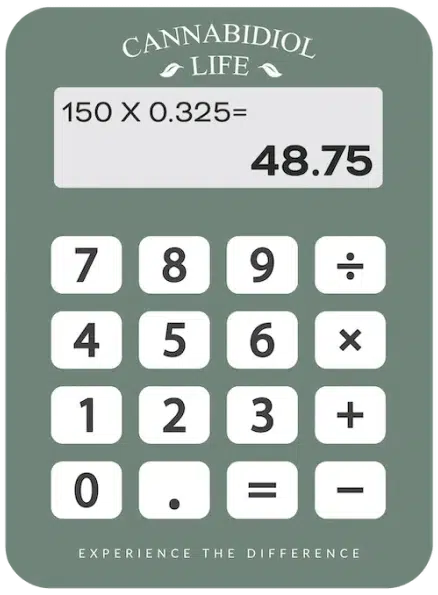
As we covered above from accumulated research, the average medical professional recommendation is based on what worked best for their scientific study.
This came out to be 0.325mg of CBD multiplied by your body weight using pounds (lbs.) as the weighing metric.
Thus, a 150lb person should start off with a CBD dose of 48.75mg.
Factors Influencing CBD Dosage
While body weight offers a practical starting point for estimating CBD needs, many other personal and product-related factors interact to determine how much CBD actually works for you.
Two people of the same weight can require noticeably different amounts because metabolism, diet, product concentration, individual body chemistry, and daily habits all play interconnected roles.
Understanding these factors helps explain the wide variation in real-world results.
Body Weight and Metabolism: How They Work Together
Body weight is commonly used in research and clinical settings because larger body mass generally means more tissue for CBD to distribute through.
Studies and medical professionals often calculate doses in milligrams per kilogram (or per pound) of body weight for this reason. However, metabolism does not act in isolation, it interacts directly with body weight.
Two individuals with identical body weight can still need different amounts of CBD for several reasons:
– Faster metabolisms tend to process and clear CBD from the system more quickly, which may require higher doses or more frequent servings to maintain consistent levels in the bloodstream.
– Slower metabolisms can allow CBD to remain active longer, meaning the same milligram amount may produce stronger or longer-lasting effects.
– Built-up tolerance from regular use and overall individual responsiveness further shift how efficiently the body handles CBD, even when weight is the same.
This is why a simple weight-based formula provides only a starting estimate, the interaction between weight and metabolism creates meaningful differences person to person.
How Diet and Food Intake Change CBD Dosage Needs
CBD is fat-soluble, so the presence of dietary fat dramatically affects how much of it your body absorbs (its bioavailability). Taking CBD with food, especially a meal containing healthy fats, can significantly increase the amount that reaches your bloodstream compared to taking it on an empty stomach.
Improved absorption often means you can achieve the same blood levels and effects with a lower milligram dose when CBD is consumed alongside fat-rich foods.
Common examples include avocados, nuts, seeds, fatty fish, olive oil, eggs, or full-fat dairy.
Conversely, taking CBD without food may result in lower absorption, so a higher dose could be needed to reach equivalent effects.
Your typical eating patterns are therefore an important factor when deciding on serving sizes.
Pairing CBD with a fatty meal is one of the simplest ways to potentially optimize absorption without increasing the total milligrams consumed.
Product Strength and Concentration: Why It Affects How Much CBD You Take
The type of product (oil, capsules, gummies, etc.) matters, but the concentration or potency within that product is equally important for dosage decisions.
A higher-concentration product delivers more CBD per drop, per capsule, or per gummy. This means you need smaller volumes or fewer units to reach your target milligram amount.
Lower-concentration products require larger amounts (more drops, more pieces) to deliver the same total milligrams of CBD.
Always check the label for both total CBD content and concentration per serving. This allows you to accurately calculate and adjust your intake regardless of which specific product you choose.
Focusing on concentration helps you maintain consistent dosing even when switching between different potencies of the same product form.
Individual Variability in Endocannabinoid System Response
Beyond weight, metabolism, diet, and product strength, each person has a unique endocannabinoid system (ECS), the network of receptors and signaling molecules that CBD primarily interacts with.
Differences in genetics, baseline ECS tone, receptor sensitivity, and overall body chemistry create wide variability in how responsive someone is to CBD.
Some people naturally experience noticeable effects at lower doses because their ECS is more sensitive or responsive.
Others may require higher amounts to achieve similar results due to lower inherent responsiveness or other physiological differences.
This biological individuality explains why even people with very similar body weights, diets, and using identical products can have markedly different experiences with the exact same dose.
These differences in how the body’s own ECS functions are a key reason dosage remains highly personalized.
Timing, Daily Routine, and Consistency of CBD Use
Your daily habits and the timing of your servings can also influence the amount of CBD you need over time.
Consistent daily use may lead to different cumulative effects or slight adaptations compared with sporadic or intermittent use.
The time of day you take CBD (morning versus evening) and your activity level or routine around dosing can affect how you perceive the effects and, consequently, the serving size that feels optimal.
Someone building a regular routine may find their effective amount stabilizes differently than someone using CBD only occasionally.
These lifestyle factors add another layer of personalization to dosage decisions.
FINAL ANSWER
Finding out how much CBD will take a bit of trial and error, especially if you try to do it blindly on your own without research, expert opinions, and data from scientific studies.
Here are our CBD dosage suggestions for body-weight-based CBD dosing based on the severity of your health concern:
CBD DOSING BASED ON SEVERITY OF SYMPTOMS
Severe Symptoms
10mg to 20mg of CBD per 1 kg or 2.2 lbs of body weight per day.
Moderate Symptoms
5mg to 7mg of CBD per 1 kg or 2.2 lbs of body weight per day.
Light Symptoms
1mg to 3mg of CBD per 1 kg or 2.2 lbs of body weight per day.
Daily Wellness
25mg – 50mg of CBD per day
As a quick reminder, it’s always recommended to consult a healthcare professional before use/altering your diet with new substances, as individual responses differ and CBD may interact with medications.
BE SAFE, NOT SORRY.
The information provided is intended to improve, not replace, the direct relationship between you and your healthcare professional. This information has not been evaluated by the Food & Drug Administration (FDA). The FDA has not tested any Cannabidiol Life products for safety or efficacy. Always speak to a licensed medical professional before altering your diet, and always seek legal counsel if you are unclear about your local CBD laws and regulations. Regardless of the facts, opinions, data, and research provided by Cannabidiol Life partners and staff, all CBD products, including Cannabidiol Life CBD products, are not intended to diagnose, treat, cure, or prevent any specific health condition or disease.
– https://jcannabisresearch.biomedcentral.com/articles/10.1186/s42238-021-00073-1
– https://www.fda.gov/news-events/public-health-focus/fda-regulation-cannabis-and-cannabis-derived-products-including-cannabidiol-cbd
– https://pmc.ncbi.nlm.nih.gov/articles/PMC9841308/
– https://www.webmd.com/diet/health-benefits-cbd


