Small trials of CBD for migraines (cannabidiol, a non-intoxicating hemp compound) found benefits, both with CBD alone and with products that also contain THC. In a 2026 trial, vaporized THC-plus-CBD flower eased pain in more attacks than placebo at 2 hours; CBD-dominant flower helped at 1 hour, not 2. A THC-free CBD gel lowered migraine disability in adults with jaw-muscle pain. The FDA has not approved CBD for migraines or other headaches. The FDA has approved only one drug that contains CBD: Epidiolex, a prescription medicine for seizures linked to Lennox-Gastaut syndrome, Dravet syndrome or tuberous sclerosis complex in people 1 year of age and older.
Quick facts
- Vaporized THC-plus-CBD flower left more than twice as many migraine attacks pain-free at 2 hours as placebo (34.5% vs 15.5%) in a 2026 randomized trial (Headache).
- In the same trial, CBD-dominant flower (0.35% THC) eased pain at 1 hour in 59% of attacks vs 37% with placebo; at the main 2-hour mark, 53% vs 47% was not a significant difference.
- For CBD alone, a nightly 10% CBD gel cut median migraine-disability scores by about half (17 to 8; placebo stayed at 12) over 30 days in a randomized trial of adults with jaw-muscle pain; prescription CBD in 10 people with Sturge-Weber syndrome showed no difference.
- 8 CBD headache studies are registered on ClinicalTrials.gov: 5 are recruiting or set to start, and none targets cluster headache (our data, November 17, 2026).
- Can CBD cause headaches? In a 2026 meta-analysis of 4 trials in 269 healthy adults, headache was not significantly more common with CBD than with placebo. In a small phase I trial at very high doses, 4 of 9 people at each dose reported headache vs 0 of 6 on placebo.
Does CBD help migraines? What the research shows
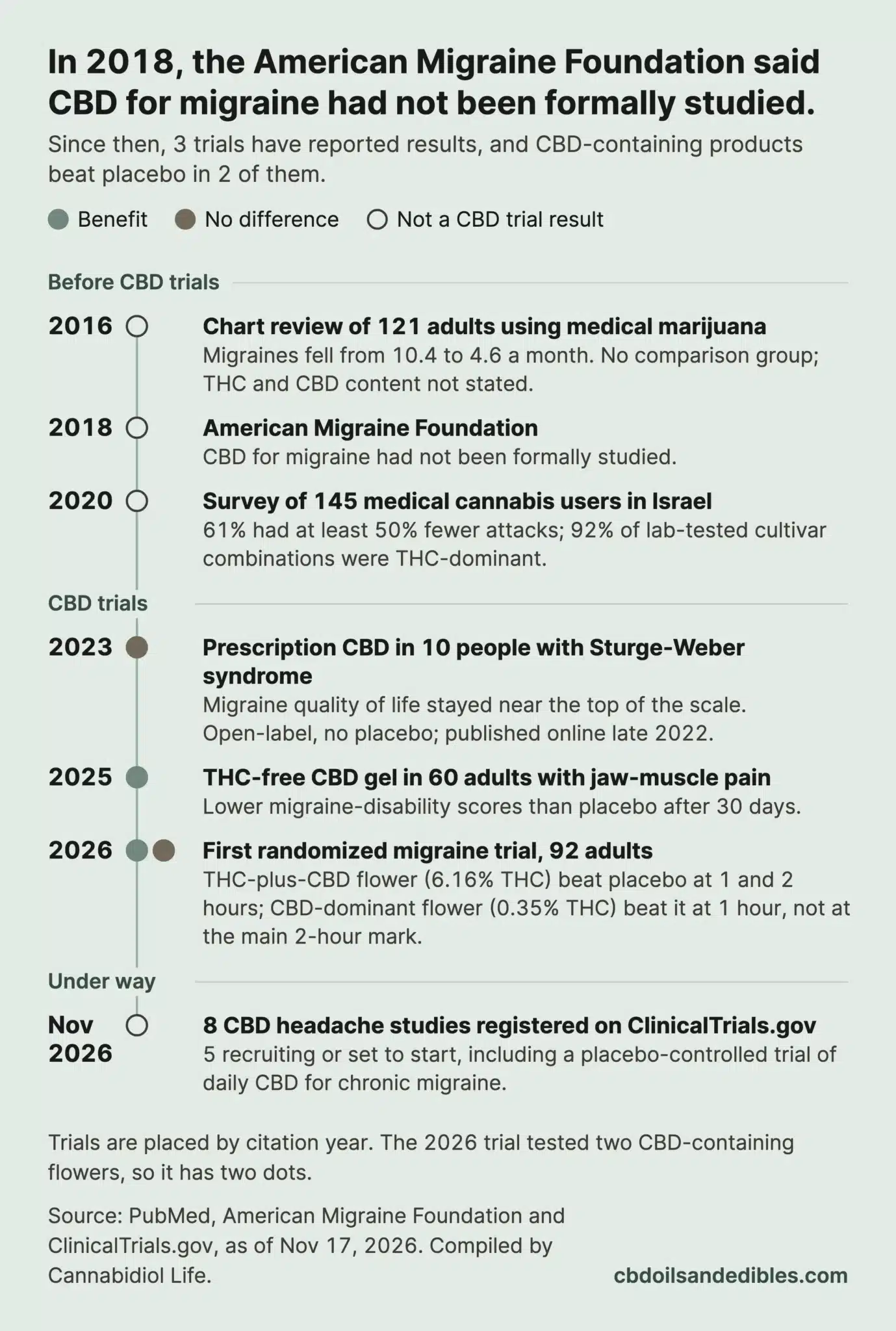
Three human trials have measured a migraine or headache outcome with CBD. Across their four CBD-containing comparisons, two found a benefit (one with CBD alone, one with THC-plus-CBD flower) and two found no difference, and none found harm on the measured outcome. Research on CBD oil and migraines is still early, and all three trials were small.
We sort results into three groups: CBD alone (no THC stated, or a product without THC), CBD with a stated THC dose, and THC-dominant products, which are not counted as CBD results.
CBD alone: 1 benefit (a nightly CBD gel, migraine disability) and 1 no difference (prescription CBD in Sturge-Weber syndrome, no test reported). CBD with a stated THC dose: 1 benefit (THC-plus-CBD flower) and 1 no difference at 2 hours (CBD-dominant flower, better than placebo at 1 hour). Sturge-Weber syndrome, the condition in the prescription CBD study, is a rare condition, usually diagnosed in infants, in which small blood vessels in the brain, eyes and skin develop abnormally (NINDS).
Cannabis has a long medical history: a 2015 review notes that many physicians once recommended it, especially for headache and migraine, before it became illegal. Until late 2022, no published human trial had reported a headache outcome with CBD, and early evidence came from people using medical cannabis for months or years without a comparison group. In one such study from 2020, 92% of the lab-tested cultivar combinations were THC-dominant. Since late 2022, three trials that tested CBD products directly have published results, and the first randomized migraine trial (2026) separated a CBD-dominant flower from a THC-plus-CBD flower and measured single doses over hours rather than months of use.
On December 7, 2018 (page updated in 2022), the American Migraine Foundation wrote that there was “no scientific evidence or research on CBD as an effective treatment for migraine,” “in large part because it has not been formally studied.” An October 31, 2018 expert Q&A from the American Headache Society added: “That does not mean they do not work, however. What it means is that they have not been studied.” Both predate the three trials. Every trial is in the study table.
Does CBD help migraine pain during an attack?
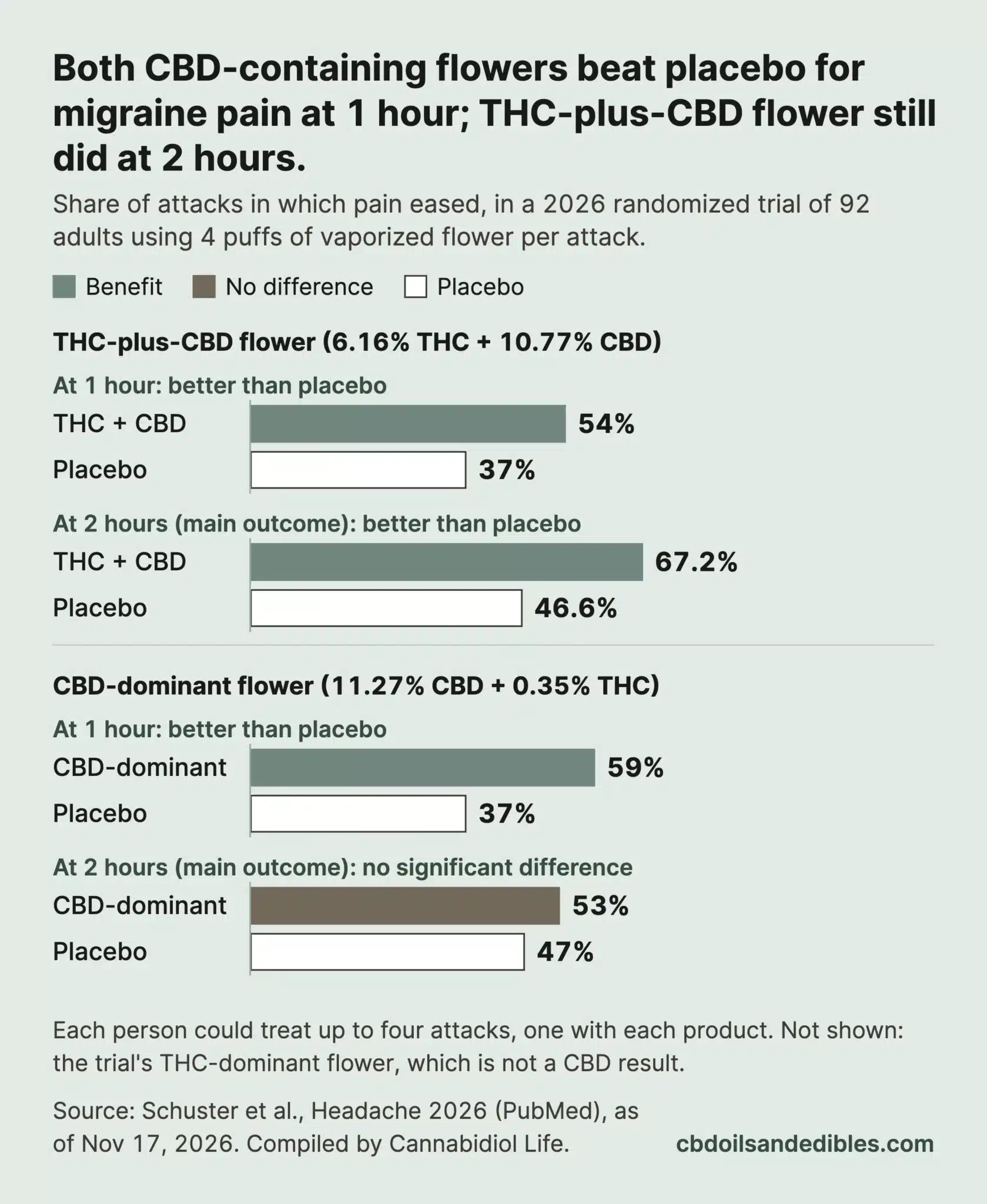
One randomized trial has tested CBD products during migraine attacks. In the 2026 trial of 92 adults, vaporized THC-plus-CBD flower beat placebo at 2 hours for pain relief, pain freedom and freedom from the most bothersome symptom. CBD-dominant flower beat placebo at 1 hour but not at the 2-hour main endpoint.
The trial, published in Headache in 2026, was double-blind and placebo-controlled with a crossover design: each person could treat up to four attacks, one with each product, in random order. Adults aged 21 to 65 (median age 41; 83% women) took part. The “most bothersome symptom” was light sensitivity, sound sensitivity or nausea, whichever each person rated worst.
With THC-plus-CBD flower (about 1 part THC to 1.75 parts CBD), pain relief came in 54% of attacks vs 37% with placebo at 1 hour (p = 0.039) and in 67.2% vs 46.6% at 2 hours, the main outcome (p = 0.016); the study table gives its pain-freedom figures. It also beat placebo for light and sound sensitivity at 2 hours, but not for nausea or vomiting. Freedom from the most bothersome symptom held at 24 and 48 hours, while sustained pain freedom at 48 hours (23% vs 10%) was not significant.
With CBD-dominant flower (about 1 part THC to 32 parts CBD), pain relief at 1 hour came in 59% of attacks vs 37% with placebo (p = 0.011), and the most bothersome symptom was gone in 41% vs 22% (p = 0.018). At 2 hours, pain relief was 53% vs 47%, not a significant difference, and later outcomes did not differ from placebo.
The same limits apply to both products: one dose per attack and outcomes followed for hours (more limits are under the study table). The CBD-dominant flower held 0.35% THC, so no trial has yet tested CBD without any THC during an attack. Earlier versions of this trial appeared as a 2024 preprint and as meeting abstracts; we count it once.
Daily CBD and migraine frequency: what studies tested
A placebo-controlled trial of a nightly THC-free CBD gel in 60 adults with jaw-muscle pain, who were not chosen for migraine, found lower migraine-disability scores after 30 days. No completed trial has yet tested daily oral CBD to lower how often migraines happen. Long-term medical cannabis users report fewer migraines in studies without control groups.
In that 2025 gel trial, both gel strengths lowered Migraine Disability Assessment (MIDAS) scores compared with placebo, and sleep quality also improved (see CBD for sleep).
Studies of medical cannabis use point the same way. A 2016 chart review of 121 adults found migraines fell from 10.4 to 4.6 a month (THC and CBD content not stated). In the 2020 Israeli survey of 145 patients, 61% had at least 50% fewer attacks; most cultivars tested in that study were THC-dominant. In the UK Medical Cannabis Registry (2026), 203 adults used prescribed cannabis products (median 20 mg CBD and 19 mg THC a day at the start; 25.5 mg CBD and 134 mg THC a day at 24 months). They improved on the Headache Impact Test (HIT-6) at every check up to 24 months, and on MIDAS up to 12 months but not at 18 or 24 months. At 24 months, 60.59% of the data were missing.
The registry also reported better anxiety and sleep scores up to 24 months (see CBD for anxiety). Studies without a comparison group cannot show that the product caused the change, and people who stopped are often missing.
Does CBD help chronic migraines?
In a 2022 Italian retrospective study of oral cannabis preparations for chronic migraine (THC and CBD content not stated in the abstract), pain intensity and acute-medicine use fell, while migraine days did not change. A placebo-controlled trial of purified CBD for chronic migraine is recruiting; an earlier one of CBD with CBG and low-dose THC stopped early without results.
The University of Calgary trial tests CBD softgels with under 1% THC and began recruiting in April 2026. The CAMTREA trial in Brazil (CBD with CBG and low-dose THC, in chronic migraine with medication-overuse headache) stopped early in February 2025 (registry status: terminated) and has no results. Medication-overuse headache, also called rebound headache, is a headache that keeps coming back when pain medicines are taken too often, such as more than 3 days a week (MedlinePlus).
CBD vs THC for migraines: is one better?
In the one head-to-head migraine trial, THC-plus-CBD flower had the broadest benefits at 2 hours and the longest-lasting ones. THC-dominant flower eased pain at 2 hours about as often (68.9% vs 67.2% of attacks) but did not raise pain freedom, and CBD-dominant flower helped at 1 hour. THC is the intoxicating cannabinoid; CBD is not.
Side effects differed by product. At 1 hour, euphoria was reported in 29% of THC-plus-CBD treatments vs 9.0% with CBD-dominant flower and 7% with placebo, and sleepiness in 45% and 38% vs 27%. There were no serious adverse events.
“This study gives clinicians evidence-based data to guide their discussions with patients”
Self-reported app data, which have no placebo group, also looked at THC and CBD levels. Among 699 people logging cannabis flower in an app study, 94% reported their headache or migraine symptoms eased within two hours, and THC levels of 10% or more were the strongest predictor of that. In a 2019 app study of 2,987 people, CBD levels generally were not linked with less pain across five pain types, including headache.
Does CBD oil help headaches?
No trial has tested CBD oil for headaches other than migraine yet. In surveys and app data on cannabis and CBD for headaches, many people who use cannabis products report less headache severity, but these were cannabis products, not CBD alone. Surveys show what users report, not whether the product caused the change.
In a Canadian headache-clinic survey of 200 patients, 34.0% were active cannabinoid users, and 60% of those users felt cannabinoids reduced headache severity. At a US headache center (1,373 patients), cannabis users reported better headache intensity (78.1%), duration (73.4%) and frequency (62.4%). In app data on inhaled cannabis, self-rated headache and migraine severity fell by about 50%, but the effect seemed to fade over time while doses rose. In a social-media survey, 39% of 164 cannabis users said it was not effective for them.
Does CBD help tension headaches?
No published study has reported CBD results in tension-type headache. A placebo-controlled trial in Poland is testing CBD and CBN (cannabinol) oral solutions for facial pain and headache of muscular origin. The nearest evidence is the CBD gel trial in jaw-muscle pain, which lowered migraine-disability scores.
A tension-type headache, the most common type of headache, is pain or discomfort in the head, scalp or neck that often comes with tight or tender muscles there (MedlinePlus). The gel trial’s jaw-muscle pain results are covered in CBD for pain. In its 2018 expert interview page, the American Migraine Foundation said topical CBD “may still be a viable topical option for some patients with joint and muscle pain associated with migraine.”
“If you have a lot of neck pain or soreness, it is perfectly reasonable to use CBD oil.”
Does CBD oil help cluster headaches?
No trial has tested CBD for cluster headaches, and none of the 8 registered CBD headache studies targets it. Evidence on CBD oil and cluster headaches comes from surveys of cannabis use, not CBD trials: about 1 in 4 people who tried cannabis for attacks reported some benefit, while most in a larger survey saw no change.
A cluster headache is an uncommon, severe headache on one side of the head that comes in attacks of 15 minutes to 3 hours, daily or almost daily for weeks or months (MedlinePlus). In a French survey of 139 people with cluster headache, 27 had tried cannabis for attacks: 25.9% reported some efficacy, 51.8% variable or uncertain effects and 22.3% negative effects. In a Dutch survey of 756 people, 86 used cannabis during a cluster episode; attack frequency fell for 17.4%, did not change for 67.4% and rose for 15.1%.
A 2015 review saw a possible role for cannabinoids in cluster headache, based mostly on case reports, anecdotes and lab research.
Can CBD cause headaches?
Can CBD oil cause headaches? Headache shows up as a side effect in some studies, but in a 2026 meta-analysis of 4 trials in 269 healthy adults, it was not significantly more common with CBD than with placebo. A 2020 meta-analysis of 12 trials (803 people) did not list headache among the side effects linked to CBD.
In a phase I trial in healthy adults taking 750 or 1,500 mg twice a day for 7 days, 4 of 9 people at each dose reported headache vs 0 of 6 on placebo. In a single-dose phase 1 study, headache was the most frequent side effect (17% of all participants, CBD and placebo together), and the CBD and placebo safety profiles were similar. Headache is not listed among the adverse reactions in the Epidiolex label.
Stopping CBD has been studied too. In a withdrawal trial, 58% of healthy volunteers switched to placebo after 4 weeks of 1,500 mg a day reported headache, and the authors found no evidence of a withdrawal syndrome. In a Quebec medical cannabis registry, headache was the most common moderate-or-severe side effect reported with inhaled cannabis of any THC and CBD content (13.0% of 23 reports), while vomiting was most common with CBD-dominant products (20 reports).
No study in our review measured headache by product form, such as gummies, or by time of day, and the studies do not explain why some people report headaches with CBD.
Can CBD cause rebound headaches?
No human study has measured whether CBD itself causes medication-overuse (rebound) headache. In a 2021 chart review of 368 adults with chronic migraine, medication-overuse headache was present in 81% of current cannabis users vs 41% of non-users (adjusted odds ratio 6.3), an association that does not prove cause.

Every human trial of CBD for migraines and headaches in our review
This table holds every published human trial in our review that gave CBD and measured a migraine or headache outcome: 3 trials, in 4 rows because the 2026 trial tested two CBD-containing flowers. It is the complete set.
| Study | Product group | Design and people | Product and amount used | Length | Measured | Result |
|---|---|---|---|---|---|---|
| Walczyńska-Dragon 2025, Pharmaceuticals | CBD alone | Randomized, double-blind, placebo-controlled, 3 groups; 60 adults (average age about 24) with jaw-muscle pain from teeth grinding (bruxism), not selected for migraine | CBD isolate gel (no THC), 5% (25 mg) or 10% (50 mg) in 0.5 mL, applied nightly inside the mouth to the jaw muscles | 30 days | Migraine disability (MIDAS), a main outcome in the paper | Benefit: lower migraine disability than placebo with both strengths (10%: median 17 to 8, p < 0.001; 5%: 15 to 10, p = 0.010; placebo 12 to 12). Sleep quality also improved. |
| Smegal 2023, Pediatric Neurology | CBD alone | Open-label, no placebo (phase II); 10 people with Sturge-Weber syndrome, ages 3 to 50 eligible (average about 14); 8 analyzed for this outcome | Prescription CBD (Epidiolex oral solution), 5 mg/kg a day rising weekly to a maximum of 20 mg/kg a day | 6 months | Migraine quality of life (secondary outcome; 0 to 100) | No difference: scores were near the top of the scale at the start (96.8) and stayed there (97.5); no statistical test reported. 6 of 10 had mild-to-moderate side effects; 1 withdrew. |
| Schuster 2026, Headache | CBD with a stated THC dose (CBD-dominant, about 1:32 THC:CBD) | Randomized, double-blind, placebo-controlled crossover; 92 adults with migraine (ages 21 to 65), 247 attacks | Vaporized flower, 11.27% CBD + 0.35% THC; 4 puffs within 4 hours of attack onset (milligrams delivered not stated) | One dose per attack; outcomes to 48 hours | Pain relief at 2 hours (main outcome) | Better than placebo at 1 hour: pain relief 59% vs 37% (p = 0.011), most-bothersome-symptom freedom 41% vs 22% (p = 0.018). No difference at 2 hours: 53% vs 47%, not significant. |
| Schuster 2026, Headache (same trial) | CBD with a stated THC dose (about 1:1.75 THC:CBD) | Same trial as above | Vaporized flower, 6.16% THC + 10.77% CBD; 4 puffs | One dose per attack | Pain relief at 2 hours (main outcome) | Benefit: pain relief 67.2% vs 46.6% (p = 0.016); pain-free 34.5% vs 15.5%; most-bothersome-symptom free 60.3% vs 34.5%; sustained pain freedom to 24 hours 28% vs 11%. |
- Not a CBD result: the same trial’s THC-dominant flower (5.62% THC + 0.03% CBD) eased pain at 2 hours in 68.9% of attacks vs 46.6% with placebo (p = 0.008) but did not raise pain freedom or most-bothersome-symptom freedom.
- Limits, stated for every row: the gel trial’s registry record (NCT05562635) has an oral-film title (its arms describe the gel), 30 planned participants and different main outcomes (muscle activity and pain) and does not list MIDAS; the 2026 trial’s 1-hour results were registered as “other” outcomes; neither paper reports a correction for multiple comparisons; the Sturge-Weber study had no placebo group.
- The gel trial was reported in two papers (2024 and 2025) and is counted once.
How much CBD for migraines? Doses and forms used in studies
There is no official dose of CBD for migraines, and research does not show what amount works for a given person. The trials used vaporized flower, a gel applied inside the mouth to the jaw muscles, and prescription CBD by mouth. No completed trial has tested CBD oil for migraines, or CBD capsules or gummies.
In the trials, adults used a gel with 25 or 50 mg of CBD each night for 30 days, or 4 puffs of vaporized flower within 4 hours of an attack starting (milligrams not stated); the Sturge-Weber study, which included children, used prescription CBD at 5 rising to 20 mg/kg a day. Registered trials without results are testing softgels (100 or 200 mg of CBD a day), oral solutions, a cannabis extract with 25 times more CBD than THC in adolescents, sublingual tablets for period pain with menstrual headache or migraine and a topical roll-on. On timing, both CBD-containing flowers in the 2026 trial beat placebo at 1 hour, and THC-plus-CBD flower also did at 2 hours. As for how to use CBD for migraines, studies so far show which forms were tested, not which works best.
These are the amounts researchers used in studies. They are not dosing advice. Talk to your doctor before trying CBD, especially if you take any medicines.
CBD creams, balms and roll-ons for headaches
The one completed topical trial found a benefit: a THC-free CBD gel on the jaw muscles, inside the mouth, lowered migraine-disability scores in adults with jaw-muscle pain. No completed trial has tested CBD cream, balm or roll-on on the head or neck for migraine; a peppermint-and-lavender CBD roll-on for attacks is being tested in an open-label trial in Iran (recruiting).
What do research reviews say about CBD for migraines?
The reviews below are a selection: those whose own results or conclusion reported a favorable finding for migraine or headache. Cautious conclusions are shown with both halves. None pooled CBD alone; most cover medical cannabis in general. The 2026 systematic review’s migraine evidence is the 2026 trial above, so it is not counted twice.
| Review | Type and what it pooled | What it found | Its limit |
|---|---|---|---|
| Costa-Oliveira 2026, Cannabis and Cannabinoid Research | Systematic review of 5 randomized trials in low back pain, migraine and medication-overuse headache; CBD alone, vaporized THC + CBD, nabilone and a cannabis extract, not pooled | “Moderate-certainty evidence supports vaporized THC + CBD for acute migraine outcomes” | “a CBD-dominant formulation showed no clear benefit”; no class-wide effect for headache disorders |
| Okusanya 2022, Frontiers in Neurology | Systematic review, 12 publications, 1,980 people; all medical cannabis products | “promising evidence” on onset and duration; fewer migraine days and migraines per month | High-quality research is lacking; noted medication-overuse headache |
| Sherpa 2022, Cureus | Systematic review of 9 studies; medical marijuana in adults | “significant clinical response by reducing the length and frequency of migraines”; no severe side effects | More clinical trials with longer follow-up needed |
| Kuruvilla 2025, Current Opinion in Neurology | Narrative review; cannabinoids in headache | May help reduce headache frequency, pain and sleep problems | No standard dosing, long-term safety data or controlled trials |
| Chandwani 2023, Current Pain and Headache Reports | Narrative review; cannabis and cannabinoid therapies | “Preliminary studies show that CCT have evidence for the management of migraine.” | Needs randomized trials; not in the AHS 2021 consensus |
| Lo Castro 2022, Journal of Clinical Medicine | Narrative review; plant and synthetic cannabinoids | “promising data are emerging” | Low-quality studies; real effectiveness and safety not yet shown |
| Pantoja-Ruiz 2022, Brazilian Journal of Anesthesiology | Scoping review; cannabis across pain types | Calls the evidence for headache “weak” | Risks not systematically analyzed |
| Poudel 2021, Cureus | Narrative review of 34 articles; medical cannabis | Decreases migraine duration and frequency | US research limited; anecdotal studies |
| Mechtler 2021, Current Pain and Headache Reports | Narrative review with clinical experience; medical cannabis | Patients report improved migraine profile and common comorbidities | Not enough data for dose recommendations |
| Duarte 2021, Current Pain and Headache Reports | Narrative primer; cannabis for headache pain | Specific formulations effective for chronic pain, including headache | No FDA-approved cannabis product for headache; mostly retrospective evidence |
| Baron 2018, Headache | Narrative review; cannabinoids, terpenes, flavonoids | Benefits for pain “may also apply” to migraine and headache | Headache benefit extrapolated from pain evidence; written before the three trials |
| Lochte 2017, Cannabis and Cannabinoid Research | Narrative review; cannabis for headache disorders | Enough preliminary results to warrant trials | “not enough evidence from well-designed clinical trials” |
| Baron 2015, Headache | Narrative review; medicinal cannabis and cannabinoids | Suggests a role in several headache types, including migraine and cluster headache | Mostly case-based, anecdotal or lab research |
How might CBD affect migraine? What lab studies show
Lab and animal studies suggest CBD may act on migraine pathways, including CGRP (calcitonin gene-related peptide), a signaling molecule involved in migraine, and the body’s cannabinoid signaling network, the endocannabinoid system. Three studies in rats and mice tested this directly:
- In rat migraine models, CBD reduced pain sensitivity in the trigeminal nerve area and lowered CGRP and inflammatory cytokine levels, but it did not change TNF-alpha (more on inflammation in CBD for inflammation).
- In a mouse CGRP model, a single CBD dose protected females and males against touch sensitivity around the eye, but did not protect females against light sensitivity.
- In three mouse models, a 100:1 CBD:THC combination reduced light aversion triggered by CGRP or sodium nitroprusside, while no treatment reversed touch sensitivity around the eye. No human trial has tested a 100:1 product.
These findings come from rats and mice, not people.
Our data: CBD for migraines by the numbers (November 2026)
Cannabidiol Life computed these figures on November 17, 2026 from our study table, ClinicalTrials.gov, PubMed and Ahrefs search data. The number of registered studies shows research interest, not whether CBD works.
- Vaporized THC-plus-CBD flower left more than twice as many migraine attacks pain-free at 2 hours as placebo: 34.5% vs 15.5% (Schuster 2026).
- At 1 hour, CBD-dominant flower (0.35% THC) eased pain in 59% of attacks vs 37% on placebo; at 2 hours the gap was not significant (Schuster 2026).
- A 10% THC-free CBD gel cut median migraine-disability scores by about half (17 to 8) in adults with jaw-muscle pain; placebo stayed at 12 (Walczyńska-Dragon 2025).
- At 1 hour, euphoria was reported after 9.0% of CBD-dominant flower treatments, vs 7% with placebo and 29% with THC-plus-CBD flower (Schuster 2026).
- Of 4 CBD-containing comparisons in 3 trials, 2 found a benefit, 1 with CBD alone and 1 with THC-plus-CBD flower; 2 found no difference (our study table).
- All 3 published CBD trials that measured a migraine or headache outcome are from 2023-2026, including the first randomized migraine trial (2026) (how the research has changed).
- The 3 trials included 162 people: 92 adults with migraine, 60 adults with jaw-muscle pain and 10 people with Sturge-Weber syndrome (our study table).
- Trials used 3 forms: vaporized flower, a jaw-muscle gel and prescription oral CBD; no completed trial has tested CBD gummies or capsules for migraine (doses and forms used in studies).
- 8 CBD headache studies are registered on ClinicalTrials.gov; 1 has published results, and 5 are recruiting or set to start, planning 244 people (ClinicalTrials.gov).
- Of the 8 registered CBD headache studies, 6 involve migraine, 1 tension-type or muscle-related headache, 1 post-traumatic headache and none targets cluster headache (ClinicalTrials.gov).
- Papers per year mentioning CBD with migraine or headache rose from 5 in 2019 to 14 in 2025, 2.8 times as many (PubMed search).
- US searches for “cbd for migraines” averaged 294 a month over the last 12 complete months, 87.7% below the 2019 average of 2,400.

How we built this: we counted the 3 trials and 4 CBD-containing comparisons in our study table. We ran six ClinicalTrials.gov API searches on November 17, 2026 (data timestamp 2026-11-17T10:00:05) and read each record, keeping studies that give CBD to people with a listed headache disorder. We counted PubMed papers with the query cannabidiol[tiab] AND (migrain*[tiab] OR headache*[tiab] OR cephalalg*[tiab]) by publication year (78 in all, 0.9% of 8,666 cannabidiol papers; a paper can count in two years). We screened all 58 CBD studies that mention migraine or headache among the 5,446 cannabis studies in the Cannabidiol Life study database, and read Ahrefs Keywords Explorer volume history (US, modelled monthly estimates). Every figure, formula and source row is in our research files.
Cite this data: Cannabidiol Life. “Our Data: CBD for Migraines by the Numbers (November 2026).” Data as of November 17, 2026, from our study table, ClinicalTrials.gov, PubMed, Ahrefs and the Cannabidiol Life study database. https://cbdoilsandedibles.com/health/cbd-for-migraine-headaches/
Is CBD safe with migraine medicines? Side effects and interactions
CBD can cause side effects such as sleepiness, diarrhea and changes in liver tests, and most of the measured figures come from prescription seizure doses. It can also interact with some migraine medicines, including topiramate and valproate, which are covered below.
In Epidiolex seizure trials at 10 to 20 mg/kg a day, which are prescription doses, sleepiness affected 32% vs 11% on placebo, and the liver enzyme ALT rose above 3 times normal in 13% vs 1% (12% at 25 mg/kg a day), per the Epidiolex label. The FDA lists changes in alertness, diarrhea or decreased appetite, and mood changes such as irritability and agitation, and says CBD with alcohol or other drugs that slow brain activity raises drowsiness.
Do not use CBD if you are pregnant, planning a pregnancy or breastfeeding. The FDA strongly advises against using CBD, THC or marijuana in any form during pregnancy or while breastfeeding. Headache is one reason people give: in a 2019-2021 survey, 20.4% of pregnant women used CBD-only products, and 35.6% of those users gave headache as a reason.
CBD products are not for children. Keep them out of reach of children and pets. If a child swallows a CBD or THC product, call Poison Control at 1-800-222-1222 or get medical care right away.
Get emergency care (call 911) for sudden, severe or unexplained pain, chest pain, trouble breathing, or signs of a stroke. Talk to your doctor before using CBD, especially if you take any medicines or supplements, have liver problems, or have a health condition.
Can you take CBD with Topamax, triptans or other migraine medicines?
No study has measured CBD with triptans, gepants or CGRP antibodies. In epilepsy studies, topiramate (Topamax) levels rose as CBD doses rose but stayed in the usual therapeutic range, and valproate taken with higher CBD doses raised the risk of liver-enzyme increases. Both drugs are also used to prevent migraines in some people.
The topiramate and valproate findings come from a 2017 epilepsy study of prescription CBD at 5 to 50 mg/kg a day (p < 0.01 for both; AST and ALT for valproate), and the Epidiolex label carries the same valproate warning. A 2019 review lists topiramate as a drug that may lower CBD levels, and a 2021 review lists it among seizure medicines with possible interactions.
“CBD can affect how other drugs you are taking work, potentially causing serious side effects.”
CBD is a moderate inhibitor of the liver enzyme CYP2C19, per the label, which can raise levels of drugs that use it, such as propranolol and some antidepressants (a potential effect, not measured in people with migraine). The 2019 review notes that verapamil may raise CBD levels and flags possible side effects such as bleeding when CBD is used with naproxen or ibuprofen (also potential, not measured). Do not stop, reduce or change any prescribed medicine or treatment without talking to the doctor who prescribed it.
What should you look for in a CBD product for migraines?
No product has been shown to work best for migraines. Look for a batch certificate of analysis (COA) from an accredited third-party lab, and learn how to read a COA to match the label’s batch and CBD amount to the lab report. Our guide to verifying the lab shows how to vet the lab named on the COA.
In the trials, the CBD-alone results came from a CBD isolate gel and prescription CBD, while the attack trial’s flowers contained THC. Our side-by-side chart of CBD isolate vs full-spectrum and broad-spectrum CBD shows how the three product types differ. Full-spectrum extracts contain other hemp compounds besides CBD, and the entourage effect is the idea that these may work better together than CBD alone. Our CBD dosage guide explains how to read the suggested serving on a product label.
CBD’s legal status in the US
Is CBD legal? Federal law is changing. Under the 2018 Farm Bill definition, hemp (including hemp-derived CBD) is cannabis with no more than 0.3% delta-9 THC by dry weight, and it is not a controlled substance. A new federal definition applies in two steps (section 781 of Public Law 119-37, with start dates set by Public Law 119-103). Since November 12, 2026, hemp products that contain cannabinoids the plant cannot produce naturally no longer count as hemp. Starting December 11, 2026, the rest of the definition applies. It counts total THC, including THCA, and a finished hemp product such as a CBD oil or gummy qualifies as hemp only if each container holds no more than 0.4 mg of total THC and similar cannabinoids, and contains no cannabinoids that were synthesized or manufactured outside the plant. Some full-spectrum CBD products contain more THC than that. State laws differ and can be stricter. This is general information, not legal advice.
Frequently asked questions
Should CBD be used for migraines?
Early trials found benefits with THC-plus-CBD flower during attacks, and a THC-free CBD gel lowered migraine-disability scores in people with jaw-muscle pain. CBD-dominant flower helped at 1 hour, not 2, and prescription CBD showed no difference in Sturge-Weber syndrome. Neither the American Headache Society’s 2021 consensus (per a 2023 review) nor the Canadian Headache Society’s 2024 prevention guideline includes cannabinoids.
Can CBD stop a migraine?
In the 2026 trial, THC-plus-CBD flower left more attacks pain-free at 2 hours than placebo (34.5% vs 15.5%), and CBD-dominant flower beat placebo for pain relief at 1 hour. No study shows that CBD makes migraines go away for good, and long-term use has not been tested in a controlled trial.
Do CBD gummies work for migraines?
No trial has tested CBD gummies for migraines. The trials used vaporized flower, a gel applied inside the mouth and prescription CBD by mouth. See what to look for in a CBD product.
Does smoking CBD help with migraines?
No study has tested smoked CBD flower for migraines. The 2026 trial used vaporized flower, which is heated rather than burned: CBD-dominant flower with 0.35% THC beat placebo at 1 hour but not at 2 hours, and THC-plus-CBD flower beat placebo at 2 hours.
Does CBD help vestibular migraines?
No trial has tested CBD in vestibular migraine, a type of migraine that can cause vertigo (MedlinePlus). In a 2026 survey at a Canadian dizziness clinic, where it was the most common diagnosis (48 of 154), 14 of 78 cannabis users said cannabis eased their dizziness and 9 their headaches or migraines. Results were not reported for vestibular migraine alone.
Does CBD help migraines with aura?
No human study in our review reported CBD results for migraine with aura. In a 2025 mouse study, a 100:1 CBD:THC combination did not change cortical spreading depolarization, the brain event linked to aura, but reduced pain-like facial grimacing after it, and it reduced light aversion in two other migraine models. These are mouse results.
The bottom line on CBD for migraines and headaches
Small trials found benefits with CBD-containing products for migraine: vaporized THC-plus-CBD flower left more than twice as many attacks pain-free at 2 hours as placebo (34.5% vs 15.5%), and a 10% THC-free CBD gel cut migraine-disability scores by about half in adults with jaw-muscle pain. CBD-dominant flower eased pain at 1 hour but not significantly at 2 hours, and prescription CBD showed no difference in Sturge-Weber syndrome. With 5 of 8 registered CBD headache studies recruiting or set to start, including a placebo-controlled trial of daily CBD for chronic migraine, research on CBD for migraine headaches is still growing.
How we researched this
We do not sell or recommend products on this page. Every study cited was checked at PubMed or the publisher. The figures in our data section show the date and source used.
On November 17, 2026 we searched PubMed, ClinicalTrials.gov and the Cannabidiol Life study database (see our data above), and included every human trial that measured a migraine or headache outcome after CBD was given. Studies that measured only blood levels, or tested THC-like drugs without CBD, were not counted. Reviews were included when their own results or conclusion were favorable. More condition guides are in our CBD health guides.
Sources
Show the source list
- Schuster NM, Wallace MS, Marcotte TD, Buse DC, Lee E, Liu L, Sexton M. Vaporized cannabis versus placebo for acute migraine: A randomized, double-blind, placebo-controlled crossover trial. Headache. 2026;66(2):365-376. Registry: ClinicalTrials.gov NCT04360044. Funding (paper): sponsored by the Migraine Research Foundation; partly supported by the UCSD Academic Senate, NIH CTSA grant UL1TR001442 and a gift from Leonard and Marilyn Berger. An earlier version appeared as a 2024 preprint (counted once). PMID 41469488
- Walczyńska-Dragon K, Fiegler-Rudol J, Baron S, Nitecka-Buchta A. Expanding the Therapeutic Profile of Topical Cannabidiol in Temporomandibular Disorders: Effects on Sleep Quality and Migraine Disability in Patients with Bruxism-Associated Muscle Pain. Pharmaceuticals (Basel). 2025;18(7):1064. Registry: ClinicalTrials.gov NCT05562635. Companion paper on the same trial: PubMed 38592260 (counted once). Funding (paper): no specific grant; done as part of the authors’ employment at the Medical University of Silesia. PMID 40732351
- U.S. Food and Drug Administration. FDA Regulation of Cannabis and Cannabis-Derived Products, Including Cannabidiol (CBD) (content current as of 07/16/2024). fda.gov
- Smegal LF, Vedmurthy P, Ryan M, Eagen M, Andrejow NW, Sweeney K, et al. Cannabidiol Treatment for Neurological, Cognitive, and Psychiatric Symptoms in Sturge-Weber Syndrome. Pediatr Neurol. 2023;139:24-34. Registry: ClinicalTrials.gov NCT04447846. Funding: no funder named in the PubMed record (tagged as non-US-government research support). PMID 36508880
- Sawaira F, Shah MA, Hageen AW, Rashid M, Ullah R, Ali ME, et al. Safety of cannabidiol versus placebo in healthy population: a systematic review and meta-analysis. Ann Med Surg (Lond). 2026;88(3):2348-2356. PMID 41789242
- Taylor L, Gidal B, Blakey G, et al. A Phase I, Randomized, Double-Blind, Placebo-Controlled, Single Ascending Dose, Multiple Dose, and Food Effect Trial of the Safety, Tolerability and Pharmacokinetics of Highly Purified Cannabidiol in Healthy Subjects. CNS Drugs. 2018;32(11):1053-1067. PMID 30374683
- National Institute of Neurological Disorders and Stroke (NIH). Sturge-Weber Syndrome. Accessed November 17, 2026. ninds.nih.gov
- Aviram J, Vysotski Y, Berman P, Lewitus GM, Eisenberg E, Meiri D. Migraine Frequency Decrease Following Prolonged Medical Cannabis Treatment: A Cross-Sectional Study. Brain Sci. 2020;10(6):360. PMID 32526965
- American Migraine Foundation. Migraine and CBD Oil (interview with Stephen Silberstein, MD). Published 2018-12-07; page modified 2022-12-01. americanmigrainefoundation.org
- American Headache Society. Migraine and CBD Oil: Doctor Q&A With Stephen Silberstein, MD, FACP, FAHS (datePublished 2018-10-31; dateModified 2024-11-06). americanheadachesociety.org
- Rhyne DN, Anderson SL, Gedde M, Borgelt LM. Effects of Medical Marijuana on Migraine Headache Frequency in an Adult Population. Pharmacotherapy. 2016;36(5):505-10. PMID 26749285
- Hooper L, Erridge S, Clarke E, McLachlan K, Coomber R, Iqbal A, et al. UK Medical Cannabis Registry: A Clinical Outcomes Analysis for Migraine. Brain Behav. 2026;16(4):e71323. PMID 41943196
- Baraldi C, Lo Castro F, Negro A, Ferrari A, Cainazzo MM, Pani L, et al. Oral Cannabinoid Preparations for the Treatment of Chronic Migraine: A Retrospective Study. Pain Med. 2022;23(2):396-402. PMID 34347088
- Cannabis for the Prophylactic Treatment of Migraine: a Randomized Double-Blind Placebo-Controlled Clinical Trial (University of Calgary). ClinicalTrials.gov NCT03972124.
- CAMTREA trial: CBD 133 mg + CBG 66 mg + THC 4 mg a day vs placebo as adjunctive therapy in chronic migraine (Hospital Israelita Albert Einstein, Brazil). ClinicalTrials.gov NCT04989413.
- MedlinePlus Medical Encyclopedia (U.S. National Library of Medicine). Headache. Accessed November 17, 2026. medlineplus.gov
- Stith SS, Diviant JP, Brockelman F, Keeling K, Hall B, Lucern S, Vigil JM. Alleviative effects of Cannabis flower on migraine and headache. J Integr Med. 2020;18(5):416-424. PMID 32758396
- Li X, Vigil JM, Stith SS, Brockelman F, Keeling K, Hall B. The effectiveness of self-directed medical cannabis treatment for pain. Complement Ther Med. 2019;46:123-130. PMID 31519268
- Melinyshyn AN, Amoozegar F. Cannabinoid Use in a Tertiary Headache Clinic: A Cross-Sectional Survey. Can J Neurol Sci. 2022;49(6):781-790. PMID 34511153
- Starkey B, Pearlson GD, Bond D, Glaser C, Bhargava A, Grosberg BM, Verhaak A. Characterizing Cannabis Use and Perceived Benefit in a Tertiary Headache Center Patient Sample. Neurol Clin Pract. 2024;14(2):e200285. PMID 38455123
- Cuttler C, Spradlin A, Cleveland MJ, Craft RM. Short- and Long-Term Effects of Cannabis on Headache and Migraine. J Pain. 2020;21(5-6):722-730. PMID 31715263
- Kuruvilla DE, Mehta A, Ravishankar N, Cowan RP. A patient perspective of complementary and integrative medicine (CIM) for migraine treatment: a social media survey. BMC Complement Med Ther. 2021;21(1):58. PMID 33568112
- Effectiveness of CBD and CBN oral solutions in facial pain and headache of muscular origin (Wroclaw Medical University, Poland). ClinicalTrials.gov NCT05961501.
- MedlinePlus Medical Encyclopedia (U.S. National Library of Medicine). Tension headache. Accessed November 17, 2026. medlineplus.gov
- MedlinePlus Medical Encyclopedia (U.S. National Library of Medicine). Cluster headache. Accessed November 17, 2026. medlineplus.gov
- Leroux E, Taifas I, Valade D, Donnet A, Chagnon M, Ducros A. Use of cannabis among 139 cluster headache sufferers. Cephalalgia. 2013;33(3):208-13. PMID 23197349
- de Coo IF, Naber WC, Wilbrink LA, Haan J, Ferrari MD, Fronczek R. Increased use of illicit drugs in a Dutch cluster headache population. Cephalalgia. 2019;39(5):626-634. PMID 30290701
- Baron EP. Comprehensive Review of Medicinal Marijuana, Cannabinoids, and Therapeutic Implications in Medicine and Headache: What a Long Strange Trip It’s Been …. Headache. 2015;55(6):885-916. PMID 26015168
- Chesney E, Oliver D, Green A, et al. Adverse effects of cannabidiol: a systematic review and meta-analysis of randomized clinical trials. Neuropsychopharmacology. 2020;45(11):1799-1806. PMID 32268347
- Perkins D, Butler J, Ong K, et al. A Phase 1, Randomised, Placebo-Controlled, Dose Escalation Study to Investigate the Safety, Tolerability and Pharmacokinetics of Cannabidiol in Fed Healthy Volunteers. Eur J Drug Metab Pharmacokinet. 2020;45(5):575-586. PMID 32409982
- Taylor L, Crockett J, Tayo B, et al. Abrupt withdrawal of cannabidiol (CBD): A randomized trial. Epilepsy Behav. 2020;104(Pt A):106938. PMID 32036242
- Hachem Y, Moride Y, Castilloux AM, et al. A Descriptive Analysis of Adverse Event Reports from the Quebec Cannabis Registry. Drug Saf. 2024;47(2):161-171. PMID 37996777
- Zhang N, Woldeamanuel YW. Medication overuse headache in patients with chronic migraine using cannabis: A case-referent study. Headache. 2021;61(8):1234-1244. PMID 34370866
- Okusanya BO, Lott BE, Ehiri J, McClelland J, Rosales C. Medical Cannabis for the Treatment of Migraine in Adults: A Review of the Evidence. Front Neurol. 2022;13:871187. PMID 35711271
- CAN-CHA: A multi-centre tolerability study of a cannabidiol-enriched cannabis herbal extract for chronic headaches in adolescents (University of Manitoba). ClinicalTrials.gov NCT05337033; protocol: Chhabra M, et al. PLoS One. 2024;19(9):e0290185.
- Sublingual tablets with cannabinoid combinations for dysmenorrhea and associated symptoms including menstrual headache or migraine (Pure Green). ClinicalTrials.gov NCT04091789.
- Evaluation of Efficacy and Safety of Topical Cannabidiol (Canvert-M) in the Treatment of Migraine Attacks (Alasht Pharmed, Iran). ClinicalTrials.gov NCT07093138.
- Costa-Oliveira CD, Castro MJ, Silvério LAL, Brandão MFBO, Ramos YJ, Mazzola PG. Efficacy and Safety of Cannabinoid-Based Interventions for Low Back Pain and Migraine: A Systematic Review of Randomized Controlled Trials. Cannabis Cannabinoid Res. 2026 (online ahead of print): 25785125261490003. PMID 42773786
- Sherpa ML, Shrestha N, Ojinna BT, Ravi N, Shantha Kumar V, Choday S, et al. Efficacy and Safety of Medical Marijuana in Migraine Headache: A Systematic Review. Cureus. 2022;14(12):e32622. PMID 36660507
- Kuruvilla DE. Cannabinoids in headache: helpful or harmful? Curr Opin Neurol. 2025;38(3):277-280. PMID 40152937
- Chandwani B, Bradley BA, Pace A, et al. The Exploration of Cannabis and Cannabinoid Therapies for Migraine. Curr Pain Headache Rep. 2023;27(9):339-350. PMID 37515745
- Lo Castro F, Baraldi C, Pellesi L, Guerzoni S. Clinical Evidence of Cannabinoids in Migraine: A Narrative Review. J Clin Med. 2022;11(6):1479. PMID 35329806
- Pantoja-Ruiz C, Restrepo-Jimenez P, Castañeda-Cardona C, Ferreirós A, Rosselli D. Cannabis and pain: a scoping review. Braz J Anesthesiol. 2022;72(1):142-151. PMID 34280454
- Poudel S, Quinonez J, Choudhari J, Au ZT, Paesani S, Thiess AK, et al. Medical Cannabis, Headaches, and Migraines: A Review of the Current Literature. Cureus. 2021;13(8):e17407. PMID 34589318
- Mechtler LL, Gengo FM, Bargnes VH. Cannabis and Migraine: It’s Complicated. Curr Pain Headache Rep. 2021;25(3):16. PMID 33630181
- Duarte RA, Dahmer S, Sanguinetti SY, Forde G, Duarte DP, Kobak LF. Medical Cannabis for Headache Pain: a Primer for Clinicians. Curr Pain Headache Rep. 2021;25(10):64. PMID 34628531
- Baron EP. Medicinal Properties of Cannabinoids, Terpenes, and Flavonoids in Cannabis, and Benefits in Migraine, Headache, and Pain: An Update on Current Evidence and Cannabis Science. Headache. 2018;58(7):1139-1186. PMID 30152161
- Lochte BC, Beletsky A, Samuel NK, Grant I. The Use of Cannabis for Headache Disorders. Cannabis Cannabinoid Res. 2017;2(1):61-71. PMID 28861505
- Greco R, Francavilla M, Demartini C, Zanaboni AM, Sodergren MH, Facchetti S, et al. Characterization of the biochemical and behavioral effects of cannabidiol: implications for migraine. J Headache Pain. 2023;24(1):48 (erratum: J Headache Pain 2023;24(1):67, PMID 37277720). PMID 37138206
- Sturaro C, Fakhoury B, Targowska-Duda KM, Zribi G, Schoch J, Ruzza C, et al. Preclinical effects of cannabidiol in an experimental model of migraine. Pain. 2023;164(11):2540-2552. PMID 37310430
- Zorrilla E, Krivoshein G, Kuburas A, Schenke M, Piña CL, van Heiningen SH, et al. Combined effects of cannabidiol and Δ9-tetrahydrocannabinol alleviate migraine-like symptoms in mice. Cephalalgia. 2025;45(2):3331024251314487. PMID 39988876
- nVNS, CBD, and standard of care for persistent post-traumatic headache in elite athletes (American Society of Pain and Neuroscience). ClinicalTrials.gov NCT07624279.
- EPIDIOLEX (cannabidiol) oral solution, Full Prescribing Information. Jazz Pharmaceuticals. DailyMed setid 8bf27097-4870-43fb-94f0-f3d0871d1eec, SPL version 35, effective 2026-05-29. dailymed.nlm.nih.gov
- U.S. Food and Drug Administration. What You Need to Know (And What We’re Working to Find Out) About Products Containing Cannabis or Cannabis-derived Compounds, Including CBD. Consumer Update (content current as of 03/05/2020). fda.gov
- Bhatia D, Battula S, Mikulich-Gilbertson S, et al. Cannabidiol-Only Product Use in Pregnancy in the United States and Canada: Findings From the International Cannabis Policy Study. Obstet Gynecol. 2024;144(2):156-159. PMID 38723262
- Gaston TE, Bebin EM, Cutter GR, Liu Y, Szaflarski JP; UAB CBD Program. Interactions between cannabidiol and commonly used antiepileptic drugs. Epilepsia. 2017;58(9):1586-1592. PMID 28782097
- Brown JD, Winterstein AG. Potential Adverse Drug Events and Drug-Drug Interactions with Medical and Consumer Cannabidiol (CBD) Use. J Clin Med. 2019;8(7):989. PMID 31288397
- Gilmartin CGS, Dowd Z, Parker APJ, Harijan P. Interaction of cannabidiol with other antiseizure medications: A narrative review. Seizure. 2021;86:189-196. PMID 33541771
- Medrea I, Cooper P, Langman M, et al. Updated Canadian Headache Society Migraine Prevention Guideline with Systematic Review and Meta-analysis. Can J Neurol Sci. 2024 (corrigendum PMID 40842385). doi:10.1017/cjn.2024.285
- MedlinePlus Medical Encyclopedia (U.S. National Library of Medicine). Vertigo-associated disorders. Accessed November 17, 2026. medlineplus.gov
- Elmi P, Mavedatnia D, Berberi G, Lawrence M, Tohmé A, Hong X, Lelli D, Tse D. A Cross-Sectional Survey of Cannabis Use and Utility Among Patients Experiencing Dizziness. Brain Sci. 2026;16(4):360. PMID 42041771