
CBD for ADHD research is early. CBD (cannabidiol) is a non-intoxicating hemp compound. A 2026 open-label study without a control group found teacher-rated ADHD symptoms improved in autistic youth on a CBD-rich cannabis oil that very likely contained a little THC. A 2017 placebo-controlled trial of a THC + CBD spray found no significant difference on its main test. Neither tested CBD alone. The FDA has not approved CBD for ADHD. The FDA has approved only one drug that contains CBD: Epidiolex, a prescription medicine for seizures linked to Lennox-Gastaut syndrome, Dravet syndrome or tuberous sclerosis complex in people 1 year of age and older.
Quick facts
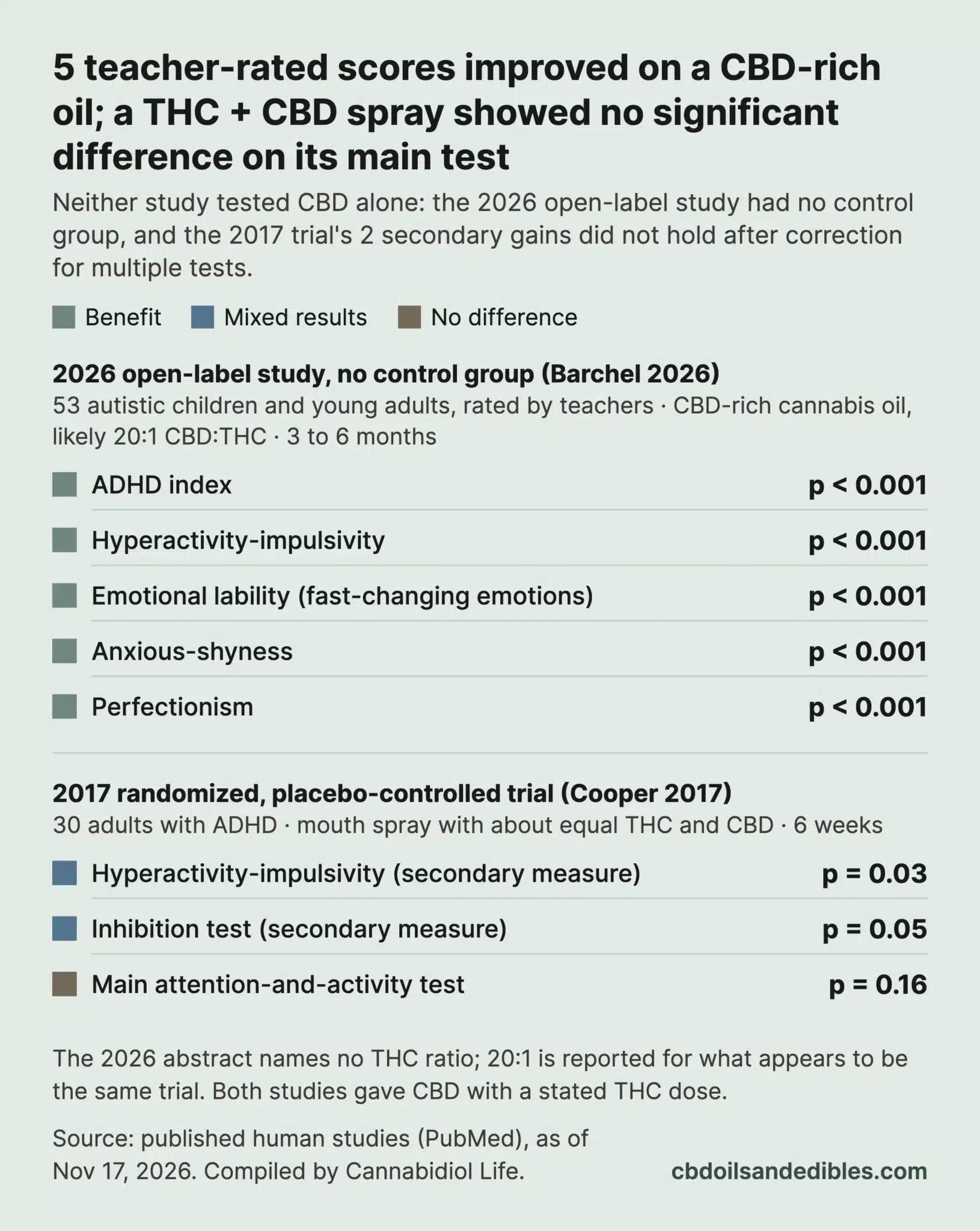
- A 2026 open-label study with no control group found 5 teacher-rated scores improved (p < 0.001), including the ADHD index and hyperactivity-impulsivity, in 53 autistic young people on a CBD-rich cannabis oil (likely 20:1 CBD:THC; Barchel 2026).
- In the one randomized trial, 30 adults on a spray with about equal THC and CBD improved nominally on 2 secondary measures (p = 0.03 and p = 0.05), gains that did not hold after correction for multiple tests. The main test showed no significant difference (p = 0.16; Cooper 2017).
- All 5 reviews we include report a favorable signal, each with its own limits, and all 5 rest on that same 30-person trial for their controlled evidence (for example Khan 2020).
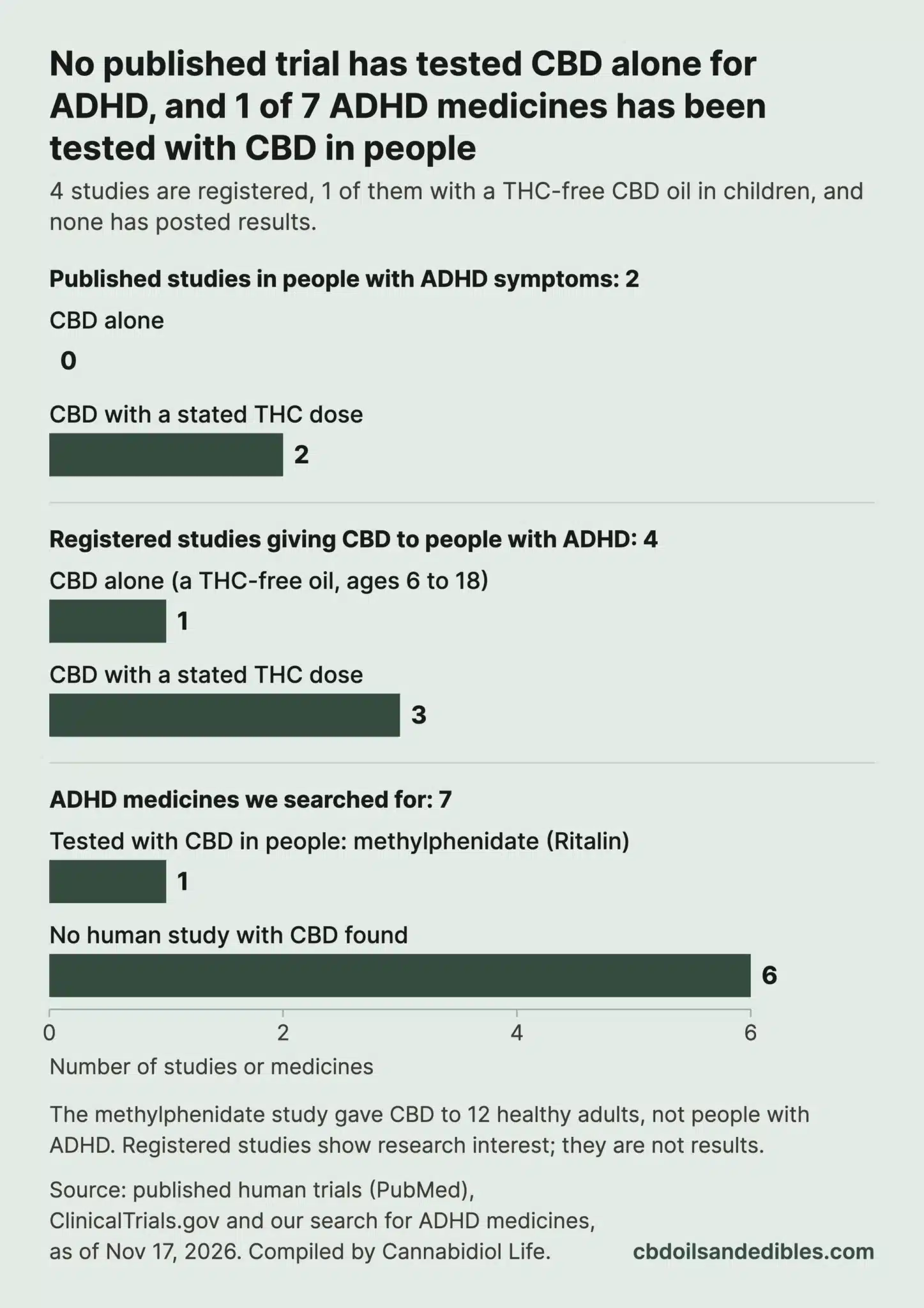
- No published trial has tested CBD alone in ADHD. ClinicalTrials.gov lists 4 registered CBD studies in people with ADHD, 1 of them with a THC-free CBD oil in children, and 0 have posted results (ClinicalTrials.gov, November 17, 2026).
- Of 7 ADHD medicines we searched for, 1 has a human study with CBD: in 12 healthy adults taking 1,500 mg of CBD a day, levels of a single methylphenidate (Ritalin) dose changed slightly. We found no human study of CBD with Adderall (Markowitz 2022).
Does CBD help with ADHD? What the research shows
Two human studies have tested CBD products in people with ADHD symptoms, and neither used CBD alone. A 2026 open-label study of a CBD-rich oil reported improved teacher ratings in autistic young people; a 2017 randomized trial of a THC + CBD spray in adults found no significant difference on its main test.
ADD is another name for ADHD (MedlinePlus). ADHD has three types: mostly inattentive, mostly hyperactive-impulsive and combined (MedlinePlus ADHD topic). So research on CBD for ADD, on CBD oil for ADHD, or on CBD and ADHD in general is the research below.
The 2026 study. Barchel and colleagues recruited 109 children and young adults with autism and ADHD symptoms; teachers rated 53 before and after treatment. Teacher-rated ADHD index, hyperactivity-impulsivity, emotional lability, anxious-shyness and perfectionism scores improved (p < 0.001), and the authors report trends toward improvement in inattention, hyperactivity, oppositional behavior and the Conners’ Global Index (p = 0.003 to 0.009).
Its abstract names neither the oil’s THC content nor a trial registration. But its hospital (Shamir Medical Center in Israel), start of recruitment (November 2019), single-group open-label design and size (about 110 recruited) match an autism trial there whose other reports describe a 20:1 CBD:THC oil. So it very likely reports that trial (Stolar 2022; Hacohen 2022). The authors name the open-label design, with no comparison group, as the main limit (Barchel 2026).
The 2017 trial. Cooper and colleagues randomly gave 30 adults nabiximols, a mouth spray with about equal THC and CBD, or a placebo. On secondary measures, hyperactivity-impulsivity improved nominally (p = 0.03), as did a test of inhibition (p = 0.05). On the main test, the active group “usually had scores that were better than the placebo group,” but the difference was not significant (p = 0.16), and the secondary gains did not hold after correction for multiple tests (Cooper 2017).
Reviews from 2022 and 2024 found no published study of CBD alone in ADHD (Kirkland 2022; Dammann 2024).
How the evidence has changed. The 2017 trial gave adults a THC + CBD spray for 6 weeks and measured attention with a computer test, which showed no significant difference. The 2026 study gave autistic young people a CBD-rich oil for 3 to 6 months and asked teachers to rate symptoms, which improved, without a control group. In between, surveys of cannabis users grew, and registered trials moved toward CBD-dominant oils and children.
What do ADHD groups and regulators say?
CHADD, a US ADHD patient organization, wrote in February 2021, before the 2026 study: “When it comes to CBD use and ADHD, there is not the evidence that this is a helpful intervention or support.” In 2019, the FTC and FDA warned a company over “potentially unsubstantiated claims” that its products could treat autism and ADHD.
In February 2026, the Association of Cannabinoid Specialists, a US nonprofit that educates clinicians on cannabinoid medicine, said THC or CBD “cannot be recommended as a first- or second-line therapy at this time,” and that “some individual adults may pursue adjunctive use under medical supervision” once evidence-based options are exhausted.
For standard care, MedlinePlus says: “Medicine combined with behavioral treatment often works best.”
CBD for ADHD studies: the human trials in one table
These are the human studies in people with ADHD or ADHD symptoms that our review found, favorable and no-difference alike, newest first. Studies in autism (Lawson 2026) and tic disorders (Müller-Vahl 2023) that measured ADHD-type symptoms are described below and are not counted here. Products follow three groups: CBD alone, CBD with a stated THC dose, and THC-dominant.
| Study (year) | Design | People | Product and dose (group) | Length | Main result |
|---|---|---|---|---|---|
| Barchel et al. 2026 | Open-label, one group, no control (before vs after) | 53 children and young adults with autism and ADHD symptoms, rated by teachers (109 recruited) | CBD-rich cannabis oil; likely 20:1 CBD:THC, the ratio reported for what appears to be the same trial (the abstract gives none). CBD with a stated THC dose. Dose: see the children’s section | 3 to 6 months | Teacher-rated ADHD index, hyperactivity-impulsivity and emotional lability improved (p < 0.001) |
| Cooper et al. 2017 (NCT02249299) | Randomized, placebo-controlled pilot trial | 30 adults with ADHD (ages 18 to 55) | Nabiximols mouth spray, 2.7 mg THC + 2.5 mg CBD per spray (about equal THC and CBD). CBD with a stated THC dose | 6 weeks | Hyperactivity-impulsivity improved on a secondary measure (p = 0.03; nominal, not significant after correction for multiple tests); no significant difference on the main attention-and-activity test (p = 0.16) |
CBD-rich cannabis oil may reduce ADHD symptoms in children with ASD. These findings support the need for future clinical trials to validate efficacy and determine optimal dosing.
What do reviews of CBD for ADHD conclude?
The reviews below are a selection: those whose own results or conclusions report a favorable signal for ADHD. Each has its own limit, and all five rely on the same 2017 nabiximols trial for their controlled ADHD evidence, so they are not five separate confirmations.
- Khan et al. 2020 (CBD and nabiximols) gave a “Grade B recommendation supporting the use of CBD for the treatment of … attention deficit hyperactivity disorder (ADHD),” yet its full text also says “Nabiximols showed no credible effect in the treatment of ADHD.”
- Sarris et al. 2020 (all medicinal cannabis): “One isolated study indicates some potential efficacy for an oral cannabinoid/terpene combination in ADHD,” but “it is currently premature to recommend cannabinoid-based interventions.”
- Bilbao and Spanagel 2022 (meta-analysis by cannabinoid type): nabiximols improved hyperactivity and impulsivity against placebo (standardized effect size -0.83; p = 0.03), but single-trial uses such as ADHD “could not be included in our conclusions.”
- Hoch et al. 2019 (THC- and CBD-based medicines): “improvements in hyperactivity/impulsivity (p = 0.03) and a cognitive measure of inhibition (p = 0.05) were found,” but “Results did not meet significance following adjustment for multiple testing.”
- Francisco et al. 2023 (39 studies of cannabis in general, not CBD): “some studies indicated that cannabis improved ADHD symptoms,” while “most studies indicated it worsened or had no effect,” and “cannabis is not recommended for people with ADHD.”
Does CBD help with ADHD in adults?
The one adult trial gave 30 adults a spray with about equal THC and CBD for 6 weeks. Hyperactivity-impulsivity improved on a secondary measure (a nominal result that did not hold after correction for multiple tests), and the main attention test showed no significant difference. No trial has tested CBD alone in adults with ADHD.
Its adults built up the dose over 2 weeks, then used their own dose. One serious adverse event (muscular seizures or spasms) and three mild ones occurred on the spray, against one serious event (cardiovascular problems) on placebo (Cooper 2017).
While not definitive, this study provides preliminary evidence supporting the self-medication theory of cannabis use in ADHD and the need for further studies of the endocannabinoid system in ADHD.
In a 2023 trial of the same spray in 97 adults with tic disorders, an exploratory analysis found tics improved in particular in people who also had ADHD; it studied tics, so it is not counted (Müller-Vahl 2023). A trial of three cannabis oils in adults with ADHD, two of them with 19:1 CBD:THC (one also with CBG), was terminated after 8 people enrolled, with no results (NCT05219370).
Does CBD help kids with ADHD? Studies in children and teens
The 2026 open-label study reported better teacher ratings in autistic children and young adults with ADHD symptoms on a CBD-rich cannabis oil (likely 20:1 CBD:THC), without a control group. No randomized trial has tested CBD for ADHD in children, and two trials in children and teens are registered without results.
In a 2023 US survey, 31.3% of 518 parents of children with ADHD, autism and/or anxiety had given their child an unlicensed CBD product (Schwaller 2023).
Research on CBD for children with ADHD comes from these labeled studies:
- Open-label trial that very likely produced the 2026 study. It enrolled ages 5 to 25. Each drop of the study oil held 5.7 mg CBD and 0.3 mg THC; researchers started at one drop a day and went up to no more than 10 mg/kg a day of CBD (Hacohen 2022). Higher CBD blood levels predicted greater improvement in emotional lability; dose and blood levels showed no significant link with the other scores (Barchel 2026).
- Parent-reported, autism. In an earlier report by the same lead author, parents of 38 autistic children with hyperactivity on a 20:1 CBD:THC oil said it improved in 68.4%, did not change in 28.9% and worsened in 2.6%; side effects, mostly sleepiness and appetite change, were mild (Barchel 2018).
- Caretaker-reported, autism. In 18 autistic patients aged 6 to 17 on a 75:1 CBD:THC extract, caretakers of the 15 who continued, all with ADHD symptoms, reported a median 30% improvement in that category, with no statistical test (Fleury-Teixeira 2019).
- Open-label trial, autism, CBD alone. In 23 autistic children and teens on Epidiolex (3 to 9 mg/kg a day for 6 weeks), the registered ADHD scale result cannot be read as better or worse, with no test posted, so it is not counted (Lawson 2026).
- Before-and-after study, autism, CBD alone. In Argentina, 20 children with severe autism and intellectual disability had purified CBD added to their usual medicines. Hyperactivity scores on a behavior checklist improved, and 18 of the 20 improved in at least one parent-reported symptom, with no control group and no test reported in the abstract. Other medicines were reduced in 40%, and 65% had side effects, mainly irritability and lower appetite, all mild or moderate and short-lived (Fortini 2025). In the 13 who completed about 27.6 months of follow-up, the improvements were modest but sustained (Fortini 2026).
- Registered, no results yet. A CBD oil without THC in ages 6 to 18 (NCT06542445, status unknown) and an oil with equal amounts of CBG and CBD (30 mg/mL each) and 3 mg/mL THC in ages 12 to 17 (NCT07592390, recruiting).
Is CBD safe for kids with ADHD?
The 2026 study’s abstract does not mention side effects, and its full text was not available to us. The best pediatric safety data come from Epidiolex trials in seizure disorders, at prescription doses (see the safety section). In juvenile rats, at exposures about 4 times those in people, the Epidiolex label reports delayed male sexual maturation and neurobehavioral effects.
In the trial that very likely produced the 2026 study, 12 of the 110 young people who started (11%) stopped because of side effects (Hacohen 2022), and an interim report found no clinically significant blood-test changes after 3 months in 59 participants (Stolar 2022). In the 75:1 autism study, 3 of 18 stopped in the first month because of insomnia, irritability, a faster heart rate or worse behavior (Fleury-Teixeira 2019).
CBD products are not for children. Keep them out of reach of children and pets. If a child swallows a CBD or THC product, call Poison Control at 1-800-222-1222 or get medical care right away. Talk to your child’s doctor before giving a child any CBD or cannabis product.
Can CBD help with ADHD and autism?
Several of the children’s studies above enrolled autistic young people who also had ADHD symptoms (Barchel 2026, Barchel 2018, Fleury-Teixeira 2019 and Lawson 2026), so their ADHD findings come from autistic children. For the autism trials themselves, including irritability and behavior outcomes, see CBD for autism.
Can you take CBD with Adderall, Ritalin or other ADHD medicines?
One small study has tested CBD with an ADHD medicine. In healthy adults taking 1,500 mg of CBD a day, levels of a single methylphenidate (Ritalin) dose changed slightly, a change the authors judged unlikely to matter clinically. We found no human study that tested CBD with Adderall or the other ADHD medicines.
Methylphenidate (Ritalin). Twelve healthy adults, not people with ADHD, took 750 mg of CBD twice a day (1,500 mg a day) for about 4 days, with one 10 mg dose of methylphenidate. Exposure changed by ratios of 1.09 (total) and 1.08 (peak); the upper limits of the confidence intervals passed the usual equivalence bound, and the authors called the change “unlikely to be of clinical significance” (Markowitz 2022). In lab and model work, CBD blocked CES1, the liver enzyme that breaks down methylphenidate, and a model of repeated CBD at 10 mg/kg twice a day predicted up to 55% higher exposure (Qian 2022).
Adderall and other ADHD medicines. We found no human study of CBD with Adderall (mixed amphetamine salts), lisdexamfetamine, atomoxetine, guanfacine, clonidine or viloxazine. The Epidiolex label calls CBD a moderate inhibitor of the liver enzyme CYP2C19 and names no ADHD medicine. The FDA warns that “CBD can affect how other drugs you are taking work, potentially causing serious side effects” (FDA).
Appetite and weight. In Epidiolex trials at prescription seizure doses, lower appetite was reported by 16% at 10 mg/kg a day and 22% at 20 mg/kg a day, against 5% on placebo, and 16% lost at least 5% of their weight, against 8%. No study has measured CBD plus a stimulant on appetite or weight.
Some cannabis users with ADHD say cannabis improved most of their medicine’s side effects (Stueber 2022), but no study has tested CBD for stimulant side effects.
Do not stop, reduce or change any prescribed medicine or treatment without talking to the doctor who prescribed it. Talk to your doctor before using CBD, especially if you take any medicines or supplements, have liver problems, or have a health condition.
Does CBD help with ADHD focus, anxiety or sleep?
In the 2026 open-label study, teacher-rated inattention moved toward improvement (cognitive inattention p = 0.009; DSM-IV inattention p = 0.003), results the authors call trends. In the 2017 trial, inattention was a non-significant trend (p = 0.10). No study has tested CBD alone for focus in ADHD.
Emotional lability, meaning fast-changing emotions, improved in the 2026 study (p < 0.001) and was a non-significant trend in the 2017 trial (p = 0.11).
In the 2026 open-label study, teacher-rated anxious-shyness also improved (p < 0.001), and in the 75:1 CBD:THC autism study, caretakers reported sleep among the strongest improvements, with no test reported (Fleury-Teixeira 2019). Outside autism, the anxiety and sleep findings come from THC-dominant cannabis. In a UK registry of 68 people with ADHD on prescribed cannabis (median 208.75 mg THC against 15 mg CBD a day), anxiety and sleep quality scores improved at 1 to 12 months, with no control group (Ittiphakorn 2023). For the CBD research itself, see CBD for anxiety and CBD for sleep.
CBD vs THC for ADHD: what cannabis studies found
THC (tetrahydrocannabinol) causes the high in cannabis; CBD does not. This research on THC and ADHD covers cannabis that contains THC, and the one randomized trial used about equal THC and CBD, so it cannot separate the two.
Reported as helpful. In a 2022 survey of 1,738 students, those with ADHD said cannabis had acute benefits on symptoms such as hyperactivity and impulsivity (Stueber 2022). In a 2026 survey of 900 adults with ADHD, 42% of those who had used cannabis used it to manage symptoms, and daily users more often reported improved mental frustration and impulsivity (odds ratios 2.39 and 1.69) (Ryan 2026). A 2020 survey of 59 medical cannabis patients with ADHD in Israel linked lower symptom scores to high doses of the cannabinoid CBN, not THC, among the 27 whose cannabis could be analyzed (Hergenrather 2020).
No change or worse. In 223 adults with chronic pain followed for 12 months, high-THC products went with fewer ADHD symptoms in those with few symptoms at the start, but medical cannabis was not linked to a change overall (Saunders 2025; for pain itself, see CBD for pain). Daily users in the 2026 survey were, in the authors’ words, “more likely to report that cannabis use worsened ADHD symptoms of inattention” and had more cannabis use disorder (62% against 38%). People with ADHD who were high on their own cannabis did better on two impulsivity tests but worse on five other thinking tests (Stueber 2026).
Surveys show what users report, not what caused a change.
Does weed help with ADHD?
Some adults with ADHD report that cannabis (weed, which contains THC) eases impulsivity or hyperactivity. In the one controlled trial, a 2017 spray containing THC improved hyperactivity-impulsivity on a secondary measure, but not after correction for multiple tests or on the main test. Daily users report worse attention more often, and a 2023 review does not recommend cannabis for ADHD.
How might CBD affect ADHD? What lab studies show
Our guide to the endocannabinoid system explains how cannabinoids such as CBD act in the body. In a 2023 mouse study, a single CBD dose did not change attention-like behavior in normal mice; in a gene-altered strain, females lost attention while males improved (Huffstetler 2023). Results in animals may not apply to people.
Research papers on CBD and ADHD have become more common since 2019.
How much CBD for ADHD? Doses used in studies
There is no official dose of CBD for ADHD, and research does not show what amount works for a given person. In the one adult ADHD trial, people used an average of 4.7 sprays a day, up to 14, each with 2.5 mg CBD and 2.7 mg THC (Cooper 2017; Khan 2020).
The terminated adult trial planned 0.3 to 1.8 mL a day of an oil with 95 mg CBD and 5 mg THC per mL. For seizures, the Epidiolex label uses 5 to 20 mg/kg a day, up to 25 mg/kg a day for tuberous sclerosis complex. No dose has been set for children, and no study reports how long CBD takes to affect ADHD symptoms; the trials measured at 6 weeks and at 3 to 6 months.
These are the amounts researchers used in studies. They are not dosing advice.
Our data: CBD for ADHD by the numbers (November 2026)
We computed these figures ourselves from the study table above, ClinicalTrials.gov, PubMed and US search data. Each is free to quote with a link to this page.

The 12 facts, each with its source, as of November 17, 2026:
- 5 teacher-rated scores improved (p < 0.001) in 53 autistic young people on a CBD-rich oil (likely 20:1 CBD:THC) in a 2026 open-label, uncontrolled study (Barchel 2026).
- In a 2018 report, parents of 38 autistic children with hyperactivity said it improved in 68.4% (about 2 in 3) on a 20:1 CBD:THC oil (Barchel 2018).
- Caretakers of 15 autistic young people reported a median 30% improvement in ADHD symptoms on a 75:1 CBD:THC extract, with no test reported (Fleury-Teixeira 2019).
- The one randomized trial (30 adults, THC + CBD spray) saw 2 nominal secondary gains and no significant difference on its main test (Cooper 2017).
- 0 of the 2 published ADHD studies tested CBD alone: both gave CBD with a stated THC dose (the study table).
- All 5 reviews we include rest on the same 30-person 2017 trial for their controlled ADHD evidence (the reviews above).
- 4 registered studies give CBD to people with ADHD; 0 have posted results, and 2 plan to enroll 180 children and teens (ClinicalTrials.gov).
- Of 7 ADHD medicines we searched for, 1 has a human study with CBD: methylphenidate (Ritalin), tested in 12 healthy adults (Markowitz 2022).
- 0 of the 2 ADHD studies tested gummies or vapes: one used a mouth spray, the other an oil (the study table).
- PubMed papers mentioning cannabidiol and ADHD averaged 6.6 a year in 2019-2025, about 4 times the 1.5 a year of 2015-2018 (PubMed).
- In a 2023 survey of 518 US parents of children with ADHD, autism and/or anxiety, 31.3% (nearly 1 in 3) had given unlicensed CBD (Schwaller 2023).
- US searches for “CBD for ADHD” averaged 745 a month over the last 12 complete months, two-thirds below the 2019 average of 2,238 (Ahrefs Keywords Explorer, US).
Cannabidiol Life’s Evidence Tracker counts CBD-for-ADHD research in public registries and databases; every figure is reproducible from the source shown.
| Metric | Value | As of | Source and query |
|---|---|---|---|
| Registered studies giving CBD to people with ADHD | 4: 1 CBD alone (oil without THC, children), 3 CBD with a stated THC dose (19:1 oil; spray with about equal THC and CBD; oil with equal CBG and CBD and 3 mg/mL THC) | Nov 17, 2026 | ClinicalTrials.gov ADHD + CBD search and five related queries |
| Of those, with results posted | 0. Status: 1 completed (published in 2017), 1 terminated after 8 enrolled, 1 unknown, 1 recruiting | Nov 17, 2026 | NCT02249299, NCT05219370, NCT06542445, NCT07592390 |
| People enrolled / planned | 38 enrolled (actual); 180 more planned in two studies of children and teens (estimated) | Nov 17, 2026 | The same four records |
| CBD studies in other conditions that register an ADHD scale or attention outcome | 3 (autism and tic disorders) | Nov 17, 2026 | ClinicalTrials.gov, same six queries |
| PubMed records mentioning cannabidiol and ADHD | 50 (1 to 3 a year in 2015-2018; 4 to 10 a year in 2019-2026), against 8,666 mentioning cannabidiol. Mentions, not trials | Nov 17, 2026 | PubMed: cannabidiol and ADHD; PubMed: cannabidiol |
| Human studies in people with ADHD or ADHD symptoms (our review) | 2: 1 open-label study without a control group reported improvement (CBD-rich cannabis oil, likely 20:1 CBD:THC, 2026); 1 randomized trial found no significant difference on its main measure (spray with about equal THC and CBD, 2017); 0 tested CBD alone | Nov 17, 2026 | The study table above |
| Cannabidiol Life’s study database | 5,446 PubMed studies; 43 CBD studies mention ADHD and 54 name an ADHD medicine; each was classified for this review | Nov 17, 2026 | Cannabidiol Life study database |
| US monthly searches for “CBD for ADHD” | 745 a month on average over the last 12 complete months, down 66.7% from the 2019 average of 2,238 and 73.9% below the March 2019 peak of 2,856 | Nov 17, 2026 | Ahrefs Keywords Explorer, US volume history |
Method. Facts are computed by one script from Cannabidiol Life’s study table (2 human studies in people with ADHD or ADHD symptoms), the ClinicalTrials.gov records our queries returned (each read), PubMed title-and-abstract counts (yearly averages use complete years; one paper can fall in two years) and Ahrefs US search data. Across six ClinicalTrials.gov queries, we kept a study if CBD was in an active arm and ADHD was a listed condition, or an ADHD scale was a registered outcome in another condition. The number of registered studies shows research interest, not whether CBD works.
Cite this data: Cannabidiol Life, “Our data: CBD for ADHD by the numbers (November 2026),” cbdoilsandedibles.com, https://cbdoilsandedibles.com/health/cbd-for-add-adhd/, data as of 2026-11-17.
Is CBD safe for ADHD? Side effects and warnings
CBD’s side effects are best known from Epidiolex trials at prescription seizure doses: sleepiness, diarrhea, lower appetite and raised liver enzymes. Liver-enzyme rises also showed up in healthy adults at lower doses. Drug interactions and children’s safety have their own sections above.
CBD use has been associated with liver injury, male reproductive harm, and interactions with other drugs.
At 10 to 20 mg/kg a day, sleepiness or sedation affected 32% on Epidiolex against 11% on placebo, and diarrhea and fatigue are common. ALT, a liver enzyme, rose above 3 times normal in 13% against 1% on placebo, and in 3% of those taking neither valproate nor clobazam (Epidiolex label). In healthy adults taking 5 mg/kg a day for 28 days, 8 of 151 on CBD (5.6% in the paper’s analysis) had liver-enzyme rises above 3 times normal, against 0 of 50 on placebo (Florian 2025). At 1,500 mg a day, 44% of 16 rose above normal and 31% above 5 times normal (Watkins 2021; its four authors were consultants to or employees of GW Research or Greenwich Biosciences, part of the company that developed Epidiolex).
The Epidiolex label carries the warning given to all antiseizure drugs about suicidal thoughts or behavior. If you are in crisis or thinking about harming yourself, call or text 988 to reach the 988 Suicide & Crisis Lifeline. In an emergency, call 911.
Using CBD can lead to a positive drug test: in a 2026 controlled study, at least one person in every group taking CBD oil with a little THC tested positive, as did one urine sample from the CBD-only group (Wolinsky 2026; one author works for a CBD company).
Do not use CBD if you are pregnant, planning a pregnancy or breastfeeding. The FDA strongly advises against using CBD, THC or marijuana in any form during pregnancy or while breastfeeding (FDA).
What should you look for in a CBD product for ADHD?
The ADHD studies used a mouth spray and oils; none tested gummies or vapes. Before you buy, learn how to read a certificate of analysis (COA) from an accredited third-party lab. A companion guide shows how to verify the lab named on the COA.
Full-spectrum products keep other hemp compounds alongside CBD; the idea that these compounds may work better together is called the CBD entourage effect. Our full-spectrum vs broad-spectrum CBD chart shows how the three product types differ.
CBD’s legal status in the US
Is CBD legal? Federal law is changing. Under the 2018 Farm Bill definition, hemp (including hemp-derived CBD) is cannabis with no more than 0.3% delta-9 THC by dry weight, and it is not a controlled substance. A new federal definition applies in two steps (section 781 of Public Law 119-37, with start dates set by Public Law 119-103). Since November 12, 2026, hemp products that contain cannabinoids the plant cannot produce naturally no longer count as hemp. Starting December 11, 2026, the rest of the definition applies. It counts total THC, including THCA, and a finished hemp product such as a CBD oil or gummy qualifies as hemp only if each container holds no more than 0.4 mg of total THC and similar cannabinoids, and contains no cannabinoids that were synthesized or manufactured outside the plant. Some full-spectrum CBD products contain more THC than that. State laws differ and can be stricter. This is general information, not legal advice.
Frequently asked questions
Does CBD work for people with ADHD?
A 2026 open-label study of a CBD-rich cannabis oil (likely 20:1 CBD:THC) found teacher-rated ADHD symptoms improved in autistic young people, without a comparison group. The 2017 randomized trial of a THC + CBD spray in 30 adults found no significant difference on its main test. No trial has tested CBD alone.
Does CBD help with ADD?
ADD is another name for ADHD, which has a mostly inattentive type. In the 2026 open-label study (CBD-rich oil, likely 20:1 CBD:THC), teacher-rated inattention moved toward improvement, results the authors call trends. In the 2017 THC + CBD spray trial, inattention showed a non-significant trend (p = 0.10). No study has tested CBD in the inattentive type on its own.
Is THC or CBD good for ADHD?
No study has compared THC with CBD for ADHD, and the one randomized trial used about equal amounts, so it cannot separate them. In a 2026 survey of adults with ADHD, daily cannabis users more often reported improved impulsivity, but also worse inattention and more cannabis use disorder. THC is intoxicating; CBD is not.
Can CBD make ADHD worse?
Neither ADHD study of a CBD product reported worse average ADHD scores: the 2026 study reported improvement, and the 2017 trial found no significant difference. In one 75:1 CBD:THC autism study, a few children stopped early because of side effects (see the children’s safety section). Daily THC-containing cannabis use went with more reports of worse attention.
Do CBD gummies work for ADHD?
No study has tested CBD gummies for ADHD; the studies used a mouth spray and oils.
What do Reddit and online forums say about CBD for ADHD?
The one published analysis of forum posts looked at cannabis, not CBD alone. Of 401 posts on cannabis and ADHD, 25% described it as therapeutic, 8% as harmful, 5% as both and 2% said it had no effect (Mitchell 2016). Forum posts show what people report, not what caused a change.
The bottom line on CBD for ADHD
The newest study found 5 teacher-rated scores improved in 53 autistic young people on a CBD-rich oil (likely 20:1 CBD:THC), without a control group. The one randomized trial, a THC + CBD spray in 30 adults, showed nominal secondary gains but no significant difference on its main test, and no published trial has tested CBD alone. Four registered studies, two of them in children and teens, have no results posted on ClinicalTrials.gov. If you take ADHD medicine, read the medicines section first. Our CBD health guides cover other conditions.
How we researched this
We searched PubMed and ClinicalTrials.gov on November 17, 2026, read every registry record our queries returned, and checked Cannabidiol Life’s database of 5,446 PubMed studies; an independent verifier re-checked every trial row. We included human studies in people with ADHD, or with ADHD symptoms as the measured main outcome. We do not sell or recommend products on this page. Every study cited was checked at PubMed or the publisher. Figures in Our data, Cannabidiol Life’s Evidence Tracker, show the date and source used.
Sources
Show the source list
- Barchel D, Kohn E, Hazan A, Berkovitch M, Babarashvili I, Heyman E, et al. CBD-Rich Cannabis Therapy in Children with Autism Spectrum Disorder May Improve Symptoms of Hyperactivity and Attention Deficit: An Open-Label Study. Curr Neuropharmacol. 2026. PMID 41503912
- Cooper RE, Williams E, Seegobin S, Tye C, Kuntsi J, Asherson P. Cannabinoids in attention-deficit/hyperactivity disorder: A randomised-controlled trial. Eur Neuropsychopharmacol. 2017;27(8):795-808. PMID 28576350; NCT02249299
- Stolar O, Hazan A, Vissoker RE, Kishk IA, Barchel D, Lezinger M, et al. Medical cannabis for the treatment of comorbid symptoms in children with autism spectrum disorder: An interim analysis of biochemical safety. Front Pharmacol. 2022;13:977484 (registered as NCT05212493; very likely the trial the 2026 study reports). PMID 36249785
- Hacohen M, Stolar OE, Berkovitch M, Elkana O, Kohn E, Hazan A, et al. Children and adolescents with ASD treated with CBD-rich cannabis exhibit significant improvements particularly in social symptoms: an open label study. Transl Psychiatry. 2022;12(1):375 (very likely the same trial as the 2026 study: ages, oil and dose). PMID 36085294
- US Food and Drug Administration. FDA Regulation of Cannabis and Cannabis-Derived Products, Including Cannabidiol (CBD). Content current as of 07/16/2024. fda.gov
- EPIDIOLEX (cannabidiol) oral solution, Full Prescribing Information. DailyMed, SPL version 35, effective 2026-05-29.
- Khan R, Naveed S, Mian N, Fida A, Raafey MA, Aedma KK. The therapeutic role of Cannabidiol in mental health: a systematic review. J Cannabis Res. 2020;2(1):2. PMID 33526132
- Sarris J, Sinclair J, Karamacoska D, Davidson M, Firth J. Medicinal cannabis for psychiatric disorders: a clinically-focused systematic review. BMC Psychiatry. 2020;20(1):24. PMID 31948424
- Bilbao A, Spanagel R. Medical cannabinoids: a pharmacology-based systematic review and meta-analysis for all relevant medical indications. BMC Med. 2022;20(1):259. PMID 35982439
- Hoch E, Niemann D, von Keller R, Schneider M, Friemel CM, Preuss UW, et al. How effective and safe is medical cannabis as a treatment of mental disorders? A systematic review. Eur Arch Psychiatry Clin Neurosci. 2019;269(1):87-105. PMID 30706168
- Francisco AP, Lethbridge G, Patterson B, Goldman Bergmann C, Van Ameringen M. Cannabis use in Attention – Deficit/Hyperactivity Disorder (ADHD): A scoping review. J Psychiatr Res. 2023;157:239-256. PMID 36508935
- Kirkland AE, Fadus MC, Gruber SA, Gray KM, Wilens TE, Squeglia LM. A scoping review of the use of cannabidiol in psychiatric disorders. Psychiatry Res. 2022;308:114347. PMID 34952255
- Dammann I, Rohleder C, Leweke FM. Cannabidiol and its Potential Evidence-Based Psychiatric Benefits – A Critical Review. Pharmacopsychiatry. 2024;57(3):115-132. PMID 38267003
- MedlinePlus Medical Encyclopedia. Attention deficit hyperactivity disorder (ADHD). Review date May 15, 2026. medlineplus.gov
- MedlinePlus. Attention Deficit Hyperactivity Disorder (health topic). medlineplus.gov
- CHADD, ADHD Weekly. What’s Up with Suggestions of Marijuana or CBD Oil for ADHD? February 18, 2021. chadd.org
- US Federal Trade Commission. FTC and FDA Warn Florida Company Marketing CBD Products about Claims Related to Treating Autism, ADHD, Parkinson’s, Alzheimer’s, and Other Medical Conditions. October 22, 2019. ftc.gov
- Tishler J. Cannabinoids for Attention Deficit Hyperactivity Disorder (ADHD). Association of Cannabinoid Specialists. February 24, 2026. cannaspecialists.org
- Müller-Vahl KR, Pisarenko A, Szejko N, Haas M, Fremer C, Jakubovski E, et al. CANNA-TICS: Efficacy and safety of oral treatment with nabiximols in adults with chronic tic disorders – Results of a prospective, multicenter, randomized, double-blind, placebo controlled, phase IIIb superiority study. Psychiatry Res. 2023;323:115135. PMID 36878177
- ClinicalTrials.gov. NCT05219370 (CBD-rich oil in adults with ADHD; terminated).
- ClinicalTrials.gov. NCT06542445 (CBD oil without THC, ages 6 to 18).
- ClinicalTrials.gov. NCT07592390 (oil with CBG 30 mg/mL, CBD 30 mg/mL and THC 3 mg/mL, ages 12 to 17; recruiting).
- Barchel D, Stolar O, De-Haan T, Ziv-Baran T, Saban N, Fuchs DO, et al. Oral Cannabidiol Use in Children With Autism Spectrum Disorder to Treat Related Symptoms and Co-morbidities. Front Pharmacol. 2018;9:1521. PMID 30687090
- Fleury-Teixeira P, Caixeta FV, Ramires da Silva LC, Brasil-Neto JP, Malcher-Lopes R. Effects of CBD-Enriched Cannabis sativa Extract on Autism Spectrum Disorder Symptoms: An Observational Study of 18 Participants Undergoing Compassionate Use. Front Neurol. 2019;10:1145. PMID 31736860
- Lawson J, Robinson L, Conlon GR, Shalev RA, Cervantes PE, Yoncheva Y, et al. A Phase-2 Open-Label Trial of Cannabidiol to Treat Core and Associated Symptoms of Autism in Children and Adolescents Without Intellectual Disability. J Child Adolesc Psychopharmacol. 2026;36(6):350-358. PMID 42204954
- Fortini PS, Toibaro JJ, Caraballo RH. Purified cannabidiol leads to improvement of severe treatment-resistant behavioral symptoms in children with autism spectrum disorder. Pharmacol Biochem Behav. 2025;249:173971. PMID 39965749
- Fortini PS, Toibaro JJ, Caraballo RH. Long-term follow-up of children with autism spectrum disorder and severe treatment-resistant behavioral symptoms treated with purified cannabidiol. Pharmacol Biochem Behav. 2026;266:174220. PMID 42248366
- Schwaller K, Krauss Z, Chen AMH, Cole JW. Parental Perceptions and Usage of Unlicensed Cannabidiol Products in Children With Anxiety and Neurodevelopmental Disorders. J Pediatr Pharmacol Ther. 2023;28(4):323-328. PMID 37795288
- Markowitz JS, De Faria L, Zhang Q, Melchert PW, Frye RF, Klee BO, et al. The Influence of Cannabidiol on the Pharmacokinetics of Methylphenidate in Healthy Subjects. Med Cannabis Cannabinoids. 2022;5(1):199-206. PMID 36467779
- Qian Y, Markowitz JS. Prediction of Carboxylesterase 1-mediated In Vivo Drug Interaction between Methylphenidate and Cannabinoids using Static and Physiologically Based Pharmacokinetic Models. Drug Metab Dispos. 2022;50(7):968-979. PMID 35512806
- US Food and Drug Administration. What You Need to Know (And What We’re Working to Find Out) About Products Containing Cannabis or Cannabis-derived Compounds, Including CBD. Consumer Update, content current as of 03/05/2020. fda.gov
- Stueber A, Cuttler C. Self-Reported Effects of Cannabis on ADHD Symptoms, ADHD Medication Side Effects, and ADHD-Related Executive Dysfunction. J Atten Disord. 2022;26(6):942-955. PMID 34632827
- Ittiphakorn P, Erridge S, Holvey C, Coomber R, Rucker JJ, Sodergren MH. UK Medical Cannabis Registry: An analysis of clinical outcomes of medicinal cannabis therapy for attention-deficit/hyperactivity disorder. Neuropsychopharmacol Rep. 2023;43(4):596-606. PMID 38058251
- Ryan JE, Herens A, Fruchtman M, Veliz P, Kelly EL, Worster B. Cannabis Use in a Community-Based Sample of Adults Diagnosed With ADHD: Prevalence, Impact on Symptoms, and Stimulant Side Effects. J Atten Disord. 2026;30(3):407-422. PMID 40874736
- Hergenrather JY, Aviram J, Vysotski Y, Campisi-Pinto S, Lewitus GM, Meiri D. Cannabinoid and Terpenoid Doses are Associated with Adult ADHD Status of Medical Cannabis Patients. Rambam Maimonides Med J. 2020;11(1). PMID 32017685
- Saunders D, Slawek D, Zhang C, Sohler N, Cunningham C, Minami H, et al. ADHD Symptoms and Medical Cannabis Use Among Adults With Chronic Pain. J Atten Disord. 2025;29(9):757-765. PMID 40380798
- Stueber AM, LaFrance EM, Herbert RS, Cuttler C. A naturalistic examination of the effects of chronic and acute cannabis use on cognition and perceived symptoms of attention-deficit/hyperactivity disorder. Psychopharmacology (Berl). 2026;243(7):1727-1742. PMID 41062851
- Huffstetler CM, Cochran B, May CA, Maykut N, Silver CR, Cedeno C, et al. Single cannabidiol administration affects anxiety-, obsessive compulsive-, object memory-, and attention-like behaviors in mice in a sex and concentration dependent manner. Pharmacol Biochem Behav. 2023;222:173498. PMID 36455670
- Florian J, Salcedo P, Burkhart K, Shah A, Chekka LMS, Keshishi D, et al. Cannabidiol and Liver Enzyme Level Elevations in Healthy Adults: A Randomized Clinical Trial. JAMA Intern Med. 2025;185(9):1070-1078. PMID 40622698
- Watkins PB, Church RJ, Li J, Knappertz V. Cannabidiol and Abnormal Liver Chemistries in Healthy Adults: Results of a Phase I Clinical Trial. Clin Pharmacol Ther. 2021;109(5):1224-1231. PMID 33022751
- Wolinsky D, Zamarripa CA, Spindle TR, et al. The acute and chronic pharmacokinetics and pharmacodynamics of oral cannabidiol with and without low doses of delta-9-tetrahydrocannabinol. J Anal Toxicol. 2026;50(1):bkaf075. PMID 40704705
- US Food and Drug Administration. What You Should Know About Using Cannabis, Including CBD, When Pregnant or Breastfeeding. Consumer Update. fda.gov
- Mitchell JT, Sweitzer MM, Tunno AM, Kollins SH, McClernon FJ. “I Use Weed for My ADHD”: A Qualitative Analysis of Online Forum Discussions on Cannabis Use and ADHD. PLoS One. 2016;11(5):e0156614. PMID 27227537
- Cannabidiol Life Evidence Tracker: CBD for ADHD (November 2026), data as of 2026-11-17, from ClinicalTrials.gov, PubMed and the Cannabidiol Life study database. ClinicalTrials.gov query; PubMed query