In placebo-controlled trials of CBD (cannabidiol, a non-intoxicating hemp compound) for autism, 20:1 and 9:1 CBD:THC extracts (Aran 2021; Silva 2024) and a CBDA-rich hemp extract (mostly CBDA, the acid form of CBD; Keating 2026) improved symptom ratings. Five placebo-controlled trials of CBD alone, two in fragile X or intellectual disability, found no difference on their main measures. The FDA has not approved CBD for autism. The FDA has approved only one drug that contains CBD: Epidiolex, a prescription medicine for seizures linked to Lennox-Gastaut syndrome, Dravet syndrome or tuberous sclerosis complex in people 1 year of age and older.
Quick facts
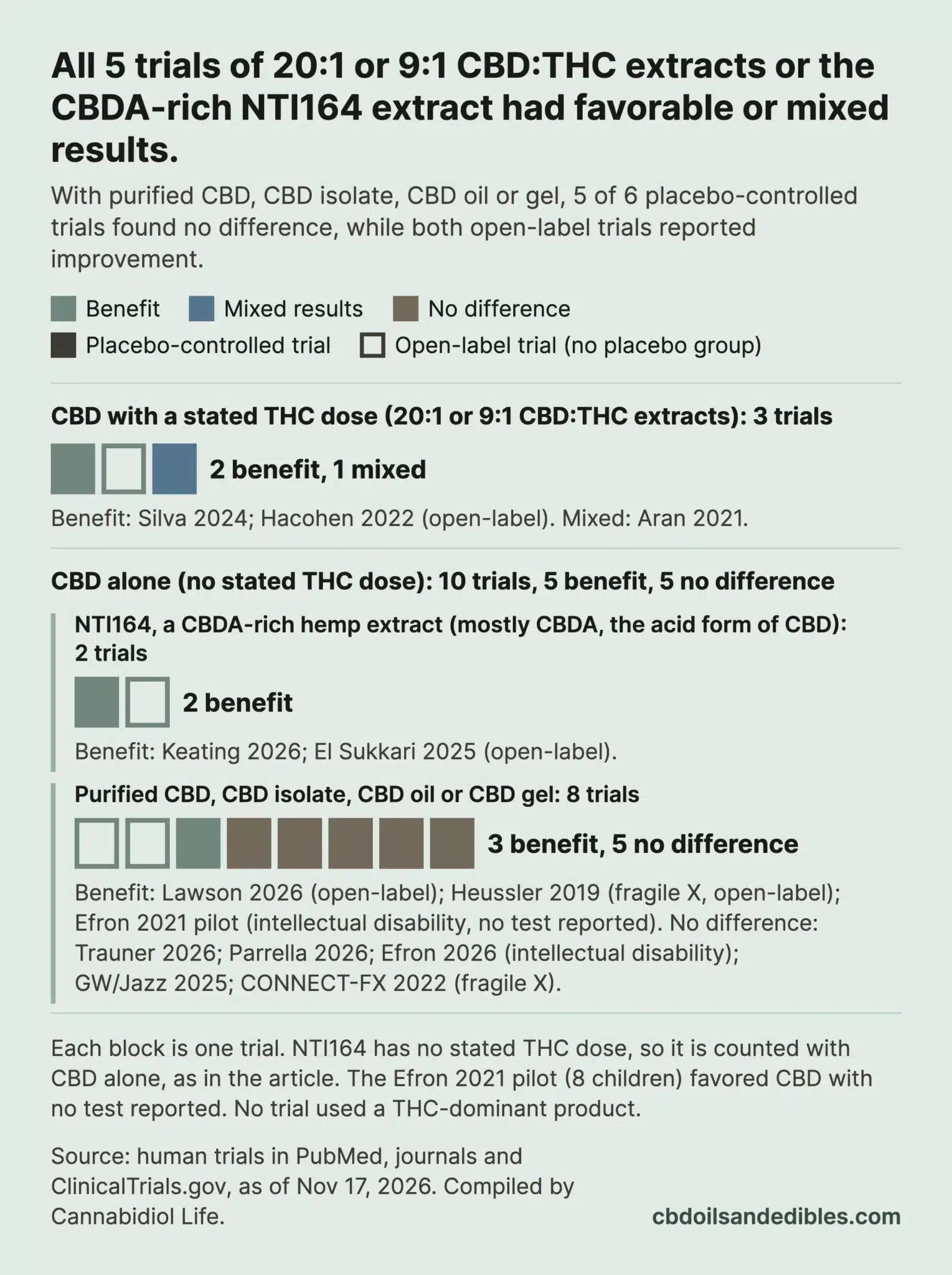
- All 5 trials of 20:1 or 9:1 CBD:THC extracts or NTI164, a CBDA-rich hemp extract (mostly CBDA, the acid form of CBD), had favorable or mixed results, including all 3 with a placebo group (Aran 2021; Silva 2024; Keating 2026).
- In the largest autism trial (150 people, ages 5 to 21), 49% on a 20:1 CBD:THC extract were much improved in disruptive behavior, more than twice the 21% on placebo (Aran 2021).
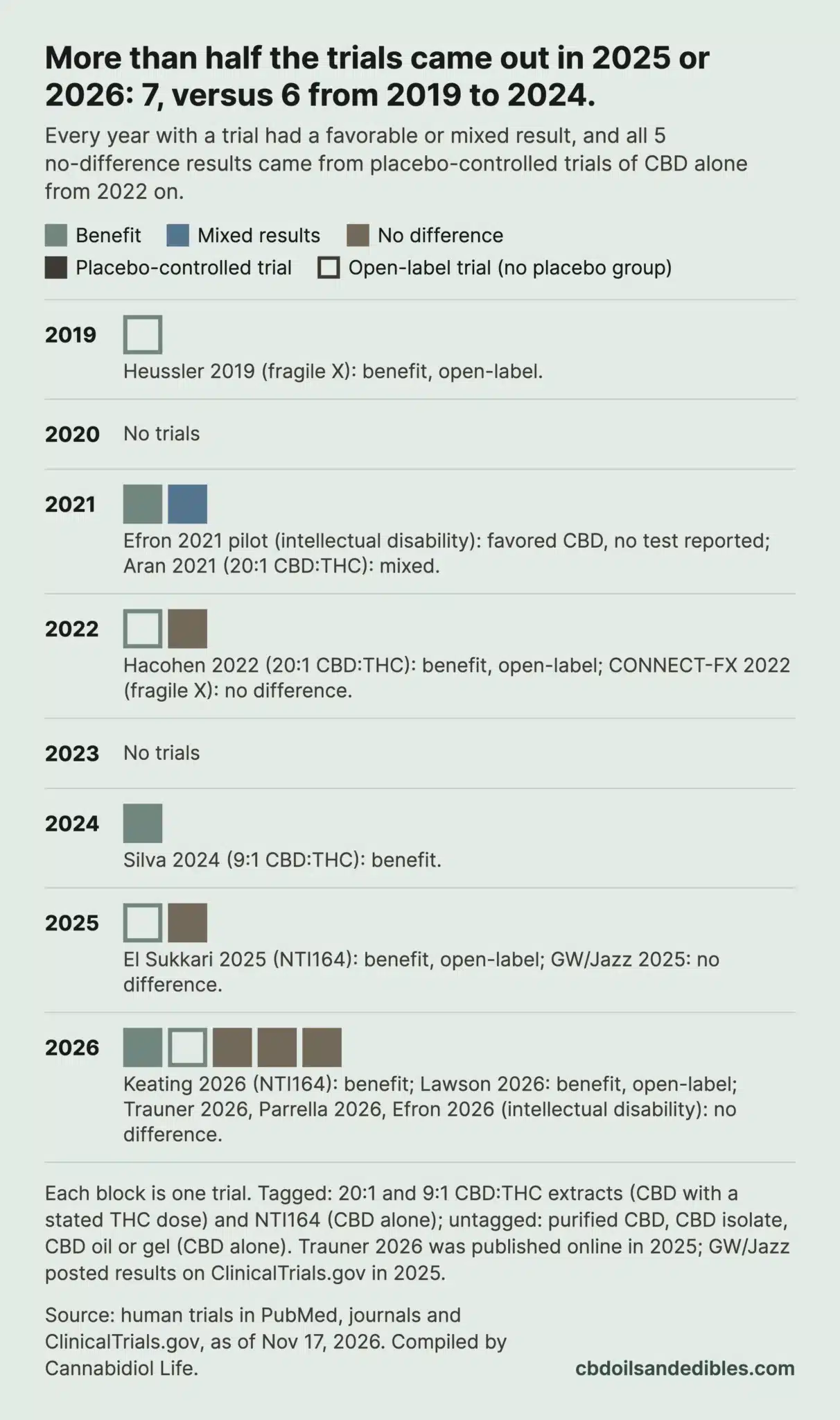
- Of 13 human trials in our review, 7 reported a benefit (1 a pilot with no test reported), 1 had mixed results and 5 found no difference; none found CBD worse (study table).
- 5 of 6 placebo-controlled trials of purified CBD, CBD isolate, CBD oil or a CBD gel found no difference on their main measure; the sixth, an 8-child pilot, favored CBD with no test reported (study table).
- Every trial enrolled children or teens (11 of 13 enrolled no one over 18), and no trial has tested CBD gummies (study table).
- Side effects in autism trials were mostly mild: on a 20:1 CBD:THC extract, sleepiness affected 28% vs 8% on placebo and lower appetite 25% vs 15% (Aran 2021).
Does CBD help with autism? What the research shows
Against placebo, a 20:1 CBD:THC extract improved disruptive behavior (Aran 2021), the CBDA-rich hemp extract NTI164 (mostly CBDA, the acid form of CBD) improved clinician-rated severity (Keating 2026), and a 9:1 CBD:THC extract improved caregiver-rated social interaction, anxiety and agitation (Silva 2024).
Open-label trials of a 20:1 extract, purified CBD and NTI164 reported improvement (Hacohen 2022; Lawson 2026; El Sukkari 2025).
Three placebo-controlled trials of CBD alone in autistic children did not meet their main goals, though two had favorable secondary results: blinded clinicians judged about 2 in 3 boys improved on CBD in Trauner 2026 (21 of 31 who completed, per the paper; published online in 2025; not a main measure, no test reported), and anxiety and social relating improved in Parrella 2026. The GW/Jazz trial (results posted on the registry, not in a journal) found no difference.
How the research has changed since 2019
Before 2020, there were no placebo-controlled symptom trials: four observational studies from Israel and Brazil and one open-label fragile X trial reported improvement in many participants, mostly with CBD-dominant oils that contained some THC (often 20:1). From 2020 to 2026, nine placebo-controlled trials followed. Extracts with a stated THC dose (20:1 and 9:1) and the CBDA-rich NTI164 extract had favorable or mixed results on their main measures, while five trials of CBD alone found no difference and an 8-child pilot favored CBD with no statistical test. Several trials saw large improvements on placebo too (Aran 2021; Trauner 2026).
CBD and autism studies: every human trial in our review
Our review found 13 human trials of CBD products that measured symptoms or behavior: 9 in autism and 4 in fragile X syndrome or intellectual disability. Each row names its product group: CBD alone, CBD with a stated THC dose, or THC-dominant (no trial used one).
| Study | Design | People | Product (group) and dose used | Length | Main result | Other results |
|---|---|---|---|---|---|---|
| Autism trials | ||||||
| Aran 2021 (with the Schnapp 2022 sleep analysis of the same trial) | Randomized, placebo-controlled, 3 arms, then crossover | 150 autistic children, teens and young adults, ages 5 to 21 | CBD with a stated THC dose: 20:1 CBD:THC whole-plant extract, up to 10 mg/kg CBD + 0.5 mg/kg THC a day (average 5.7 mg/kg CBD) | 12 weeks | Mixed: 49% much or very much improved in disruptive behavior (clinician-rated) vs 21% on placebo (p = 0.005); a parent questionnaire (HSQ-ASD) did not differ | Social responsiveness (SRS-2) improved 14.9 vs 3.6 points (p = 0.009); purified 20:1 arm 38% vs 21% (p = 0.08); sleep: no difference on any parent-rated sleep measure (Schnapp 2022) |
| Keating 2026 (NTI164) | Randomized, placebo-controlled | 61 children and teens with moderate to severe autism, ages 8 to 17 | CBD alone group (no stated THC dose): NTI164, a CBDA-rich hemp extract (mostly CBDA, the acid form of CBD; THC under 0.3%), 10 to 20 mg/kg a day | 8 weeks | Benefit: clinician-rated severity (CGI-S) improved vs placebo (difference -1.65 points, p < 0.001) | Vineland-3 communication (p = 0.047), daily living (p = 0.021) and socialization (p = 0.048) improved; SRS-2 total did not differ (p = 0.055); anxiety, depression and mood score (ADAMS) improved (p < 0.001); sleep did not differ (p = 0.214) |
| Silva 2024 | Randomized, placebo-controlled | 60 autistic children, ages 5 to 11 | CBD with a stated THC dose: CBD-rich extract, 9:1 CBD to THC, 6 to 70 drops a day (mg not stated in the paper; a 2026 sub-analysis estimated about 12 mg CBD a day) | 12 weeks | Benefit: caregiver-reported social interaction (p = 0.0002), anxiety (p = 0.016) and agitation (p = 0.003) improved | Rating scales ATEC (p = 0.098) and CARS (p = 0.188) did not differ; sleep: no significant difference (parent interview) |
| Trauner 2026 (UC San Diego; published online 2025) | Randomized, placebo-controlled crossover | 39 autistic boys with severe behavior problems, ages 7 to 14 (44 randomized) | CBD alone: Epidiolex (purified CBD), up to 20 mg/kg a day | 8 weeks per period | No difference: repetitive behavior (RBS-R, p = 0.095), behavior checklist (CBCL, p = 0.269) and ADOS-2 (p = 0.115); both groups improved | Blinded clinicians judged about 2 in 3 improved on CBD (21 of 31 who completed, per the paper; not a main measure, no test reported) |
| Parrella 2026 | Randomized, placebo-controlled crossover pilot | 29 autistic children who completed, ages 5 to 12 (34 enrolled) | CBD alone: CBD oil with terpenes, 10 mg/kg a day (no THC stated) | 12 weeks per period | No difference on social responsiveness (SRS-2, p = 0.125) | Anxiety (p = 0.002), social relating (p = 0.024) and parent stress (p = 0.044) improved on secondary measures (adjusted p-values) |
| GW/Jazz trial NCT04745026 (results posted on the registry, not in a journal; 2025) | Randomized, placebo-controlled | 103 autistic children and teens, ages 6 to 17 | CBD alone: purified CBD oral solution, 10 mg/kg a day | 12 weeks | No difference on irritability (ABC-I, p = 0.085) or any other main measure | Irritability scores fell in both groups (6.97 points on CBD, 8.57 on placebo) |
| Hacohen 2022 (Shamir Medical Center, Israel) | Open-label, no placebo group | 110 autistic children, teens and young adults, ages 5 to 25 (82 completed) | CBD with a stated THC dose: 20:1 CBD:THC extract (one drop = 5.7 mg CBD + 0.3 mg THC), up to 10 mg/kg CBD a day | 6 months | Benefit: social communication improved on ADOS-2 (p = 0.003), SRS (p = 0.043) and Vineland (p < 0.001) | No change in cognitive scores; larger gains in those with more severe symptoms at the start |
| Lawson 2026 (NYU) | Open-label dose-finding, no placebo group | 23 autistic children and teens, ages 7 to 17 | CBD alone: Epidiolex, 3, 6 or 9 mg/kg a day | 6 weeks | Benefit: 10 of 23 (44%) much improved on their chosen target symptom; 62% at 9 mg/kg a day | Responders by target: irritability and tantrums 60% (5 children), social 50% (8), anxiety 40% (5), restricted and repetitive behaviors 25% (4), sleep 0% (1) |
| El Sukkari 2025 (NTI164 open-label; journal not indexed in PubMed) | Open-label dose escalation, no placebo group | 14 autistic children and teens, ages 10 to 17 | CBD alone group (no stated THC dose): NTI164, a CBDA-rich hemp extract (mostly CBDA, the acid form of CBD; 0.08% THC), 5 rising to 20 mg/kg a day | 4 weeks | Benefit: 93% improved overall vs the start; targeted behavior much or very much improved in 46% | More than half of caregivers and participants reported less anxiety |
| Fragile X syndrome and related conditions | ||||||
| Heussler 2019 (FAB-C, fragile X) | Open-label, no placebo group | 20 children and teens with fragile X syndrome, ages 6 to 17 | CBD alone: synthetic CBD skin gel (ZYN002), 50 to 250 mg a day | 12 weeks | Benefit: anxiety, depression and mood score (ADAMS) fell (p < 0.001) | Nearly all other measures improved, including social avoidance and irritability |
| Berry-Kravis 2022 (CONNECT-FX, fragile X) | Randomized, placebo-controlled | 212 children and teens with fragile X syndrome, ages 3 to 17 | CBD alone: synthetic CBD skin gel (ZYN002), 250 or 500 mg a day | 12 weeks | No difference on social avoidance in the full group | In an ad hoc analysis of 169 children with at least 90% FMR1 methylation, social avoidance improved (nominal p = 0.020) |
| Efron 2021 (pilot, intellectual disability) | Randomized, placebo-controlled feasibility pilot | 8 children and teens with intellectual disability and severe behavior problems, ages 8 to 16 | CBD alone: 98% CBD oil, 20 mg/kg a day | 8 weeks | Favored CBD, no test reported: irritability (ABC-I) fell 12 points on CBD vs 2.5 on placebo | Main goal was feasibility, which was met: all 8 children completed |
| Efron 2026 (intellectual disability; 84% autistic) | Randomized, placebo-controlled | 131 children and teens with intellectual disability and severe behavior problems, ages 6 to 18; 84% also autistic | CBD alone: CBD isolate in oil, 10 mg/kg a day | 8 weeks | No difference on irritability (ABC-I 21.7 vs 19.2; difference 2.4, 95% CI -1.5 to 6.3) | None reported in the abstract |
Listed but not counted: Pretzsch 2019, a single-dose brain-chemistry study in men (see autistic adults), and Berry-Kravis 2025, an open-label safety extension of the skin-gel trials (see side effects).
Two papers on one trial are counted once; each trial’s funding is listed in the Sources.
What did trials find for irritability, aggression and disruptive behavior?
A 20:1 CBD:THC extract improved clinician-rated disruptive behavior vs placebo, though a parent questionnaire did not differ (Aran 2021), and 3 of 5 children targeting irritability and tantrums were much improved on purified CBD in an open-label trial (Lawson 2026). The 8-child Efron 2021 pilot of CBD alone in intellectual disability favored CBD (no test reported).
NTI164, a CBDA-rich hemp extract (mostly CBDA, the acid form of CBD), improved clinician-rated overall severity vs placebo, though that trial did not measure irritability (Keating 2026). In an observational study of a CBD oil with a stated THC dose, parents reported that self-injury and rage attacks improved in 67.6% of 34 children and worsened in 8.8% (Barchel 2019).
Irritability did not differ from placebo in the GW/Jazz trial of CBD alone or in Efron 2026 (CBD isolate, intellectual disability).
Hyperactivity and attention
Parents reported improved hyperactivity in 68.4% of 38 children on a CBD oil with a stated THC dose (Barchel 2019), and teacher-rated ADHD symptoms improved in 53 autistic children on the 20:1 extract in the Shamir open-label trial (Barchel 2026; same trial as Hacohen 2022, counted once). The hyperactivity subscale did not differ from placebo with purified CBD in the GW/Jazz trial (p = 0.305). For ADHD on its own, see CBD for ADHD.
Does CBD change social communication or other core autism traits?
Several trials measured core autism traits, with favorable results on some measures. Social communication improved with a 20:1 extract in the open-label Hacohen 2022 trial and on a secondary social-responsiveness scale in Aran 2021 (20:1), and caregiver-rated social interaction improved with a 9:1 extract in Silva 2024.
The CBDA-rich NTI164 extract improved Vineland-3 communication and socialization scores and two SRS-2 subscales, social cognition (p = 0.033) and restricted and repetitive behavior (p = 0.037), while the SRS-2 total did not differ (Keating 2026).
On CBD alone, SRS-2 (Parrella 2026’s main measure), the GW/Jazz Vineland-3 and the Trauner 2026 ADOS-2 did not differ from placebo.
For speech, the NTI164 trial’s communication domain improved (p = 0.047), while Silva 2024’s speech item (9:1 extract) and the GW/Jazz inappropriate-speech subscale (purified CBD) did not differ. No trial in our review made speech delay its main measure. The only sensory measure reported, the sensory and cognitive perception subscale of a symptom checklist (ATEC) in Silva 2024 (9:1 extract), did not differ from placebo (p = 0.212). The NYU open-label trial of purified CBD enrolled children with fluent speech and an IQ of 80 or above (Lawson 2026).
What did trials find for anxiety in autism?
Placebo-controlled trials found lower anxiety on some measures: with NTI164, a CBDA-rich hemp extract (mostly CBDA, the acid form of CBD; Keating 2026), with a CBD oil (CBD alone; Parrella 2026, a secondary measure) and with a 9:1 CBD:THC extract (Silva 2024, caregiver report).
In Keating 2026, the general anxiety score on a caregiver-rated mood scale (ADAMS) improved vs placebo (p < 0.0001), though the total of a second anxiety scale (ASC-ASD-P) did not differ (p = 0.056). In open-label studies, more than half of caregivers and participants reported less anxiety with the CBDA-rich NTI164 extract (El Sukkari 2025), and the anxiety, depression and mood score fell with a CBD gel in fragile X (Heussler 2019).
In an observational study of a CBD oil with a stated THC dose, parents reported that anxiety improved in 47.1% and worsened in 23.5% of 17 children (Barchel 2019). For anxiety outside autism, see CBD for anxiety.
Recent research has begun to explore the potential therapeutic effects of cannabis in people on the spectrum—with promising results.
Does CBD help autistic children sleep?
Parents reported better sleep in 71.4% of 21 children in an observational study of a CBD oil with a stated THC dose (Barchel 2019), and reviews of cannabinoid studies from 2020 and 2022 noted fewer sleep problems in mostly uncontrolled studies (Fusar-Poli 2020; Silva Junior 2022).
In placebo-controlled trials, Schnapp 2022 (the Aran 2021 trial, 20:1 extract) found no difference on any parent-rated sleep measure, Silva 2024 (9:1 extract) found no significant difference (parent interview), and sleep did not differ with NTI164, a CBDA-rich hemp extract (mostly CBDA, the acid form of CBD), in Keating 2026.
Parrella 2026 (CBD oil, CBD alone) also measured sleep, but its sleep result is not in the abstract or in free full text. A 2026 review of human studies, mostly of full-spectrum extracts, also found no between-group differences for sleep (Vasconcelos 2026). For sleep problems more broadly, see CBD for sleep.
CBD, seizures and autism
A 2024 paper notes that CBD is approved for epileptic syndromes often associated with autism (Manduca 2024); that is Epidiolex, the prescription CBD medicine named above. Some autism trials excluded children with epilepsy (Trauner 2026) or with refractory epilepsy (Silva 2024). Two observational studies of CBD-dominant extracts with a stated THC dose (75:1 and 20:1) reported seizure improvement in autistic people who also had epilepsy (Fleury-Teixeira 2019; Bar-Lev Schleider 2019). CBD interacts with some seizure medicines; see the safety section.
Fragile X syndrome and intellectual disability: what trials found
In fragile X syndrome (linked to the FMR1 gene), an open-label trial of a CBD skin gel reported improvement on nearly all measures (Heussler 2019), and in a 2022 survey most parents and caregivers agreed CBD improved some symptoms (Maertens 2022). The placebo-controlled CONNECT-FX trial of the same gel found no difference in social avoidance overall, with improvement in an ad hoc subgroup with at least 90% FMR1 methylation (Berry-Kravis 2022).
In intellectual disability, the 8-child Efron 2021 pilot of CBD alone favored CBD (no test reported), while the larger Efron 2026 trial of CBD isolate in 131 children and teens (84% autistic) found no difference on irritability.
What did trials in autistic children find, by age?
Trials in autistic children ages 5 to 17 found favorable results with 20:1 and 9:1 CBD:THC extracts and with NTI164, a CBDA-rich hemp extract (mostly CBDA, the acid form of CBD), while most placebo-controlled trials of CBD alone found no difference on their main measures.
No trial reported results by single year of age, so the closest evidence is the trials whose age range includes a child’s age:
- Under 5: no autism trial. A synthetic CBD skin gel (CBD alone) enrolled children with fragile X from age 3 and found no difference overall (CONNECT-FX).
- From age 5: a 20:1 CBD:THC extract, mixed results vs placebo (Aran 2021, ages 5 to 21) and a benefit in an open-label trial (Hacohen 2022, 5 to 25); a 9:1 CBD:THC extract, a benefit (Silva 2024, 5 to 11); a CBD oil with terpenes (CBD alone), no difference on its main measure (Parrella 2026, 5 to 12).
- From age 6 or 7: purified CBD (CBD alone), a benefit in the open-label Lawson 2026 (7 to 17); no difference in the GW/Jazz trial (6 to 17) and Trauner 2026 (boys, 7 to 14).
- From age 8 or 10: NTI164 (CBD-alone group), a benefit vs placebo (Keating 2026, 8 to 17) and in an open-label study (El Sukkari 2025, 10 to 17).
- Fragile X and intellectual disability, CBD alone: the skin gel, a benefit in an open-label trial (Heussler 2019, 6 to 17); CBD isolate, no difference (Efron 2026, 6 to 18); a 98% CBD oil, favored CBD with no test reported in an 8-child pilot (Efron 2021, 8 to 16).

No autism trial tested CBD gummies for autistic kids.
CBD products are not for children. Keep them out of reach of children and pets. If a child swallows a CBD or THC product, call Poison Control at 1-800-222-1222 or get medical care right away.
Is CBD safe or helpful for autistic adults?
No trial in our review enrolled only autistic adults, so CBD’s effects and safety have not been tested directly in this group. Two trials of a 20:1 CBD:THC extract included young adults: up to age 21 in Aran 2021 and up to 25 in Hacohen 2022, both with favorable results on some measures (see the study table).
In a single-dose study, 600 mg of CBD changed brain glutamate levels in both groups and moved GABA levels in opposite directions in 17 autistic and 17 non-autistic men; it measured brain chemistry, not symptoms (Pretzsch 2019).
The UK Medical Cannabis Registry reported better anxiety and sleep scores in autistic adults at 1 and 3 months (Erridge 2022) and over 18 months (Aggarwal 2026), with no control group and mostly THC-dominant products (2026 medians of about 192 mg THC and 26 mg CBD a day), so these are not CBD results. In app self-reports, 111 autistic adults using any cannabis rated symptoms 73% less severe after use (Karhson 2025), and autistic adults in a UK survey were more likely than others to have used CBD in the past year (odds ratio 3.52; Hua 2021).
No trial tested CBD gummies in autistic adults.
CBD alone vs whole-plant extracts with THC: what is the difference for autism?
In placebo-controlled trials, extracts with a stated THC dose (20:1 and 9:1) and NTI164, a CBDA-rich hemp extract (mostly CBDA, the acid form of CBD), had favorable or mixed results, while purified CBD, CBD isolate, a CBD oil with terpenes and a synthetic CBD gel mostly found no difference (counts by group below).
THC (tetrahydrocannabinol) is the intoxicating compound in cannabis. We sort trials into three groups: CBD alone (no THC dose stated, or THC-free), CBD with a stated THC dose (such as 20:1 or 9:1) and THC-dominant (about 2 parts THC to 1 part CBD or more, not a CBD result; no trial used one). NTI164 is a full-spectrum extract with a trace of THC (under 0.3% in its placebo-controlled trial, 0.08% in its open-label study), so it sits in the CBD-alone group.
By group, CBD with a stated THC dose was tested in 3 trials: 2 reported a benefit (Silva 2024, 9:1; Hacohen 2022, 20:1, open-label) and 1 had mixed results (Aran 2021, 20:1). CBD alone was tested in 10: 5 reported a benefit (the 2 NTI164 studies, 2 other open-label trials and an 8-child pilot with no statistical test) and 5 found no difference, all placebo-controlled.
There was clinically evident improvement with CBD in 2/3 of participants. A prominent placebo effect demonstrates the importance of placebo control in treatment studies.
No trial in our review compared the same extract with and without THC, so whether the small THC amounts matter is untested. In Aran 2021, a purified 20:1 product reached 38% responders vs 21% on placebo (p = 0.08). These trials do not answer questions about THC or medical marijuana for autism.
How might CBD work in autism?
Lab and animal studies suggest ways CBD could act, but they are not tests in autistic people. In animal models of autism, CBD improved repetitive behavior and social interaction, with effects that depended on dose, model and schedule (Vasconcelos 2026, a review of 9 animal studies). In a rat model of fragile X, CBD reversed memory problems (Manduca 2024).
Our guide to the endocannabinoid system explains how the body’s own cannabinoid signals work.
How much CBD was used in autism studies?
There is no official dose of CBD for autism, and research does not show what amount works for a given person. Placebo-controlled trials of oral CBD alone used 10 to 20 mg/kg a day of purified CBD, CBD isolate, CBD oil or NTI164, a CBDA-rich hemp extract (mostly CBDA, the acid form of CBD; Keating 2026).
Each trial’s dose is in the study table. Doses were raised in steps, for example from 1 mg/kg a day of the 20:1 extract in Aran 2021 and from 6 drops a day of the 9:1 extract in Silva 2024, up to 70 drops (a mean of about 12 mg CBD a day, an estimate in a 2026 sub-analysis; Medeiros 2026).
Higher whole-plant doses tracked better clinician ratings in Aran 2021 (rs = -0.29, p = 0.050), and higher CBD doses tracked better clinician ratings in Lawson 2026 (r = -0.42, p = 0.04); in Hacohen 2022, the final dose was not linked to change. Doses were taken under the tongue when possible in Aran 2021, and no trial tested inhaled CBD. Epidiolex’s seizure-label doses are not autism doses.
These are the amounts researchers used in studies. They are not dosing advice.
Observational studies and surveys: what families and clinics reported
These studies of autism and CBD had no placebo group, and most relied on parent reports. Studies without a comparison group cannot separate CBD’s effect from other changes over time. All 9 studies reported improvement in some participants, mostly with CBD-rich extracts that contained some THC; each is listed in the appendix table.
Surveys and health records show how common use is: 31.3% of 518 US parents of children with ADHD, autism and/or anxiety had given a child an unlicensed CBD product (conditions combined; Schwaller 2023), and 1.2% of 36,610 autistic people in an Israeli health plan were prescribed medical cannabis (Sadeh 2026).
What do systematic reviews conclude?
Systematic reviews from 2020 to 2026 report favorable signals in autism, such as fewer behavior problems and better social responsiveness, anxiety or sleep, many pooling CBD-rich extracts with some THC. Most of these reviews describe the evidence as limited or of low certainty.
The reviews are a selection and pool the trials above; the appendix table lists each, newest first, with what it pooled and its limit.
What do medical and autism organizations say about CBD?
Autism Speaks wrote in August 2024 that preliminary research suggests cannabis may offer relief for some conditions associated with autism, such as severe behaviors, irritability and anxiety; that larger, more rigorous trials are needed; and that families should talk with a healthcare provider first.
The American Academy of Child and Adolescent Psychiatry (AACAP) recommended in May 2019 against medical marijuana or isolated cannabinoids for core autism symptoms or co-occurring problems in children and teens, saying there was no scientific evidence of efficacy at that time. Its statement predates the randomized trials published from 2021 to 2026. In October 2019, the FDA and the Federal Trade Commission warned a company for marketing CBD with unsubstantiated claims to treat autism (FDA CBD page).
Our data: CBD for autism by the numbers (November 2026)
We computed these figures ourselves; the method and sources follow the list.
- 7 of 13 human trials reported a benefit (1 a pilot with no test reported) and 1 had mixed results; none found CBD worse (study table).
- All 5 trials of 20:1 or 9:1 CBD:THC extracts or CBDA-rich NTI164 had favorable or mixed results, including all 3 with a placebo group (study table).
- In the largest autism trial (150 people), 49% on a 20:1 CBD:THC extract were much improved in disruptive behavior, 2.3 times the 21% on placebo (Aran 2021).
- All 9 placebo-controlled trials came out in 2021 or later, and more than half of the 13 trials (7) in 2025 or 2026 (study table).
- PubMed lists 169 papers on CBD with autism or fragile X, and yearly papers doubled from 16 in 2019 to 32 in 2025 (PubMed search).
- ClinicalTrials.gov lists 21 registered studies of CBD products for autism (16) or fragile X (5); 5 include a stated THC dose (ClinicalTrials.gov search).
- 7 registered studies that are recruiting or not yet recruiting aim to enroll 576 more people, the largest a 200-person NTI164 trial (NCT07257939).
- Completed interventional studies enrolled 989 people; 3 of the 10 completed (30%) have posted results on ClinicalTrials.gov (ClinicalTrials.gov search).
- 11 of 13 trials enrolled no one over 18; the other 2 included young adults up to 21 and 25 (study table).
- No trial tested CBD gummies: 11 of 13 gave CBD by mouth (oils or oral solutions), and 2 used a skin gel (study table).
- US searches for ‘cbd for autism’ averaged 235 a month in the 12 months to October 2026, 71.8% below the 2019 average of 833 (Ahrefs Keywords Explorer, US, pulled November 17, 2026).
- 5 of 6 placebo-controlled trials of CBD alone (other than NTI164) found no difference; the sixth, an 8-child pilot, favored CBD with no test reported (study table).
Still to report: two trials past their primary completion date have no posted results or journal paper yet: RECONNECT, a Phase 3 fragile X trial of a CBD skin gel, whose maker announced on September 24, 2025 that it did not meet its main goal, citing a higher-than-expected placebo response; and the 86-person CASCADE autism trial (primary completion January 2024).

How we computed this: Cannabidiol Life computed these figures on November 17, 2026 from the 13 human trials in our study table (each checked against PubMed, the publisher or ClinicalTrials.gov), ClinicalTrials.gov (five searches, every record read) and PubMed title-and-abstract counts, plus US search volumes from Ahrefs. Registered studies are counted once each; enrollment counts are not unique people. The 3 NTI164 registry entries are counted because the NTI164 papers state the extract contains CBD; the entries themselves do not name CBD. PubMed tags 12 of the 169 papers as randomized controlled trials (a count of papers, not trials) and 14 as systematic reviews or meta-analyses. (reproduce the registry search)
The number of registered studies shows research interest, not whether CBD works.
Cite this data: Cannabidiol Life, “CBD for Autism by the Numbers (November 2026),” Our data, cbdoilsandedibles.com, https://cbdoilsandedibles.com/health/cbd-for-autism/, data as of November 17, 2026 (study table, ClinicalTrials.gov, PubMed, Ahrefs).
Is CBD safe for autistic children and adults? Side effects and medicine interactions
Side effects in autism trials were mostly mild, most often sleepiness and lower appetite. Liver effects and medicine interactions matter most at prescription doses and with seizure medicines, and long-term data in autism are limited: autism trials lasted up to 6 months.
Talk to your doctor, or your child’s doctor, before using CBD, especially if you or your child take any medicines or supplements, have liver problems, or have a health condition.
Can CBD be taken with risperidone or aripiprazole?
Risperidone and aripiprazole are the FDA-approved medicines for autism-related irritability (Aran 2021; Keating 2026). No autism study in our review measured how CBD changes their levels. In 81 children taking a 20:1 CBD:THC oil, safety and CBD blood levels were similar whether they took it with other medicines or alone (Treves 2026).
In children on a 20:1 oil, blood tests did not differ between 14 on other medicines and 45 without, apart from a potassium change (Stolar 2022), and boys on purified CBD who took behavior medicines had lower CBD blood levels, not statistically significant (Trauner 2026).
Valproate, clobazam and other seizure medicines
At prescription seizure doses (10 to 20 mg/kg a day), the Epidiolex label reports the liver enzyme ALT above 3 times normal in 13% vs 1% on placebo, and in 21% of patients also taking valproate (without clobazam) vs 3% on neither. Clobazam’s active metabolite rises about 3-fold, and CBD moderately inhibits the liver enzyme CYP2C19 and affects others. At lower autism-study doses, liver tests stayed normal in Silva 2024 (9:1 extract), in Lawson 2026 (purified CBD, 3 to 9 mg/kg a day) and in 59 children on a mean 7.88 mg/kg a day of 20:1 oil (Stolar 2022). In healthy adults on 5 mg/kg a day, 5.6% vs 0% had liver enzymes above 3 times normal within 4 weeks (Florian 2025).
CBD can affect how other medicines work, which can cause serious side effects. Using CBD with alcohol or with medicines that cause drowsiness, such as some medicines for anxiety, panic, stress or sleep, raises the risk of sleepiness and injury. Ask your doctor or pharmacist before combining CBD with any medicine or supplement. (FDA)
Side effects in autism trials
In Aran 2021 (20:1 extracts, average 5.7 mg/kg a day), sleepiness occurred in 28% on the whole-plant extract and 23% on the purified extract vs 8% on placebo, and lower appetite in 25% and 21% vs 15%. With NTI164, a CBDA-rich hemp extract (mostly CBDA, the acid form of CBD), 26 participants had 41 mild adverse events, most often nausea, headache, stomach pain and anxiety; 7 stopped, 4 because of the taste (Keating 2026). With Epidiolex (purified CBD) up to 20 mg/kg a day, there were 59 adverse events on CBD vs 49 on placebo and no ECG changes (Trauner 2026).
With the skin gel, application-site pain occurred in 6.4% vs 1.0% on placebo (CONNECT-FX), and over a mean 28 months, treatment-related side effects occurred in 12.9% (Berry-Kravis 2025). Diarrhea is among the most common reactions on the Epidiolex label.
Behavior changes and stopping
In the Shamir open-label trial, 12 of 110 stopped the 20:1 oil because of side effects: 5 for increased aggression, 3 for increased anxiety, and 1 each for weight gain, stomach pain, more hyperactivity and less communication (Hacohen 2022). With THC-containing products, one girl using higher THC had a brief serious psychotic episode (Aran 2019, chart review), and three young autistic men developed mania or psychosis after regular CBD and THC use (Al-Soleiti 2022, case series).
Heart rhythm and mood checks in the largest CBD-alone autism trial
In the GW/Jazz trial at 10 mg/kg a day (results posted on the registry, not in a journal; 49 on CBD, 54 on placebo), a heart-rhythm measure (QTcB) was above 450 ms in 7 vs 4, above 480 ms in 2 vs 0 and above 500 ms in 1 vs 0. On a suicidal-thoughts rating scale (C-SSRS), 4 vs 3 reported suicidal thoughts, and 3 vs 6 had self-harm behavior (the 3 on CBD were self-injury without suicidal intent). One serious event of suicidal thoughts occurred on CBD; no serious event was judged treatment-related. The Epidiolex label says to watch for suicidal thoughts, as with other seizure medicines.
If you are in crisis or thinking about harming yourself, call or text 988 to reach the 988 Suicide & Crisis Lifeline. In an emergency, call 911.
Who should avoid CBD
Do not use CBD if you are pregnant, planning a pregnancy or breastfeeding. The FDA strongly advises against using CBD, THC or marijuana in any form during pregnancy or while breastfeeding. (FDA) A 2024 meta-analysis of observational studies linked cannabis use in pregnancy, not CBD specifically, with autism in children (RR 1.30, 95% CI 1.03 to 1.64; Tadesse 2024). For children, see the section on ages above.
What should you look for in a CBD oil for autism?
No study has compared CBD brands for autism. If you look at a CBD oil, check for a certificate of analysis (COA) from an accredited third-party lab; our 5-point checklist shows how to read a COA and match it to the batch number on the bottle.
Caregivers, understandably seeking to help their child with Autism Spectrum Disorder, may turn to marijuana or cannabinoids in the context of unsubstantiated or distorted claims of efficacy and safety.
The products in the trials were specific formulations: purified CBD, CBD isolate, a CBD oil with terpenes, a synthetic CBD skin gel, a CBDA-rich hemp extract (mostly CBDA, the acid form of CBD; NTI164), and 20:1 and 9:1 extracts. Results from one product do not carry over to another. Hemp seed oil is not CBD oil: the seeds do not naturally contain CBD (FDA).
Our side-by-side chart of CBD isolate vs full-spectrum and broad-spectrum CBD shows how the three product types differ. A separate explainer on the entourage effect covers the idea that hemp compounds may work better together than CBD alone.
Is CBD legal?
Federal law is changing. Under the 2018 Farm Bill definition, hemp (including hemp-derived CBD) is cannabis with no more than 0.3% delta-9 THC by dry weight, and it is not a controlled substance. A new federal definition applies in two steps (section 781 of Public Law 119-37, with start dates set by Public Law 119-103). Since November 12, 2026, hemp products that contain cannabinoids the plant cannot produce naturally no longer count as hemp. Starting December 11, 2026, the rest of the definition applies. It counts total THC, including THCA, and a finished hemp product such as a CBD oil or gummy qualifies as hemp only if each container holds no more than 0.4 mg of total THC and similar cannabinoids, and contains no cannabinoids that were synthesized or manufactured outside the plant. Some full-spectrum CBD products contain more THC than that. State laws differ and can be stricter. This is general information, not legal advice.
Frequently asked questions
Can CBD help an autistic child?
In placebo-controlled trials in young people, a 20:1 CBD:THC extract improved clinician-rated disruptive behavior (Aran 2021), a 9:1 CBD:THC extract improved caregiver-rated social interaction, anxiety and agitation (Silva 2024), and a CBDA-rich hemp extract (mostly CBDA, the acid form of CBD) improved clinician-rated severity (Keating 2026). Most placebo-controlled trials of CBD alone found no difference on their main measures.
Is CBD safe for children with autism?
Trials in children lasted up to 6 months, and a skin-gel safety extension ran 28 months on average. Side effects were mostly mild, most often sleepiness and lower appetite. Liver effects and interactions matter most with seizure medicines. See the safety section above for behavior changes, heart-rhythm checks and medicines studied with CBD.
Is CBD safe for autistic adults?
No trial in our review enrolled only autistic adults, so safety has not been tested directly in this group. Trials of a 20:1 CBD:THC extract that included young adults up to ages 21 and 25 reported mostly mild side effects. In adults generally, CBD can raise liver enzymes and interact with medicines, and it should be avoided in pregnancy.
Can CBD help with aggression in autism?
Clinician-rated disruptive behavior improved with a 20:1 CBD:THC extract (Aran 2021), and parents reported improvement in self-injury and rage attacks in an observational study of a CBD oil with a stated THC dose (Barchel 2019). Irritability did not differ from placebo in two larger trials of CBD alone (GW/Jazz; Efron 2026). Behavior changes are covered in the safety section.
Does CBD help with speech in autistic children?
Communication scores improved on a secondary measure with the CBDA-rich NTI164 extract (Keating 2026), and social communication improved in an open-label trial of a 20:1 CBD:THC extract (Hacohen 2022). Silva 2024’s speech item (9:1 extract) and the GW/Jazz speech subscale (purified CBD) did not differ. No trial made speech delay its main measure.
Is CBD the same as THC or medical marijuana for autism?
No. CBD is non-intoxicating, and THC is the intoxicating compound in cannabis. Some autism trials used CBD-dominant extracts with a small stated THC dose (20:1 or 9:1), and none used a THC-dominant product. Medical marijuana products can be THC-dominant, like most products in the UK registry.
How long did CBD take to work in autism studies?
Trials measured results after 4 weeks to 6 months, most often at 8 or 12 weeks. With the CBDA-rich NTI164 extract, the paper describes separation from placebo by week 4; its statistical test was at week 8 (Keating 2026). No study reported a minimum time to effect, and several trials found no difference from placebo at their final measurement.
The bottom line on CBD for autism
Extracts with a stated THC dose (20:1 or 9:1 CBD:THC) and NTI164, a CBDA-rich hemp extract (mostly CBDA, the acid form of CBD), had favorable or mixed results, including in the largest autism trial, where 49% were much improved in disruptive behavior vs 21% on placebo. Most placebo-controlled trials of purified CBD, CBD isolate, CBD oil or gel found no difference on their main measures, though some found favorable secondary results. Every trial so far enrolled children or teens, and more trials are registered, including a planned 200-person trial of NTI164.
Important safety and legal information
This information is for educational purposes only and is not a substitute for professional medical advice, diagnosis, or treatment. Always seek the advice of your physician or other qualified health provider with any questions you may have about a medical condition.
These statements have not been evaluated by the Food and Drug Administration. Hemp-derived CBD products are not intended to diagnose, treat, cure, or prevent any disease.
For side effects, medicine interactions, children and pregnancy, see the safety section above.
How we researched this
We do not sell or recommend products on this page. Every study cited was checked at PubMed or the publisher. Figures in Our data show the date and source used.
For this review of CBD oil and autism, we searched PubMed, ClinicalTrials.gov and Cannabidiol Life’s research library of 5,446 PubMed studies, which holds 108 CBD studies that mention autism or fragile X, on November 17, 2026. An independent reviewer checked every trial row against PubMed, the full text or the registry. Every human trial that met our rules is in the study table, and the reviews shown are a selection. We will update this page on January 1, 2027, with re-run data. For other conditions, see CBD research by health condition.
Appendix: selected systematic reviews
| Review | What it pooled | Favorable finding | Its limit |
|---|---|---|---|
| Wilson 2026, Lancet Psychiatry (systematic review and meta-analysis) | Any cannabinoid across mental health conditions; for autism, 2 trials, both combined THC and CBD (per its June 2026 correction), none of CBD alone | Autistic traits fell vs placebo (SMD -0.36, 95% CI -0.66 to -0.07) | Generally low-quality evidence; cannabinoids raised overall side effects |
| Boeri 2026 (systematic review) | CBD, CBDV, THC or combinations in autism, fragile X and Rett syndrome; 17 studies, 2 randomized | Behavioral improvements in autism and fragile X | Mostly non-randomized studies; evidence insufficient for routine use |
| Vasconcelos 2026 (systematic review) | Mostly full-spectrum extracts, often 20:1 CBD:THC; 12 studies, 4 randomized | A 20:1 extract improved global clinical impression and social communication in one trial | Other outcomes null, including sleep; very low certainty for non-randomized studies |
| Riera 2025 (systematic review of randomized trials) | Any cannabis derivative; 4 trials with results in children and teens | Whole-plant extract may improve global symptom ratings | Very low to low certainty |
| Pereira 2025, Cureus (systematic review) | CBD-rich products, mostly with THC; 7 studies, 494 patients | Modest benefits for sleep, social interaction and anxiety | Responses inconsistent; larger controlled trials needed |
| Kock 2024 (meta-analysis of placebo-controlled trials) | Cannabinoids in 8 trials, ages 0 to 25, several conditions | Autism showed the most consistent effect (Hedges’ g = 0.264) | Small effect; 5 of 8 trials at high risk of bias |
| Jawed 2024 (systematic review) | CBD-rich cannabis, often with trace THC; 4 studies, 353 people | Better behavior, social responsiveness and communication | Few, varied studies; some stopped for increased aggression |
| Ibsen 2024 (systematic review) | Cannabinoids; 5 studies (2 randomized) on core symptoms | All 5 reported an effect; one improved all three core symptoms | Most effects not significant; high risk of bias in 4 of 5; effect on core symptoms not clear |
| Doucette 2024 (systematic review, pediatric) | Plant-derived medical cannabis, mostly CBD:THC products; 4 autism studies | Both randomized trials improved validated autism measures | Few studies |
| Watkins 2024 (systematic review, fragile X) | All drug classes in fragile X; 16 randomized trials | Cannabinoid data encouraging in fragile X | Limited data for any specific drug |
| Parrella 2023 (systematic review of CBD trials) | 9 CBD trials, with or without THC, across neurodevelopmental conditions | Several trials suggest potential efficacy | Too inconsistent to guide use |
| Silva Junior 2022 (systematic review) | Cannabis and cannabinoid products; 9 studies | Fewer or milder symptoms such as hyperactivity, self-harm, sleep problems, anxiety and agitation in some studies | Mostly observational |
| Fusar-Poli 2020 (systematic review) | Cannabinoids; 10 studies plus 4 ongoing | Improved problem behaviors, sleep and hyperactivity; fewer prescribed medicines | Mostly uncontrolled studies, before the randomized trials |
| Khan 2020 (systematic review) | CBD and nabiximols (about equal THC and CBD) across psychiatric conditions | Moderate (grade B) support for autism-related problems | Includes case reports and series; predates the 2021-2026 trials |
Appendix: observational studies of CBD products in autism
| Study | Type | People | Product | What was reported |
|---|---|---|---|---|
| Aran 2019 | retrospective chart review, Israel | 60 children, ages 5 to 17 | CBD-rich cannabis with a stated THC dose (20:1 CBD:THC, 6:1 in poor responders, per the 2020 and 2022 reviews) | Behavioral outbreaks much or very much improved in 61% |
| Barchel 2019 | parent-report follow-up, Israel | 53 children and young people, ages 4 to 22 | CBD oil with a stated THC dose (median 90 mg CBD + 7 mg THC a day) | Improved self-injury and rage (67.6%), hyperactivity (68.4%), sleep (71.4%) and anxiety (47.1%; worse in 23.5%) |
| Bar-Lev Schleider 2019 | treatment-program registry, Israel | 188 patients (93 assessed at 6 months) | CBD oil with a stated THC dose (30% CBD, 1.5% THC; 20:1) | At 6 months, 30.1% reported significant and 53.7% moderate improvement |
| Fleury-Teixeira 2019 | compassionate-use cohort, Brazil | 18 (15 kept taking it) | CBD-enriched extract with a stated THC dose (75:1), capsules | All but 1 of the 15 showed improvement in autism symptoms; 3 stopped for side effects in the first month |
| Bilge 2021 | single-clinic experience, Turkey | 33 children, mean age 7.7 | Full-spectrum CBD with trace THC, mean 0.7 mg/kg a day | Parents reported fewer behavioral problems in 32.2% |
| Montagner 2023 | retrospective case series, Brazil | 20 | Full-spectrum extracts, CBD-rich, some with added THC-rich extract | 18 of 20 improved in most core and co-occurring symptoms |
| Mazza 2024 | retrospective cohort, Brazil | 30 children and teens with moderate to severe autism, ages 5 to 18 | CBD-dominant full-spectrum extract with a stated THC dose (33:1 CBD:THC), average final dose 3.11 mg/kg a day of CBD | Clinician ratings showed overall improvement in all 30 after about 6 months; 20 of 27 taking other medicines reduced or stopped at least one; 2 stopped early for side effects |
| Fortini 2025 | before-and-after study, Argentina | 20 children with severe autism and intellectual disability | Purified CBD added to usual medicines | 18 of 20 improved in at least one parent-reported symptom; other medicines reduced in 40%; side effects in 65% (mainly irritability, lower appetite; all mild or moderate and short-lived) |
| Guimaraes 2025 | real-life cohort with an untreated group, Brazil | 16 treated, 17 untreated | CBD-rich extract | Internalizing behavior problems (Vineland-3) fell at 3 months (p = 0.008); groups differed at the start |
Sources
Show the source list
- Aran A, Harel M, Cassuto H, Polyansky L, Schnapp A, Wattad N, et al. Cannabinoid treatment for autism: a proof-of-concept randomized trial. Mol Autism. 2021;12(1):6. PubMed 33536055; PMC7860205; doi:10.1186/s13229-021-00420-2. Funding and interests: BOL Pharma (product maker) and the National Institute for Psychobiology in Israel; Aran and Castellanos report fees and stock options from BOL Pharma.
- Schnapp A, et al. Sleep results of the same trial (Biomedicines, 2022). PubMed 35884990.
- Keating BA, Ogru Y, Isikgel E, Sharma K, El-Sukkari D, Fahey MC. NTI164, a novel medicinal cannabis extract, improves core symptoms of autism spectrum disorder: Results from a double-blind, randomised, controlled trial (The Harmony study). Neurotherapeutics. 2026;23(5):e01033. PubMed 42561512; PMC13474237; doi:10.1016/j.neurot.2026.e01033. Funding and interests: Fenix Innovation Group and Neurotech International (sponsors; NTI164 owner); authors report financial support from Fenix and consulting/equity ties to Neurotech.
- El Sukkari D, Sharma K, Fleiss B, Braganza DL, Keating BA, Ogru Y, et al. Safety and efficacy of orally administered full-spectrum medicinal cannabis plant extract 0.08% THC (NTI164) in children with autism spectrum disorder (open-label). Adv Complement Alt Med. 2025;8(4). DOI 10.31031/ACAM.2025.08.000693. Funding and interests: Commercially funded by Fenix Innovation Group and Neurotech International; corresponding author at Fenix Innovation Group (publisher full text, read 2026-11-17).
- Jazz Pharmaceuticals (GW Research). Trial of cannabidiol oral solution (GWP42003-P) in children and adolescents with autism spectrum disorder; results posted on ClinicalTrials.gov, not published in a journal. NCT04745026. Funding and interests: Sponsor: Jazz Pharmaceuticals (GW Research).
- Silva EAD, Medeiros WMB, Santos JPMD, Sousa JMM, Costa FBD, Pontes KM, et al. Evaluation of the efficacy and safety of cannabidiol-rich cannabis extract in children with autism spectrum disorder: randomized, double-blind, and placebo-controlled clinical trial. Trends Psychiatry Psychother. 2024;46:e20210396. PubMed 35617670; PMC11332686; doi:10.47626/2237-6089-2021-0396. Funding and interests: Not stated in the abstract; extract donated by the patient association ABRACE (full text); authors declare no conflicts.
- Medeiros WMB, et al. Post hoc sub-analysis of the same trial, with the dose estimate (Autism Res, 2026). PubMed 42644517.
- Trauner D, Umlauf A, Grelotti DJ, Fitzgerald R, Hannawi A, Marcotte TD, et al. Cannabidiol (CBD) Treatment for Severe Problem Behaviors in Autistic Boys: A Randomized Clinical Trial. J Autism Dev Disord. 2026;56(11):4362-4375. PubMed 40410546; PMC12885472; doi:10.1007/s10803-025-06884-y. Funding and interests: Ray and Tye Noorda Foundation and Wholistic Foundation; NIH grant UL1TR001442; GW Pharmaceuticals (now Jazz) supplied Epidiolex and placebo with no role; authors report no relevant interests.
- Parrella NF, Hill AT, Enticott PG, Botha T, Catchlove S, Downey L, et al. Effects of Cannabidiol on Social Relating, Anxiety, and Parental Stress in Autistic Children: A Randomized Controlled Crossover Trial. Autism Res. 2026;19(2):e70159. PubMed 41452412; doi:10.1002/aur.70159. Funding and interests: Investigator-initiated; no external funding; CBD oil and placebo oil supplied in kind by Medigrowth Australia; all authors declare no conflicts (published correction, Autism Res 2026 e70380, PMID 42861636, which corrects only the Funding and Conflict of Interest statements; read at Wiley 2026-11-17).
- Hacohen M, Stolar OE, Berkovitch M, Elkana O, Kohn E, Hazan A, et al. Children and adolescents with ASD treated with CBD-rich cannabis exhibit significant improvements particularly in social symptoms: an open label study. Transl Psychiatry. 2022;12(1):375. PubMed 36085294; PMC9461457; doi:10.1038/s41398-022-02104-8. Funding and interests: Research Support, Non-U.S. Gov’t (PubMed); authors declare no competing interests.
- Stolar OE, et al. Biochemical safety analysis of the same trial (Front Pharmacol, 2022). PubMed 36249785.
- Treves N, et al. Add-on vs monotherapy analysis of the same trial (J Psychopharmacol, 2026). PubMed 40613426.
- Barchel D, et al. Teacher-rated ADHD symptoms in the same trial (Curr Neuropharmacol, 2026). PubMed 41503912.
- Lawson J, Robinson L, Conlon GR, Shalev RA, Cervantes PE, Yoncheva Y, et al. A Phase-2 Open-Label Trial of Cannabidiol to Treat Core and Associated Symptoms of Autism in Children and Adolescents Without Intellectual Disability. J Child Adolesc Psychopharmacol. 2026;36(6):350-358. PubMed 42204954; doi:10.1177/10445463261452514. Funding and interests: Not stated in the abstract; no conflicts of interest.
- Heussler H, Cohen J, Silove N, Tich N, Bonn-Miller MO, Du W, et al. A phase 1/2, open-label assessment of the safety, tolerability, and efficacy of transdermal cannabidiol (ZYN002) for the treatment of pediatric fragile X syndrome. J Neurodev Disord. 2019;11(1):16. PubMed 31370779; PMC6676516; doi:10.1186/s11689-019-9277-x. Funding and interests: Zynerba Pharmaceuticals (several authors employees or consultants).
- Berry-Kravis E, Hagerman R, Budimirovic D, Erickson C, Heussler H, Tartaglia N, et al. A randomized, controlled trial of ZYN002 cannabidiol transdermal gel in children and adolescents with fragile X syndrome (CONNECT-FX). J Neurodev Disord. 2022;14(1):56. PubMed 36434514; PMC9700889; doi:10.1186/s11689-022-09466-6. Funding and interests: Zynerba Pharmaceuticals; several authors are Zynerba investigators, advisors, consultants or employees.
- Efron D, Freeman JL, Cranswick N, Payne JM, Mulraney M, Prakash C, et al. A pilot randomised placebo-controlled trial of cannabidiol to reduce severe behavioural problems in children and adolescents with intellectual disability. Br J Clin Pharmacol. 2021;87(2):436-446. PubMed 32478863; doi:10.1111/bcp.14399. Funding and interests: Internal MCRI grant; CBD and placebo supplied in kind by Tilray, which had no role in the study; no competing interests (full text).
- Efron D, Taylor K, Freeman JL, Cranswick NE, Elliott EJ, Payne JM, et al. Cannabidiol for Severe Behavioral Problems in Youths With Intellectual Disability: A Randomized Clinical Trial. JAMA Pediatr. Published online November 16, 2026. PubMed 43037991; doi:10.1001/jamapediatrics.2026.5152. Funding and interests: Not in the abstract (registry sponsor Murdoch Children’s Research Institute).
- Pretzsch CM, Freyberg J, Voinescu B, Lythgoe D, Horder J, Mendez MA, et al. Effects of cannabidiol on brain excitation and inhibition systems; a randomised placebo-controlled single dose trial during magnetic resonance spectroscopy in adults with and without autism spectrum disorder. Neuropsychopharmacology. 2019;44(8):1398-1405. PubMed 30758329; PMC6784992; doi:10.1038/s41386-019-0333-8. Funding and interests: Medical Research Council, NIMH, NICHD (PubMed grants).
- Berry-Kravis E, Hagerman R, Cohen J, Budimirovic D, Buchanan CB, Silove N, et al. Long-term safety and tolerability of transdermal cannabidiol gel in children and adolescents with Fragile X syndrome (ZYN2-CL-017): an interim analysis of an ongoing open-label extension study. J Neurodev Disord. 2025;17(1):69. PubMed 41254489; PMC12625530; doi:10.1186/s11689-025-09657-x. Funding and interests: Zynerba/Harmony Biosciences (authors funded).
- Wilson J, Dobson O, Langcake A, Mishra P, Bryant Z, Leung J, et al. The efficacy and safety of cannabinoids for the treatment of mental disorders and substance use disorders: a systematic review and meta-analysis. Lancet Psychiatry. 2026;13(4):304-315. PubMed 41856154; doi:10.1016/S2215-0366(26)00015-5. Correction: PubMed 42302809 (June 2026).
- Boeri S, Bosisio L, Prato G, Martinez Popple M, De Grandis E, Striano P, et al. Efficacy and Safety of Cannabinoid-Based Products in Children and Adolescents with Autism Spectrum Disorder, Fragile X Syndrome and Rett Syndrome: A Systematic Review. J Child Adolesc Psychopharmacol. 2026;36(7):393-404. PubMed 42339654; doi:10.1177/10445463261462382.
- Vasconcelos QDJS, de Freitas RF, Freitas MC, de Andrade IP, Brandão CB, Nascimento CE, et al. Cannabinoid-based interventions for behavioral outcomes in children and adolescents with autism spectrum disorder: A systematic review of safety and effectiveness. Prog Neuropsychopharmacol Biol Psychiatry. 2026;146:111697. PubMed 41974303; doi:10.1016/j.pnpbp.2026.111697.
- Riera R, de Toledo IP, Farinasso CM, Pacheco RL, Silva RB, Colpani V, et al. Therapeutic Use of Cannabis Derivatives and Their Analogs for Autism Spectrum Disorder: A Systematic Review. J Clin Pharmacol. 2025;65(11):1339-1349. PubMed 40605143; PMC12555098; doi:10.1002/jcph.70068.
- Pereira DA, Cheidde L, Megiolaro MDR, Camargo AEF, Weba ETP, Soares VG, et al. Efficacy and Safety of Cannabinoids for Autism Spectrum Disorder: An Updated Systematic Review. Cureus. 2025;17(3):e80725. PubMed 40248548; PMC12005571; doi:10.7759/cureus.80725.
- Köck P, Badek A, Meyer M, Klaassen AL, Walter M, Kindler J. Cannabinoids for treating psychiatric disorders in youth: a systematic review of randomized controlled trials. Child Adolesc Psychiatry Ment Health. 2024;18(1):158. PubMed 39696457; PMC11657296; doi:10.1186/s13034-024-00846-5.
- Jawed B, Esposito JE, Pulcini R, Zakir SK, Botteghi M, Gaudio F, et al. The Evolving Role of Cannabidiol-Rich Cannabis in People with Autism Spectrum Disorder: A Systematic Review. Int J Mol Sci. 2024;25(22):12453. PubMed 39596518; PMC11595093; doi:10.3390/ijms252212453.
- Ibsen EWD, Thomsen PH. Cannabinoids as alleviating treatment for core symptoms of autism spectrum disorder in children and adolescents: a systematic review. Nord J Psychiatry. 2024;78(7):553-560. PubMed 39037073; doi:10.1080/08039488.2024.2381541.
- Doucette ML, Hemraj D, Casarett DJ, Macfarlan DL, Fisher E. Use of Cannabis-Based Medical Products for Pediatric Health Conditions: A Systematic Review of the Recent Literature. Med Cannabis Cannabinoids. 2024;7(1):257-267. PubMed 39659365; PMC11631168; doi:10.1159/000542550. Interests: authors work for a medical-cannabis telehealth company.
- Watkins LV, Moon S, Burrows L, Tromans S, Barwell J, Shankar R. Pharmacological management of fragile X syndrome: a systematic review and narrative summary of the current evidence. Expert Opin Pharmacother. 2024;25(3):301-313. PubMed 38393835; doi:10.1080/14656566.2024.2323605.
- Parrella NF, Hill AT, Enticott PG, Barhoun P, Bower IS, Ford TC. A systematic review of cannabidiol trials in neurodevelopmental disorders. Pharmacol Biochem Behav. 2023;230:173607. PubMed 37543051; doi:10.1016/j.pbb.2023.173607.
- Silva EAD, Medeiros WMB, Torro N, Sousa JMM, Almeida IBCM, Costa FBD, et al. Cannabis and cannabinoid use in autism spectrum disorder: a systematic review. Trends Psychiatry Psychother. 2022;44:e20200149. PubMed 34043900; PMC9887656; doi:10.47626/2237-6089-2020-0149.
- Fusar-Poli L, Cavone V, Tinacci S, Concas I, Petralia A, Signorelli MS, et al. Cannabinoids for People with ASD: A Systematic Review of Published and Ongoing Studies. Brain Sci. 2020;10(9):572. PubMed 32825313; PMC7563787; doi:10.3390/brainsci10090572.
- Khan R, Naveed S, Mian N, Fida A, Raafey MA, Aedma KK. The therapeutic role of Cannabidiol in mental health: a systematic review. J Cannabis Res. 2020;2(1):2. PubMed 33526132; PMC7819291; doi:10.1186/s42238-019-0012-y.
- Aran A, Cassuto H, Lubotzky A, Wattad N, Hazan E. Brief Report: Cannabidiol-Rich Cannabis in Children with Autism Spectrum Disorder and Severe Behavioral Problems-A Retrospective Feasibility Study. J Autism Dev Disord. 2019;49(3):1284-1288. PubMed 30382443; doi:10.1007/s10803-018-3808-2.
- Barchel D, Stolar O, De-Haan T, Ziv-Baran T, Saban N, Fuchs DO, et al. Oral Cannabidiol Use in Children With Autism Spectrum Disorder to Treat Related Symptoms and Co-morbidities. Front Pharmacol. 2018;9:1521. PubMed 30687090; PMC6333745; doi:10.3389/fphar.2018.01521.
- Bar-Lev Schleider L, Mechoulam R, Saban N, Meiri G, Novack V. Real life Experience of Medical Cannabis Treatment in Autism: Analysis of Safety and Efficacy. Sci Rep. 2019;9(1):200. PubMed 30655581; PMC6336869; doi:10.1038/s41598-018-37570-y.
- Fleury-Teixeira P, Caixeta FV, Ramires da Silva LC, Brasil-Neto JP, Malcher-Lopes R. Effects of CBD-Enriched Cannabis sativa Extract on Autism Spectrum Disorder Symptoms: An Observational Study of 18 Participants Undergoing Compassionate Use. Front Neurol. 2019;10:1145. PubMed 31736860; PMC6834767; doi:10.3389/fneur.2019.01145.
- Bilge S, Ekici B. CBD-enriched cannabis for autism spectrum disorder: an experience of a single center in Turkey and reviews of the literature. J Cannabis Res. 2021;3(1):53. PubMed 34911567; PMC8675523; doi:10.1186/s42238-021-00108-7.
- Fortini PS, Toibaro JJ, Caraballo RH. Purified cannabidiol leads to improvement of severe treatment-resistant behavioral symptoms in children with autism spectrum disorder. Pharmacol Biochem Behav. 2025;249:173971. PubMed 39965749; doi:10.1016/j.pbb.2025.173971.
- Montagner PSS, Medeiros W, da Silva LCR, Borges CN, Brasil-Neto J, de Deus Silva Barbosa V, et al. Individually tailored dosage regimen of full-spectrum Cannabis extracts for autistic core and comorbid symptoms: a real-life report of multi-symptomatic benefits. Front Psychiatry. 2023;14:1210155. PubMed 37671290; PMC10475955; doi:10.3389/fpsyt.2023.1210155.
- Mazza JAS, Ferreira LS, Martins-Vieira AF, Beserra DDL, Rodrigues VA, Malcher-Lopes R, et al. Clinical and Family Implications of Cannabidiol (CBD)-Dominant Full-Spectrum Phytocannabinoid Extract in Children and Adolescents with Moderate to Severe Non-Syndromic Autism Spectrum Disorder (ASD): An Observational Study on Neurobehavioral Management. Pharmaceuticals (Basel). 2024;17(6):686. PubMed 38931353; PMC11206937; doi:10.3390/ph17060686.
- Guimarães KÁ, Jorge LP, Resende ALO, da Silva Junior EA, Kummer AME, da Silva Lessa Júnior W, et al. Cannabinoid treatment impacts adaptive behavior in autism patients and caregivers’ mental health: A prospective real-life cohort study. Prog Brain Res. 2025;296:29-53. PubMed 40967683; doi:10.1016/bs.pbr.2025.08.014.
- Erridge S, Kerr-Gaffney J, Holvey C, Coomber R, Barros DAR, Bhoskar U, et al. Clinical outcome analysis of patients with autism spectrum disorder: analysis from the UK Medical Cannabis Registry. Ther Adv Psychopharmacol. 2022;12:20451253221116240. PubMed 36159065; PMC9500308; doi:10.1177/20451253221116240.
- Aggarwal A, Erridge S, Varadpande M, Clarke E, McLachlan K, Coomber R, et al. UK Medical Cannabis Registry: A Clinical Outcomes Analysis for Autism Spectrum Disorder. Neuropsychopharmacol Rep. 2026;46(3):e70146. PubMed 42387975; PMC13323844; doi:10.1002/npr2.70146.
- Karhson DS, LaFrance EM, Cuttler C. Acute effects of cannabis on core and co-occurring features associated with autism spectrum disorder in adults. Sci Rep. 2025;15(1):39849. PubMed 41233406; PMC12615585; doi:10.1038/s41598-025-23472-3.
- Hua DY, Lees R, Brosnan M, Freeman TP. Cannabis and cannabidiol use among autistic and non-autistic adults in the UK: a propensity score-matched analysis. BMJ Open. 2021;11(12):e053814. PubMed 34916323; PMC8685162; doi:10.1136/bmjopen-2021-053814.
- Schwaller K, Krauss Z, Chen AMH, Cole JW. Parental Perceptions and Usage of Unlicensed Cannabidiol Products in Children With Anxiety and Neurodevelopmental Disorders. J Pediatr Pharmacol Ther. 2023;28(4):323-328. PubMed 37795288; PMC10547042; doi:10.5863/1551-6776-28.4.323.
- Maertens M, Silver H, Dixon Weber J, Rosselot H, Lozano R. Parent and Caregiver Perspectives towards Cannabidiol as a Treatment for Fragile X Syndrome. Genes (Basel). 2022;13(9):1594. PubMed 36140762; PMC9498854; doi:10.3390/genes13091594.
- Sadeh H, Razi T, Arbel R, Netzer D, Meiri G. Medical Cannabis Use in Autism: Insights from an Israeli HMO on Patient Characteristics and Alignment with National Guidelines. J Child Adolesc Psychopharmacol. 2026;36(1):29-34. PubMed 41334706; doi:10.1177/10445463251404404.
- Al-Soleiti M, Balaj K, Thom RP, McDougle CJ, Keary CJ. Brief Report: Suspected Cannabis-Induced Mania and Psychosis in Young Adult Males with Autism Spectrum Disorder. J Autism Dev Disord. 2022;52(9):4164-4171. PubMed 34505186; doi:10.1007/s10803-021-05254-8.
- Vasconcelos IKM, da Silva Pitombeira MH, Fontenele DR, Vasconcelos QDJS, Aragão GF. Behavioral pharmacology of isolated cannabidiol in animal models of autism spectrum disorder: a systematic review. Psychopharmacology (Berl). 2026;243(11):2649-2668. PubMed 42616101; doi:10.1007/s00213-026-07149-x.
- Manduca A, Buzzelli V, Rava A, Feo A, Carbone E, Schiavi S, et al. Cannabidiol and positive effects on object recognition memory in an in vivo model of Fragile X Syndrome: Obligatory role of hippocampal GPR55 receptors. Pharmacol Res. 2024;203:107176. PubMed 38583687; doi:10.1016/j.phrs.2024.107176.
- Florian J, Salcedo P, Burkhart K, Shah A, Chekka LMS, Keshishi D, et al. Cannabidiol and Liver Enzyme Level Elevations in Healthy Adults: A Randomized Clinical Trial. JAMA Intern Med. 2025;185(9):1070-1078. PubMed 40622698; doi:10.1001/jamainternmed.2025.2366.
- Tadesse AW, Dachew BA, Ayano G, Betts K, Alati R. Prenatal cannabis use and the risk of attention deficit hyperactivity disorder and autism spectrum disorder in offspring: A systematic review and meta-analysis. J Psychiatr Res. 2024;171:142-151. PubMed 38281464; doi:10.1016/j.jpsychires.2024.01.045.
- US Food and Drug Administration. Epidiolex (cannabidiol) oral solution, full prescribing information (revised May 2026; DailyMed SPL version 35).
- US Food and Drug Administration. FDA regulation of cannabis and cannabis-derived products, including cannabidiol (CBD) (content current as of July 16, 2024). fda.gov.
- US Food and Drug Administration. What you should know about using cannabis, including CBD, when pregnant or breastfeeding. fda.gov.
- US Food and Drug Administration. What you need to know (and what we are working to find out) about products containing cannabis or cannabis-derived compounds, including CBD. fda.gov.
- American Academy of Child and Adolescent Psychiatry. Use of medical marijuana in children and adolescents with autism spectrum disorder for core autism symptoms or co-occurring emotional or behavioral problems (policy statement, May 2019). aacap.org.
- Shih A. Can cannabis help autism? Autism Speaks, August 12, 2024. autismspeaks.org.
- Harmony Biosciences. Harmony Biosciences provides update on its Phase 3 RECONNECT study (September 24, 2025). ir.harmonybiosciences.com; registry entry NCT04977986.
- ClinicalTrials.gov. CASCADE autism trial. NCT04520685.
- Cannabidiol Life Evidence Tracker: ClinicalTrials.gov API v2 and PubMed E-utilities searches run November 17, 2026; US search volumes from Ahrefs Keywords Explorer.